Furnace Repair That Finds the Fault Before Replacing Parts
No heat, cold air, short cycling, water, odor, or noise deserves a measured diagnosis—not a guess.
Our furnace repair process follows the heating sequence from thermostat demand through power, ignition, combustion, airflow, limits, venting, and shutdown. We handle residential and light-commercial gas, electric, propane, oil, high-efficiency, mobile-home, and forced-air furnace service across California.
- Sequence-based diagnosisControls, ignition, airflow, combustion, and safeties tested
- Evidence before approvalFault, repair option, price, and next step explained
- Operation recheckedTemperature, airflow, shutdowns, and restart verified
When to Call for Furnace Repair
The symptom points to a test path; it does not prove which part failed.
A furnace that stops heating may be reacting to a restriction or unsafe condition exactly as designed. Resetting it repeatedly can erase clues or allow the same condition to return.
Before the visit, note fault codes, thermostat behavior, odors, sounds, timing, filter condition, and whether the blower or burners start. Do not remove panels or troubleshoot fuel and electrical components.
If you smell natural gas or suspect carbon monoxide, evacuate and contact the gas utility or emergency services from a safe location before requesting routine furnace service.
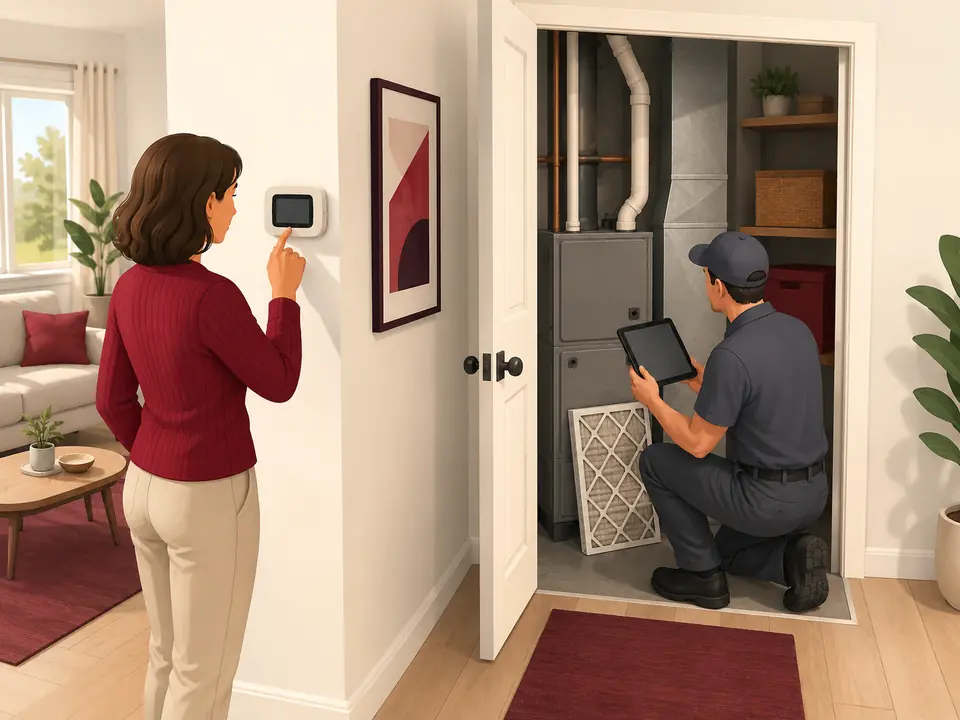
What Furnace Repair Service Includes
A proper service call follows the sequence of operation and tests the condition that stopped heat.
Professional furnace repair services connect the complaint to measured electrical, control, ignition, fuel, combustion, venting, airflow, temperature, condensate, and safety conditions. The result should be a specific diagnosis—not a list of parts to try.
From Complaint to Verified Heating Operation
Furnace Repair Cost
The failed condition, not the symptom alone, determines the repair price.
Current national planning data places many furnace repairs around $125 to $480, with labor often listed around $75 to $150 per hour before parts. Major motors, controls, venting, heat exchangers, hard access, and after-hours service can cost more. California location, equipment type, warranty coverage, and part availability also affect the estimate.
What Changes the Cost to Fix a Furnace?
- Diagnosis and access Intermittent failure, attic, crawlspace, roof, closet, or finished-area protection.
- Furnace type Gas, electric, propane, oil, condensing, mobile-home, staged, or communicating equipment.
- Part and warranty Model-specific availability, OEM requirements, coverage, shipping, and return policy.
- Safety scope Combustion, heat exchanger, gas pressure, venting, carbon monoxide, or electrical damage.
- Timing Same-day, weekend, holiday, and after-hours scheduling may carry different charges when offered.
- Repair versus replacement Age, condition, repeated failures, remaining life, and total repair value.
Published ranges are budgeting information, not a quote. Ask whether the diagnostic charge, repair labor, part, warranty, taxes, and after-hours fee are included.
How Furnace Repair Works
Follow the heat call, isolate the failed condition, complete the approved repair, then repeat the sequence.
- 01
Record and reproduce
We confirm the complaint, settings, power, filter, fault code, operating history, and complete sequence without bypassing a safety.
You get a diagnosis based on the actual failure - 02
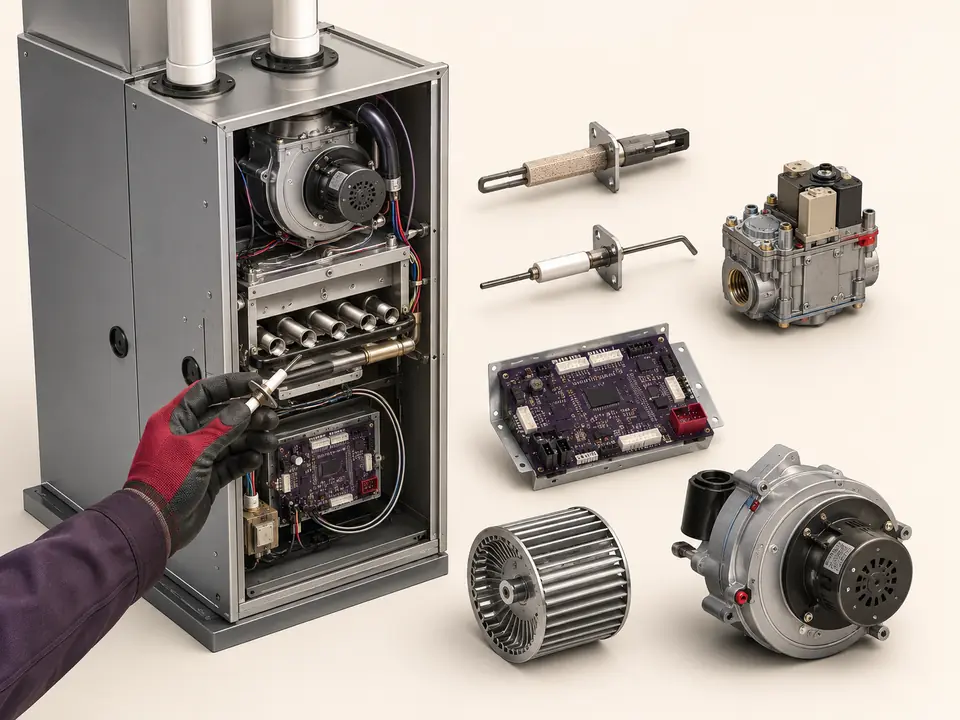
Test and repair
We measure the related circuit or system, explain the failed condition and estimate, then complete only the authorized work.
You get the fault, option, and price before repair - 03
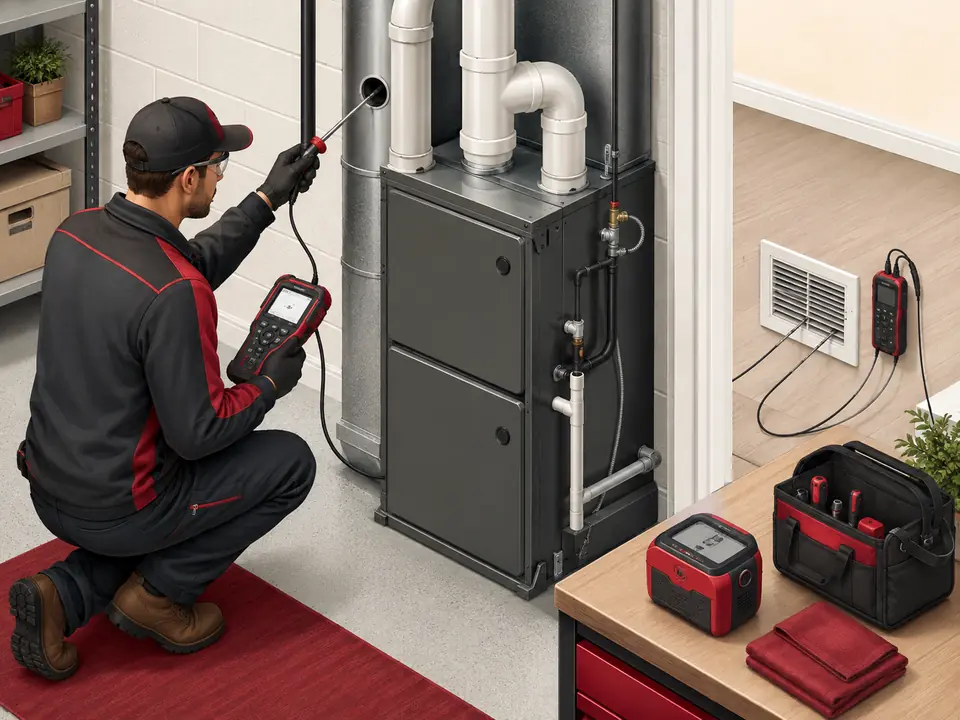
Restart and verify
We repeat ignition, heating, blower, temperature, airflow, safety shutdown, condensate, and thermostat operation as the equipment requires.
You get documented next steps and operating guidance
Common Furnace Repairs We Diagnose
A component should be replaced only after its inputs, outputs, and operating conditions are tested.
Ignitor and flame sensor
Clean, measure, or replace the failed ignition component; confirm flame signal and reliable restart.
Test before replacementGas valve and burner system
Verify supply, control voltage, pressure, burner carryover, combustion, and leak-free connections before repair.
Test before replacementControl board and transformer
Test inputs and outputs before replacing controls so a wiring, switch, thermostat, or power problem is not misdiagnosed.
Test before replacementBlower motor, capacitor, and wheel
Check voltage, amperage, capacitance, bearings, wheel condition, speed setup, static pressure, and temperature rise.
Test before replacementDraft inducer and pressure switch
Inspect vent restriction, tubing, condensate, draft, switch operation, bearings, and motor performance as one system.
Test before replacementThermostat, limit, and safety controls
Confirm the condition that opened the control; never bypass a safety to make the furnace run.
Test before replacementShould You Repair or Replace the Furnace?
The answer should come from safety, condition, repair value, and expected remaining service—not a generic age rule.
Repair is often reasonable when the heat exchanger and venting are sound, the failure is contained, parts are available, the furnace has useful life remaining, and comfort is otherwise acceptable. Replacement deserves comparison when unsafe combustion or venting is found, major failures repeat, parts are obsolete, operating cost rises, or an older furnace needs a repair that does not buy dependable service.
Ask for Evidence Behind a Major Recommendation
A repair or replacement recommendation should identify the fault and supporting measurement. For heat-exchanger, combustion, venting, or carbon-monoxide concerns, ask what was observed, what test was performed, why operation is unsafe, and what corrective paths are available. Do not operate equipment the technician or utility has identified as unsafe.
What Professional Furnace Repair Should Deliver
The repair should correct the cause and prove normal operation across the full heating cycle.
Sequence-based testing. Thermostat, power, inducer, pressure, ignition, flame, blower, limits, and shutdown are checked in order.
Measured operating conditions. Voltage, current, resistance, capacitance, flame signal, pressure, temperature, airflow, and combustion are used as applicable.
No safety bypass. A pressure switch, limit, rollout, flame safeguard, or door switch is never treated as an obstacle.
Cause and effect. The failed part and the condition that may have damaged or tripped it are separated.
Verified result. The furnace restarts, heats, moves air, drains, and shuts down correctly after repair.
Complete furnace service
Why Choose All HVAC California for Furnace Repair?
A dependable furnace repair company should make the diagnosis, options, cost, safety, and next step easy to understand.
- Complaint-first diagnosis We start with the symptom and operating history.
- Sequence-based testing Every required stage must occur before the next one can run.
- Measured findings Relevant electrical, pressure, temperature, airflow, and combustion conditions recorded.
- Written repair option Failed condition and scope explained before authorization.
- Safety controls respected Limits and interlocks are tested, never bypassed.
- Repair-or-replace context Age, condition, safety, part availability, and remaining life compared.
- Final-cycle verification Restart, heat delivery, drainage, and shutdown rechecked.
- Useful handover Fault, work, readings, filter, maintenance, and warning signs reviewed.
Local Furnace Repair Across California
Fuel, climate, building type, access, equipment listing, and parts supply change the repair plan.
Homeowners searching for furnace repair near me, heater repair near me, or a local heating repair company need a technician who can test the installed system—not just recognize the brand. Share the model, fuel, installation location, exact symptom, fault code, and any safety concern when requesting service.
- Single-family homes Central gas, electric, oil, propane, and high-efficiency furnaces.
- Condos and townhomes Closet access, shared walls, vent paths, drainage, and association rules.
- Mobile and manufactured homes Listed downflow equipment, combustion air, crossover ducts, and approved parts.
- Attics and crawlspaces Horizontal furnaces, platforms, pans, drains, flues, and restricted service access.
- Garages and workshops Clearance, elevation, combustion, impact protection, and dust exposure.
- Light commercial buildings Occupancy, access, controls, downtime, schedules, and multiple-zone symptoms.
Related Services for the Complete Heating System
A furnace symptom may involve maintenance, replacement, ducts, controls, or another HVAC component.
Our Furnace Repair Commitments
No invented warranty or response-time claims—just clear, verifiable service standards.
The relevant sequence, input, output, control, or safety condition is checked.
The evidence, scope, cost, part status, and alternative are reviewed before work.
Limits, switches, flame safeguards, venting, and combustion requirements are respected.
Heating sequence, temperature, airflow, drainage, restart, and shutdown are rechecked.
Gas, Electric, Oil, Propane, and Commercial Furnace Repair
The sequence, instruments, parts, safety checks, and qualifications change with the equipment.
Furnace Repair From No Heat to Verified Operation
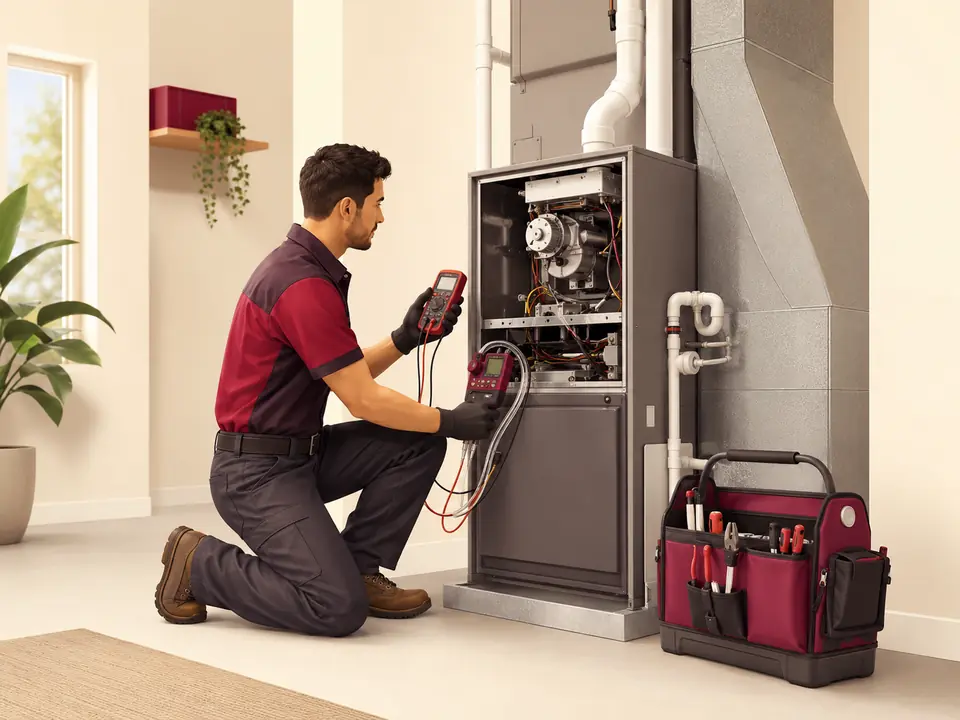
What Better Furnace Repair Feels Like
These are service standards—not fictional testimonials.
The technician connects the symptom to a tested failure instead of presenting a guess or a list of parts.
The repair option identifies the component, work, price, availability, safety context, and repair-or-replace alternative.
The furnace is restarted through a complete call for heat and its final operating conditions are rechecked.
Service Options, Costs, and Questions We Address
Use this service index to identify the installation, repair, cost, equipment, or local-support topic that matches your project.
Ready to Request Furnace Repair?
Tell us what the furnace does, when it fails, and what fault code or safety concern you observed.
Request professional furnace repair for no heat, cold air, ignition failure, short cycling, blower problems, noises, water leaks, control faults, or documented combustion concerns. Same-day, weekend, emergency, and after-hours scheduling depends on current coverage and availability.
Furnace Repair Questions Answered
National planning data places many furnace repairs around $125 to $480, while major parts can cost more. Furnace type, diagnosis, component, warranty, access, labor, California location, and after-hours scheduling change the final price. Request a written diagnosis and repair estimate before authorizing work.
Common causes include a thermostat fan set to ON instead of AUTO, a dirty filter, overheating and limit shutdown, ignition or flame-sensing failure, gas-supply trouble, a failed control, or a duct and airflow problem. A short cool-air period at startup can be normal; continuous cold air needs diagnosis.
The cause may be thermostat settings or batteries, a tripped breaker, an open service or door switch, condensate safety, failed transformer, control fault, inducer or pressure-switch problem, ignitor failure, gas-supply issue, flame lockout, or a safety limit. Avoid repeated resets when the fault returns.
Furnace short cycling can result from restricted airflow, a dirty filter, overheating, an incorrect thermostat location, flame loss, pressure-switch or vent problems, condensate issues, control faults, or oversized equipment. The shutdown reason should be measured before a part is replaced.
Leave the area immediately. From a safe location, call your gas utility; call 911 when life, injury, or property is endangered. Do not use switches, appliances, vehicles, flames, or devices that could create a spark, and do not try to locate or repair the leak.
A condensing furnace can leak from a blocked trap or drain, loose tubing, failed condensate pump, collector-box problem, or incorrectly sloped vent. Water may also come from a cooling coil, humidifier, plumbing line, or roof penetration. The source must be identified before repair.
Repair may be practical when the furnace is younger, safe, in generally sound condition, and the fault is contained. Replacement deserves consideration when the system is more than about 15 years old, has an unsafe heat-exchanger or venting finding, needs frequent repairs, has obsolete parts, or no longer provides reasonable comfort and efficiency.
Many contained diagnoses and common component repairs can be completed during one visit when the correct part is available. Intermittent faults, difficult access, vent or heat-exchanger concerns, special-order parts, oil equipment, and control or duct problems may require more time.
The diagnostic approach depends on the equipment and listing. Confirm the exact fuel, brand, model, installation type, access, and property use when scheduling so the appointment can be matched to the required furnace service.
Scheduling can change with location, weather, call volume, technician coverage, and parts. Call to ask about current availability rather than assuming a 24-hour response. For a gas odor, suspected carbon monoxide, fire, smoke, or another immediate hazard, leave the area and contact the appropriate utility or emergency service first.
Furnace Repair That Finds the Fault Before Replacing Parts
No heat, cold air, short cycling, water, odor, or noise deserves a measured diagnosis—not a guess.
Our furnace repair process follows the heating sequence from thermostat demand through power, ignition, combustion, airflow, limits, venting, and shutdown. We handle residential and light-commercial gas, electric, propane, oil, high-efficiency, mobile-home, and forced-air furnace service across California.
- Sequence-based diagnosisControls, ignition, airflow, combustion, and safeties tested
- Evidence before approvalFault, repair option, price, and next step explained
- Operation recheckedTemperature, airflow, shutdowns, and restart verified
When to Call for Furnace Repair
The symptom points to a test path; it does not prove which part failed.
A furnace that stops heating may be reacting to a restriction or unsafe condition exactly as designed. Resetting it repeatedly can erase clues or allow the same condition to return.
Before the visit, note fault codes, thermostat behavior, odors, sounds, timing, filter condition, and whether the blower or burners start. Do not remove panels or troubleshoot fuel and electrical components.
If you smell natural gas or suspect carbon monoxide, evacuate and contact the gas utility or emergency services from a safe location before requesting routine furnace service.
What Furnace Repair Service Includes
A proper service call follows the sequence of operation and tests the condition that stopped heat.
Professional furnace repair services connect the complaint to measured electrical, control, ignition, fuel, combustion, venting, airflow, temperature, condensate, and safety conditions. The result should be a specific diagnosis—not a list of parts to try.
From Complaint to Verified Heating Operation
Furnace Repair Cost
The failed condition, not the symptom alone, determines the repair price.
Current national planning data places many furnace repairs around $125 to $480, with labor often listed around $75 to $150 per hour before parts. Major motors, controls, venting, heat exchangers, hard access, and after-hours service can cost more. California location, equipment type, warranty coverage, and part availability also affect the estimate.
What Changes the Cost to Fix a Furnace?
- Diagnosis and access Intermittent failure, attic, crawlspace, roof, closet, or finished-area protection.
- Furnace type Gas, electric, propane, oil, condensing, mobile-home, staged, or communicating equipment.
- Part and warranty Model-specific availability, OEM requirements, coverage, shipping, and return policy.
- Safety scope Combustion, heat exchanger, gas pressure, venting, carbon monoxide, or electrical damage.
- Timing Same-day, weekend, holiday, and after-hours scheduling may carry different charges when offered.
- Repair versus replacement Age, condition, repeated failures, remaining life, and total repair value.
Published ranges are budgeting information, not a quote. Ask whether the diagnostic charge, repair labor, part, warranty, taxes, and after-hours fee are included.
How Furnace Repair Works
Follow the heat call, isolate the failed condition, complete the approved repair, then repeat the sequence.
- 01
Record and reproduce
We confirm the complaint, settings, power, filter, fault code, operating history, and complete sequence without bypassing a safety.
You get a diagnosis based on the actual failure - 02
Test and repair
We measure the related circuit or system, explain the failed condition and estimate, then complete only the authorized work.
You get the fault, option, and price before repair - 03
Restart and verify
We repeat ignition, heating, blower, temperature, airflow, safety shutdown, condensate, and thermostat operation as the equipment requires.
You get documented next steps and operating guidance
Common Furnace Repairs We Diagnose
A component should be replaced only after its inputs, outputs, and operating conditions are tested.
Ignitor and flame sensor
Clean, measure, or replace the failed ignition component; confirm flame signal and reliable restart.
Test before replacementGas valve and burner system
Verify supply, control voltage, pressure, burner carryover, combustion, and leak-free connections before repair.
Test before replacementControl board and transformer
Test inputs and outputs before replacing controls so a wiring, switch, thermostat, or power problem is not misdiagnosed.
Test before replacementBlower motor, capacitor, and wheel
Check voltage, amperage, capacitance, bearings, wheel condition, speed setup, static pressure, and temperature rise.
Test before replacementDraft inducer and pressure switch
Inspect vent restriction, tubing, condensate, draft, switch operation, bearings, and motor performance as one system.
Test before replacementThermostat, limit, and safety controls
Confirm the condition that opened the control; never bypass a safety to make the furnace run.
Test before replacementShould You Repair or Replace the Furnace?
The answer should come from safety, condition, repair value, and expected remaining service—not a generic age rule.
Repair is often reasonable when the heat exchanger and venting are sound, the failure is contained, parts are available, the furnace has useful life remaining, and comfort is otherwise acceptable. Replacement deserves comparison when unsafe combustion or venting is found, major failures repeat, parts are obsolete, operating cost rises, or an older furnace needs a repair that does not buy dependable service.
Ask for Evidence Behind a Major Recommendation
A repair or replacement recommendation should identify the fault and supporting measurement. For heat-exchanger, combustion, venting, or carbon-monoxide concerns, ask what was observed, what test was performed, why operation is unsafe, and what corrective paths are available. Do not operate equipment the technician or utility has identified as unsafe.
What Professional Furnace Repair Should Deliver
The repair should correct the cause and prove normal operation across the full heating cycle.
Sequence-based testing. Thermostat, power, inducer, pressure, ignition, flame, blower, limits, and shutdown are checked in order.
Measured operating conditions. Voltage, current, resistance, capacitance, flame signal, pressure, temperature, airflow, and combustion are used as applicable.
No safety bypass. A pressure switch, limit, rollout, flame safeguard, or door switch is never treated as an obstacle.
Cause and effect. The failed part and the condition that may have damaged or tripped it are separated.
Verified result. The furnace restarts, heats, moves air, drains, and shuts down correctly after repair.
Complete furnace service
Why Choose All HVAC California for Furnace Repair?
A dependable furnace repair company should make the diagnosis, options, cost, safety, and next step easy to understand.
- Complaint-first diagnosis We start with the symptom and operating history.
- Sequence-based testing Every required stage must occur before the next one can run.
- Measured findings Relevant electrical, pressure, temperature, airflow, and combustion conditions recorded.
- Written repair option Failed condition and scope explained before authorization.
- Safety controls respected Limits and interlocks are tested, never bypassed.
- Repair-or-replace context Age, condition, safety, part availability, and remaining life compared.
- Final-cycle verification Restart, heat delivery, drainage, and shutdown rechecked.
- Useful handover Fault, work, readings, filter, maintenance, and warning signs reviewed.
Local Furnace Repair Across California
Fuel, climate, building type, access, equipment listing, and parts supply change the repair plan.
Homeowners searching for furnace repair near me, heater repair near me, or a local heating repair company need a technician who can test the installed system—not just recognize the brand. Share the model, fuel, installation location, exact symptom, fault code, and any safety concern when requesting service.
- Single-family homes Central gas, electric, oil, propane, and high-efficiency furnaces.
- Condos and townhomes Closet access, shared walls, vent paths, drainage, and association rules.
- Mobile and manufactured homes Listed downflow equipment, combustion air, crossover ducts, and approved parts.
- Attics and crawlspaces Horizontal furnaces, platforms, pans, drains, flues, and restricted service access.
- Garages and workshops Clearance, elevation, combustion, impact protection, and dust exposure.
- Light commercial buildings Occupancy, access, controls, downtime, schedules, and multiple-zone symptoms.
Related Services for the Complete Heating System
A furnace symptom may involve maintenance, replacement, ducts, controls, or another HVAC component.
Our Furnace Repair Commitments
No invented warranty or response-time claims—just clear, verifiable service standards.
The relevant sequence, input, output, control, or safety condition is checked.
The evidence, scope, cost, part status, and alternative are reviewed before work.
Limits, switches, flame safeguards, venting, and combustion requirements are respected.
Heating sequence, temperature, airflow, drainage, restart, and shutdown are rechecked.
Gas, Electric, Oil, Propane, and Commercial Furnace Repair
The sequence, instruments, parts, safety checks, and qualifications change with the equipment.
Furnace Repair From No Heat to Verified Operation
What Better Furnace Repair Feels Like
These are service standards—not fictional testimonials.
The technician connects the symptom to a tested failure instead of presenting a guess or a list of parts.
The repair option identifies the component, work, price, availability, safety context, and repair-or-replace alternative.
The furnace is restarted through a complete call for heat and its final operating conditions are rechecked.
Ready to Request Furnace Repair?
Tell us what the furnace does, when it fails, and what fault code or safety concern you observed.
Request professional furnace repair for no heat, cold air, ignition failure, short cycling, blower problems, noises, water leaks, control faults, or documented combustion concerns. Same-day, weekend, emergency, and after-hours scheduling depends on current coverage and availability.
Furnace Repair Questions Answered
National planning data places many furnace repairs around $125 to $480, while major parts can cost more. Furnace type, diagnosis, component, warranty, access, labor, California location, and after-hours scheduling change the final price. Request a written diagnosis and repair estimate before authorizing work.
Common causes include a thermostat fan set to ON instead of AUTO, a dirty filter, overheating and limit shutdown, ignition or flame-sensing failure, gas-supply trouble, a failed control, or a duct and airflow problem. A short cool-air period at startup can be normal; continuous cold air needs diagnosis.
The cause may be thermostat settings or batteries, a tripped breaker, an open service or door switch, condensate safety, failed transformer, control fault, inducer or pressure-switch problem, ignitor failure, gas-supply issue, flame lockout, or a safety limit. Avoid repeated resets when the fault returns.
Furnace short cycling can result from restricted airflow, a dirty filter, overheating, an incorrect thermostat location, flame loss, pressure-switch or vent problems, condensate issues, control faults, or oversized equipment. The shutdown reason should be measured before a part is replaced.
Leave the area immediately. From a safe location, call your gas utility; call 911 when life, injury, or property is endangered. Do not use switches, appliances, vehicles, flames, or devices that could create a spark, and do not try to locate or repair the leak.
A condensing furnace can leak from a blocked trap or drain, loose tubing, failed condensate pump, collector-box problem, or incorrectly sloped vent. Water may also come from a cooling coil, humidifier, plumbing line, or roof penetration. The source must be identified before repair.
Repair may be practical when the furnace is younger, safe, in generally sound condition, and the fault is contained. Replacement deserves consideration when the system is more than about 15 years old, has an unsafe heat-exchanger or venting finding, needs frequent repairs, has obsolete parts, or no longer provides reasonable comfort and efficiency.
Many contained diagnoses and common component repairs can be completed during one visit when the correct part is available. Intermittent faults, difficult access, vent or heat-exchanger concerns, special-order parts, oil equipment, and control or duct problems may require more time.
The diagnostic approach depends on the equipment and listing. Confirm the exact fuel, brand, model, installation type, access, and property use when scheduling so the appointment can be matched to the required furnace service.
Scheduling can change with location, weather, call volume, technician coverage, and parts. Call to ask about current availability rather than assuming a 24-hour response. For a gas odor, suspected carbon monoxide, fire, smoke, or another immediate hazard, leave the area and contact the appropriate utility or emergency service first.