Whole-Home Air Purification Systems for Cleaner Indoor Air
A good air cleaner targets the pollutants you actually have. We assess your goals, HVAC airflow, filter cabinet, duct system, and product compatibility first.
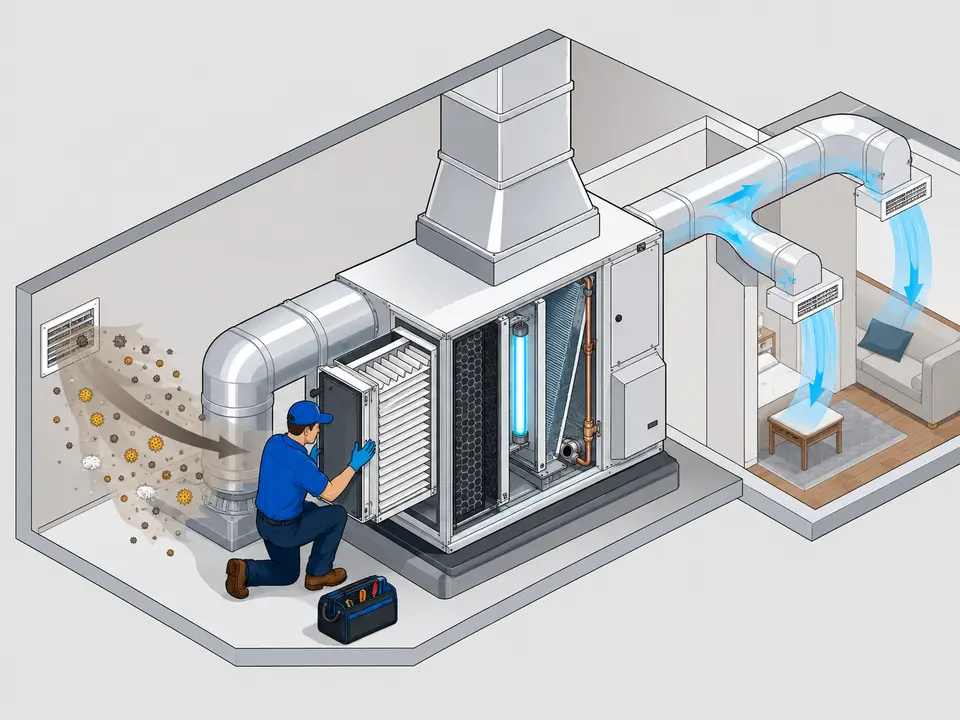
What a Whole-Home Air Purifier Actually Does
Whole-home air purification treats air as your HVAC system circulates it. Different technologies address different pollutant types.
Air Cleaning Is One Part of Indoor Air Quality
No single air purification unit solves every indoor air problem. Effective plans combine source control, appropriate filtration, humidity management, equipment hygiene, and ventilation. We explain which layer addresses each goal.
Complete Air Purification Services
We install, replace, repair, and maintain air cleaners that match the building and HVAC system.
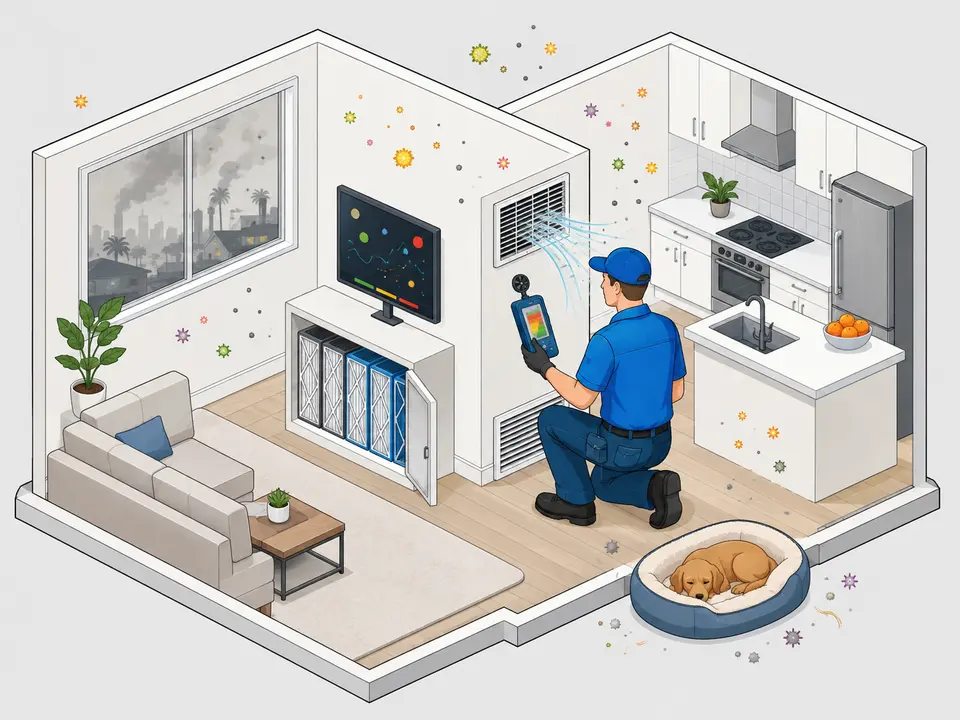
What Affects Air Purification System Cost?
Whole-house air purifier cost depends on the technology, equipment size, installation, and continuing filter needs.
Dust, smoke, pollen, odors, gases, and coil growth require different methods.
Media, HEPA, carbon, electronic, UV, and combined systems carry different costs.
Access, transitions, sealing, circuits, controls, and airflow corrections shape labor.
What Belongs in a Written Air Purifier Estimate
- Equipment scope Cleaner, cabinet, filter, carbon, lamp, transformer, controls, and accessories.
- Duct modifications Transitions, plenums, sealing, supports, access doors, and bypass arrangements.
- Electrical work Approved power source, disconnecting method, transformer, controls, and interlocks.
- Airflow correction Blower setup, filter area, return limitations, leakage, and static pressure.
- Replacement supplies Filter dimensions, lamp schedule, cell cleaning, carbon life, and availability.
- Repair needs Fault isolation, parts, access, cleaning, testing, and equipment condition.
- Removal and disposal Existing cabinets, filters, lamps, electronic cells, and packaging.
- Commissioning Operation, airflow, static pressure, controls, leakage, and homeowner guidance.
A higher purchase price does not guarantee better air. The system must match the pollutant and HVAC airflow.
From Indoor Air Assessment to Verified Operation
We start with the concern, confirm the HVAC limits, and check the finished installation.
- 01
Assess the concern
We review symptoms, sources, rooms, filters, equipment, ducts, moisture, and ventilation.
You get a pollutant-focused plan - 02
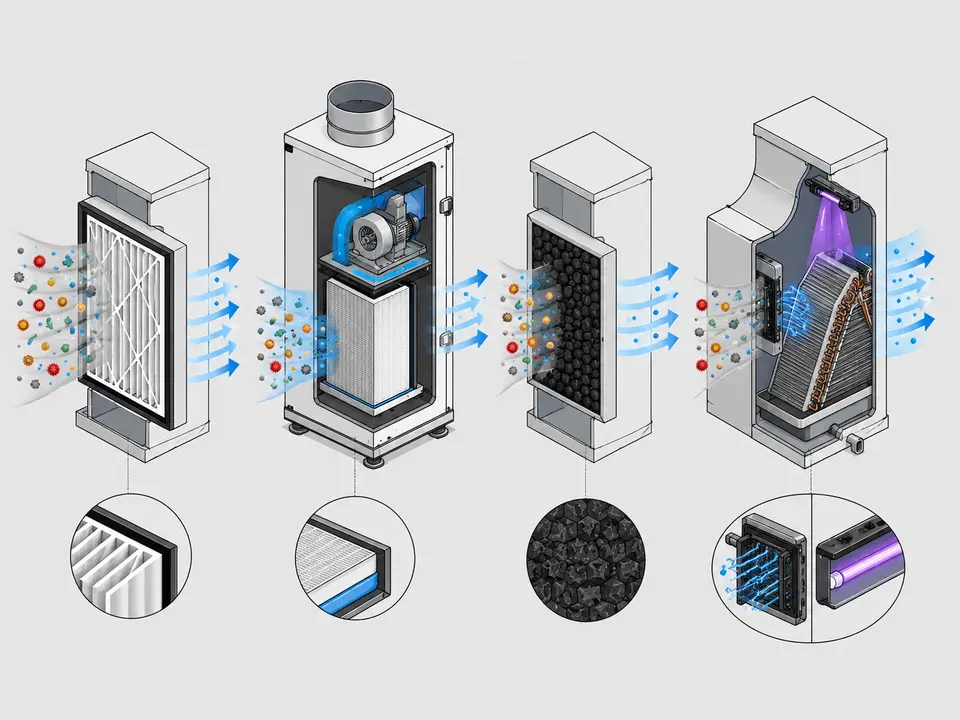
Select and install
We match treatment, cabinet area, airflow, service access, controls, and budget.
You get a defined connected scope - 03
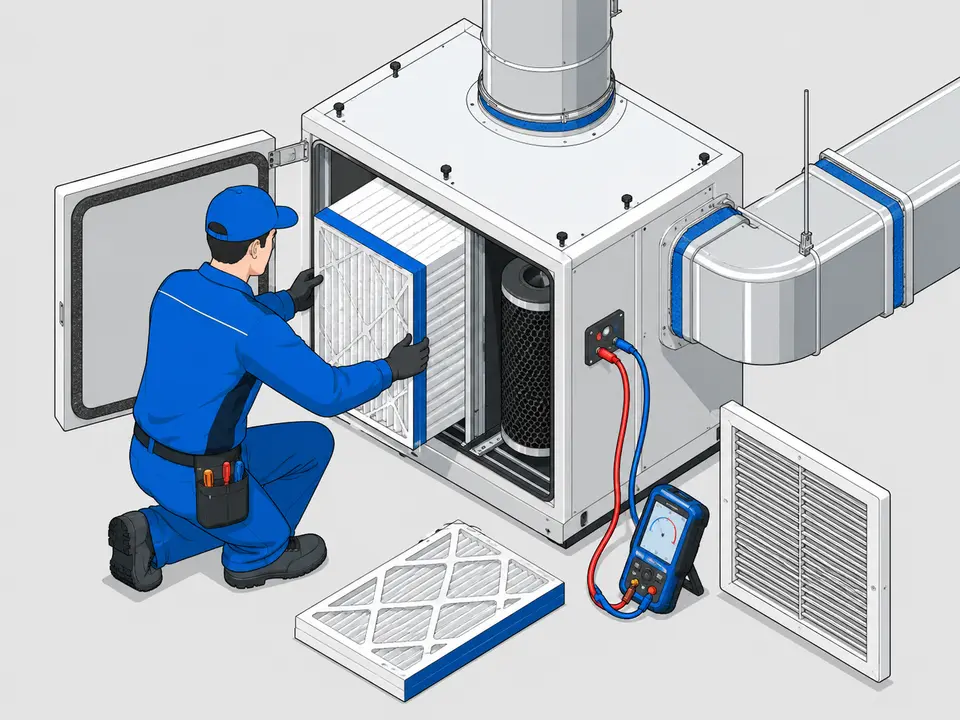
Test and explain
We check pressure, airflow, bypass leakage, controls, access, and maintenance requirements.
You get measured operating checks
Whole-Home Air Cleaner and Purifier Options
The best air purification system for a home may combine two or more methods.
Media air cleaners
Deep pleated filters capture airborne particles with more surface area than thin filters.
Dust and allergen controlHEPA filtration
True HEPA needs sufficient fan capacity, sealing, and often a dedicated or bypass design.
High particle efficiencyActivated carbon
Carbon adsorbs selected gases and odors. Media quantity and replacement timing matter.
Odor and gas layerElectronic air cleaners
Charged collection systems need regular cleaning, electrical service, and California-compliant certification.
Reusable collection cellsUV HVAC systems
UV can target compatible wet surfaces. Lamp placement, intensity, cleanliness, and replacement matter.
Coil surface supportIonization and PCO
Product performance, byproducts, ozone certification, maintenance, and application require careful review.
Evaluate product evidenceAir Purification for Dust, Allergies, Smoke, Pets, and Odors
The problem type determines the useful treatment layer.
- Dust and pollen Larger media area and good return sealing can improve particle capture.
- Pet dander Filtration can reduce airborne particles, while cleaning controls settled material.
- Wildfire smoke Fine-particle filtration, closed windows, recirculation, and fresh filters can help.
- PM2.5 Filter efficiency matters, but so do airflow, runtime, fit, and replacement.
- Cigarette and cooking smoke Particle and gas control may both be needed.
- Odors and VOCs Activated carbon may help selected compounds. Source removal remains important.
- Mold spores Filtration can capture airborne spores, but moisture and growth need correction.
- Microbial concerns Filtration and UV may reduce selected airborne or surface loads. Results vary.
Wildfire Smoke Requires a Practical Operating Plan
Use a compatible efficient filter and keep it available before smoke events. Run the HVAC fan when appropriate. Replace loaded filters. Reduce indoor particle sources. Portable cleaners can support rooms that need additional clean air delivery.
MERV 13, HEPA, and HVAC Airflow Compatibility
The highest filter number is not automatically the best choice for every existing system.
MERV describes filter performance. ASHRAE Standard 52.2 provides the test method behind MERV ratings.
MERV 13 is a common target. It is often recommended where the system can accommodate it.
HEPA is a separate efficiency class. A standard furnace filter labeled “HEPA-like” is not necessarily true HEPA.
Filter area changes resistance. Deeper, larger cabinets can provide more area and lower pressure drop.
Fit matters. Air bypass around the filter reduces effective cleaning.
Dirty filters change operation. Loading increases resistance and can reduce HVAC performance.
Selection standard
Electronic Air Cleaners and California Ozone Rules
California regulates indoor air cleaning devices that intentionally or potentially produce ozone.
- CARB certification Electronic air cleaners sold in California should appear on the current CARB-certified list.
- Ozone limit Certified devices must meet California’s 0.050 ppm, or 50 ppb, ozone emission limit.
- In-duct products Certification rules also cover electronic cleaners installed within HVAC systems.
- Product verification Check the exact manufacturer and model, not only a product family name.
- No ozone generators Ozone-producing devices are not a substitute for ventilation, filtration, or source control.
- Installation matters Electrical, airflow, location, controls, service access, and manufacturer instructions still apply.
- Maintenance matters Dirty cells, failed power supplies, and neglected lamps reduce intended operation.
- Current list Certification status can change. Confirm the current CARB listing before purchase.
Certification addresses ozone emissions. It does not prove that one device solves every indoor air quality concern.
Reviewing HVAC Air Purifier Brands and Product Types
Homeowners often ask about REME HALO, iWave, Aerus Air Scrubber, Honeywell, Carrier, Aprilaire, Lennox, Trane, and similar products.
- Published performance Review the test method, particle size, airflow, room or duct application, and operating conditions.
- California eligibility Confirm current CARB certification for electronic or ionizing models.
- System compatibility Check duct space, blower capacity, voltage, controls, temperature, and service access.
- Consumables Confirm filter, lamp, cell, cartridge, and replacement-part availability.
- Maintenance Understand cleaning, replacement, inspection, and safe shutdown requirements.
- Byproducts Evaluate ozone and other potential byproducts for the exact technology.
- Warranty terms Follow installation, registration, service, and replacement requirements.
- Whole-system value Compare the product with a larger media cabinet, duct repair, or ventilation improvement.
Product names identify requested options. They do not imply an endorsement, dealership, or manufacturer affiliation.
Why Choose All HVAC California for Air Purification?
A dependable indoor air quality contractor should connect the cleaner to the complete HVAC system.
- Goal-based selection Dust, smoke, pollen, dander, gases, odors, and surfaces receive different treatment.
- Airflow testing Static pressure and filter resistance guide cabinet and media choices.
- Honest limitations We explain what a system can address and what needs source correction.
- Layered planning Filtration, carbon, UV, humidity, duct condition, and ventilation remain separate decisions.
- California review Electronic product certification and ozone considerations receive attention.
- Clear written scope Equipment, labor, modifications, power, supplies, testing, and exclusions are separated.
- Service access Filters, lamps, cells, panels, and controls stay reachable for maintenance.
- Verified handover Operation, pressure, airflow, sealing, controls, and replacement needs receive checks.
Services Supporting Cleaner Indoor Air
Air purification works best when the filter, ducts, ventilation, humidity, and HVAC system work together.
Our Air Purification Commitments
These are process standards, not invented health claims, ratings, or guarantees.
The concern, particle size, gases, sources, rooms, occupants, and HVAC system guide options.
Filter area, pressure, blower capacity, duct space, sealing, power, and access receive review.
Equipment, labor, modifications, consumables, testing, permits, and exclusions stay defined.
Pressure, airflow, controls, bypass, power, access, and maintenance needs receive checks.
Residential and Commercial Air Purification Systems
Equipment capacity, occupancy, pollutants, runtime, code, and maintenance vary by property.
Whole-Home Air Cleaning From Assessment to Maintenance
What Better Air Purification Service Feels Like
These are service standards, not fictional testimonials.
The recommendation connects the actual pollutant concern with the treatment technology and HVAC limits.
Equipment, duct changes, electrical work, controls, supplies, maintenance, testing, and exclusions remain clear.
The finished system receives pressure, airflow, sealing, control, power, access, and operating checks.
Service Options, Costs, and Questions We Address
Use this service index to identify the installation, repair, cost, equipment, or local-support topic that matches your project.
Ready to Improve Your Indoor Air?
Share the city, property type, air quality concerns, current filter, HVAC equipment, and project timing.
Request whole-home air purifier installation, repair, replacement, maintenance, or an indoor air quality assessment. Recommendations depend on the pollutant, equipment, airflow, ducts, ventilation, access, and product availability.
Whole-Home Air Purifier Questions Answered
Cost depends on technology, capacity, cabinet size, duct modifications, electrical work, controls, access, and replacement supplies. Media, HEPA, carbon, electronic, UV, and combined systems have different installation and maintenance needs. A site review creates a useful estimate.
They can reduce targeted airborne pollutants when correctly selected, installed, operated, and maintained. Results depend on pollutant type, product performance, airflow, runtime, sealing, filter condition, room mixing, and source control.
The terms overlap in marketing. An air cleaner often emphasizes particle filtration or electronic collection. An air purifier may combine filtration with carbon, UV, ionization, or other treatment. The exact technology and verified performance matter more than the label.
No. MERV 13 is a filter performance rating under an HVAC filter test method. HEPA is a separate high-efficiency classification. True HEPA filtration often needs dedicated fan capacity, careful sealing, or a bypass arrangement.
Fine-particle filtration with adequate clean-air delivery is central. Use the most efficient compatible HVAC filter, keep it fresh, limit smoke entry, and consider a properly sized portable HEPA cleaner for priority rooms. Activated carbon may help some smoke odors and gases.
Appropriate filtration can reduce airborne dust, pollen, and pet dander. It does not remove settled material from floors and furnishings. Cleaning, source control, filter fit, airflow, runtime, and timely replacement affect results.
Activated carbon can adsorb selected gases and odors. Performance depends on the compound, carbon type, media quantity, airflow, contact time, humidity, and saturation. Remove or reduce the source whenever possible.
California requires covered electronic air cleaners to meet ozone limits and receive CARB certification. Verify the exact model on the current CARB list. Certification addresses ozone emissions, not suitability for every building or pollutant.
Use the manufacturer schedule as a starting point. Actual life depends on filter area, pollutant load, smoke events, pets, renovations, fan runtime, and system leakage. Inspect filters and track pressure rather than relying only on a calendar.
A whole-house system treats air circulated through the HVAC ducts. A portable purifier can deliver focused cleaning in one room and works without central fan runtime. Many homes benefit from compatible HVAC filtration plus portable support in priority rooms.
Whole-Home Air Purification Systems for Cleaner Indoor Air
A good air cleaner targets the pollutants you actually have. We assess your goals, HVAC airflow, filter cabinet, duct system, and product compatibility first.
What a Whole-Home Air Purifier Actually Does
Whole-home air purification treats air as your HVAC system circulates it. Different technologies address different pollutant types.
Air Cleaning Is One Part of Indoor Air Quality
No single air purification unit solves every indoor air problem. Effective plans combine source control, appropriate filtration, humidity management, equipment hygiene, and ventilation. We explain which layer addresses each goal.
Complete Air Purification Services
We install, replace, repair, and maintain air cleaners that match the building and HVAC system.
What Affects Air Purification System Cost?
Whole-house air purifier cost depends on the technology, equipment size, installation, and continuing filter needs.
Dust, smoke, pollen, odors, gases, and coil growth require different methods.
Media, HEPA, carbon, electronic, UV, and combined systems carry different costs.
Access, transitions, sealing, circuits, controls, and airflow corrections shape labor.
What Belongs in a Written Air Purifier Estimate
- Equipment scope Cleaner, cabinet, filter, carbon, lamp, transformer, controls, and accessories.
- Duct modifications Transitions, plenums, sealing, supports, access doors, and bypass arrangements.
- Electrical work Approved power source, disconnecting method, transformer, controls, and interlocks.
- Airflow correction Blower setup, filter area, return limitations, leakage, and static pressure.
- Replacement supplies Filter dimensions, lamp schedule, cell cleaning, carbon life, and availability.
- Repair needs Fault isolation, parts, access, cleaning, testing, and equipment condition.
- Removal and disposal Existing cabinets, filters, lamps, electronic cells, and packaging.
- Commissioning Operation, airflow, static pressure, controls, leakage, and homeowner guidance.
A higher purchase price does not guarantee better air. The system must match the pollutant and HVAC airflow.
From Indoor Air Assessment to Verified Operation
We start with the concern, confirm the HVAC limits, and check the finished installation.
- 01
Assess the concern
We review symptoms, sources, rooms, filters, equipment, ducts, moisture, and ventilation.
You get a pollutant-focused plan - 02
Select and install
We match treatment, cabinet area, airflow, service access, controls, and budget.
You get a defined connected scope - 03
Test and explain
We check pressure, airflow, bypass leakage, controls, access, and maintenance requirements.
You get measured operating checks
Whole-Home Air Cleaner and Purifier Options
The best air purification system for a home may combine two or more methods.
Media air cleaners
Deep pleated filters capture airborne particles with more surface area than thin filters.
Dust and allergen controlHEPA filtration
True HEPA needs sufficient fan capacity, sealing, and often a dedicated or bypass design.
High particle efficiencyActivated carbon
Carbon adsorbs selected gases and odors. Media quantity and replacement timing matter.
Odor and gas layerElectronic air cleaners
Charged collection systems need regular cleaning, electrical service, and California-compliant certification.
Reusable collection cellsUV HVAC systems
UV can target compatible wet surfaces. Lamp placement, intensity, cleanliness, and replacement matter.
Coil surface supportIonization and PCO
Product performance, byproducts, ozone certification, maintenance, and application require careful review.
Evaluate product evidenceAir Purification for Dust, Allergies, Smoke, Pets, and Odors
The problem type determines the useful treatment layer.
- Dust and pollen Larger media area and good return sealing can improve particle capture.
- Pet dander Filtration can reduce airborne particles, while cleaning controls settled material.
- Wildfire smoke Fine-particle filtration, closed windows, recirculation, and fresh filters can help.
- PM2.5 Filter efficiency matters, but so do airflow, runtime, fit, and replacement.
- Cigarette and cooking smoke Particle and gas control may both be needed.
- Odors and VOCs Activated carbon may help selected compounds. Source removal remains important.
- Mold spores Filtration can capture airborne spores, but moisture and growth need correction.
- Microbial concerns Filtration and UV may reduce selected airborne or surface loads. Results vary.
Wildfire Smoke Requires a Practical Operating Plan
Use a compatible efficient filter and keep it available before smoke events. Run the HVAC fan when appropriate. Replace loaded filters. Reduce indoor particle sources. Portable cleaners can support rooms that need additional clean air delivery.
MERV 13, HEPA, and HVAC Airflow Compatibility
The highest filter number is not automatically the best choice for every existing system.
MERV describes filter performance. ASHRAE Standard 52.2 provides the test method behind MERV ratings.
MERV 13 is a common target. It is often recommended where the system can accommodate it.
HEPA is a separate efficiency class. A standard furnace filter labeled “HEPA-like” is not necessarily true HEPA.
Filter area changes resistance. Deeper, larger cabinets can provide more area and lower pressure drop.
Fit matters. Air bypass around the filter reduces effective cleaning.
Dirty filters change operation. Loading increases resistance and can reduce HVAC performance.
Selection standard
Electronic Air Cleaners and California Ozone Rules
California regulates indoor air cleaning devices that intentionally or potentially produce ozone.
- CARB certification Electronic air cleaners sold in California should appear on the current CARB-certified list.
- Ozone limit Certified devices must meet California’s 0.050 ppm, or 50 ppb, ozone emission limit.
- In-duct products Certification rules also cover electronic cleaners installed within HVAC systems.
- Product verification Check the exact manufacturer and model, not only a product family name.
- No ozone generators Ozone-producing devices are not a substitute for ventilation, filtration, or source control.
- Installation matters Electrical, airflow, location, controls, service access, and manufacturer instructions still apply.
- Maintenance matters Dirty cells, failed power supplies, and neglected lamps reduce intended operation.
- Current list Certification status can change. Confirm the current CARB listing before purchase.
Certification addresses ozone emissions. It does not prove that one device solves every indoor air quality concern.
Reviewing HVAC Air Purifier Brands and Product Types
Homeowners often ask about REME HALO, iWave, Aerus Air Scrubber, Honeywell, Carrier, Aprilaire, Lennox, Trane, and similar products.
- Published performance Review the test method, particle size, airflow, room or duct application, and operating conditions.
- California eligibility Confirm current CARB certification for electronic or ionizing models.
- System compatibility Check duct space, blower capacity, voltage, controls, temperature, and service access.
- Consumables Confirm filter, lamp, cell, cartridge, and replacement-part availability.
- Maintenance Understand cleaning, replacement, inspection, and safe shutdown requirements.
- Byproducts Evaluate ozone and other potential byproducts for the exact technology.
- Warranty terms Follow installation, registration, service, and replacement requirements.
- Whole-system value Compare the product with a larger media cabinet, duct repair, or ventilation improvement.
Product names identify requested options. They do not imply an endorsement, dealership, or manufacturer affiliation.
Why Choose All HVAC California for Air Purification?
A dependable indoor air quality contractor should connect the cleaner to the complete HVAC system.
- Goal-based selection Dust, smoke, pollen, dander, gases, odors, and surfaces receive different treatment.
- Airflow testing Static pressure and filter resistance guide cabinet and media choices.
- Honest limitations We explain what a system can address and what needs source correction.
- Layered planning Filtration, carbon, UV, humidity, duct condition, and ventilation remain separate decisions.
- California review Electronic product certification and ozone considerations receive attention.
- Clear written scope Equipment, labor, modifications, power, supplies, testing, and exclusions are separated.
- Service access Filters, lamps, cells, panels, and controls stay reachable for maintenance.
- Verified handover Operation, pressure, airflow, sealing, controls, and replacement needs receive checks.
Services Supporting Cleaner Indoor Air
Air purification works best when the filter, ducts, ventilation, humidity, and HVAC system work together.
Our Air Purification Commitments
These are process standards, not invented health claims, ratings, or guarantees.
The concern, particle size, gases, sources, rooms, occupants, and HVAC system guide options.
Filter area, pressure, blower capacity, duct space, sealing, power, and access receive review.
Equipment, labor, modifications, consumables, testing, permits, and exclusions stay defined.
Pressure, airflow, controls, bypass, power, access, and maintenance needs receive checks.
Residential and Commercial Air Purification Systems
Equipment capacity, occupancy, pollutants, runtime, code, and maintenance vary by property.
Whole-Home Air Cleaning From Assessment to Maintenance
What Better Air Purification Service Feels Like
These are service standards, not fictional testimonials.
The recommendation connects the actual pollutant concern with the treatment technology and HVAC limits.
Equipment, duct changes, electrical work, controls, supplies, maintenance, testing, and exclusions remain clear.
The finished system receives pressure, airflow, sealing, control, power, access, and operating checks.
Ready to Improve Your Indoor Air?
Share the city, property type, air quality concerns, current filter, HVAC equipment, and project timing.
Request whole-home air purifier installation, repair, replacement, maintenance, or an indoor air quality assessment. Recommendations depend on the pollutant, equipment, airflow, ducts, ventilation, access, and product availability.
Whole-Home Air Purifier Questions Answered
Cost depends on technology, capacity, cabinet size, duct modifications, electrical work, controls, access, and replacement supplies. Media, HEPA, carbon, electronic, UV, and combined systems have different installation and maintenance needs. A site review creates a useful estimate.
They can reduce targeted airborne pollutants when correctly selected, installed, operated, and maintained. Results depend on pollutant type, product performance, airflow, runtime, sealing, filter condition, room mixing, and source control.
The terms overlap in marketing. An air cleaner often emphasizes particle filtration or electronic collection. An air purifier may combine filtration with carbon, UV, ionization, or other treatment. The exact technology and verified performance matter more than the label.
No. MERV 13 is a filter performance rating under an HVAC filter test method. HEPA is a separate high-efficiency classification. True HEPA filtration often needs dedicated fan capacity, careful sealing, or a bypass arrangement.
Fine-particle filtration with adequate clean-air delivery is central. Use the most efficient compatible HVAC filter, keep it fresh, limit smoke entry, and consider a properly sized portable HEPA cleaner for priority rooms. Activated carbon may help some smoke odors and gases.
Appropriate filtration can reduce airborne dust, pollen, and pet dander. It does not remove settled material from floors and furnishings. Cleaning, source control, filter fit, airflow, runtime, and timely replacement affect results.
Activated carbon can adsorb selected gases and odors. Performance depends on the compound, carbon type, media quantity, airflow, contact time, humidity, and saturation. Remove or reduce the source whenever possible.
California requires covered electronic air cleaners to meet ozone limits and receive CARB certification. Verify the exact model on the current CARB list. Certification addresses ozone emissions, not suitability for every building or pollutant.
Use the manufacturer schedule as a starting point. Actual life depends on filter area, pollutant load, smoke events, pets, renovations, fan runtime, and system leakage. Inspect filters and track pressure rather than relying only on a calendar.
A whole-house system treats air circulated through the HVAC ducts. A portable purifier can deliver focused cleaning in one room and works without central fan runtime. Many homes benefit from compatible HVAC filtration plus portable support in priority rooms.