Refrigerant Leak Repair That Fixes the Source
Low refrigerant is a condition. The real job is finding why it is low.
Our refrigerant leak repair service confirms the cooling problem, performs targeted refrigerant leak detection, identifies the leaking component, and explains the repair options before opening the sealed system. After an approved repair, we pressure-test, evacuate, recharge, and verify operation.
- Leak search before assumptionsLow charge confirmed and the circuit tested methodically
- Repair options separatedValve, line set, coil, or replacement scope explained
- Measured final chargeRepair verified before the system is returned to service
Is Your AC Losing Refrigerant?
Warm air and ice can point toward low charge—but they are not a leak diagnosis.
A sealed air conditioner or heat pump should not need routine refrigerant top-offs. If the system is truly low, refrigerant escaped somewhere or the original charge was incorrect.
Airflow restrictions, dirty coils, failed fans, sensors, metering devices, and electrical problems can mimic AC low refrigerant. That is why a useful visit begins with operating data.
If the evidence supports a leak, the next decision is how far to search and whether the likely repair fits the system's age, condition, warranty, refrigerant, and replacement value.
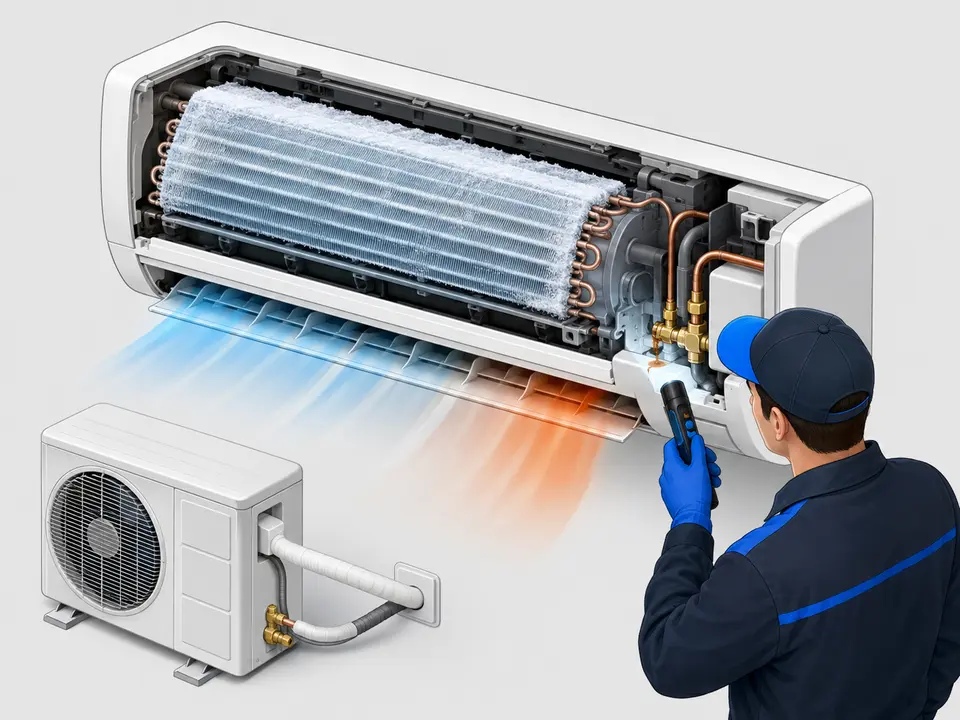
Switch the system off and request service if the coil is heavily iced, the equipment is repeatedly tripping, or abnormal noise or odor makes operation unsafe.
What Refrigerant Leak Repair Service Includes
Detection, repair, pressure testing, evacuation, and charging are separate steps.
Our refrigerant leak repair services follow the sealed circuit from symptom to verified operation. The exact search depth and repair depend on access, leak rate, system design, refrigerant, warranty, and whether a component should be replaced instead of patched.
From AC Leak Detection to Final Performance Test
AC Refrigerant Leak Repair Cost
The leak's location matters more than the word “leak.”
A national planning range for total AC leak repair cost is roughly $250 to $1,600. Detection alone often plans around $100 to $330. Coil replacement can exceed those ranges. California labor, access, refrigerant, equipment size, and warranty status affect the written price.
What Changes Refrigerant Leak Repair Price?
- Leak location A valve core differs from a corroded evaporator coil.
- Search time Small, intermittent, hidden, or multi-circuit leaks take longer.
- Access Attics, finished walls, rooftops, and concealed lines affect labor.
- System refrigerant R-22, R-410A, R-454B, R-32, and others require the correct procedures.
- Charge quantity Equipment size and line length affect refrigerant amount.
- Component warranty Covered parts may still leave labor, refrigerant, and materials.
- Coil availability Matching, lead time, and conversion requirements affect the option.
- System age Major repair on an aging system may trigger a replacement comparison.
How AC Refrigerant Leak Repair Works
Find the problem, choose the right repair, then prove the circuit is tight.
- 01
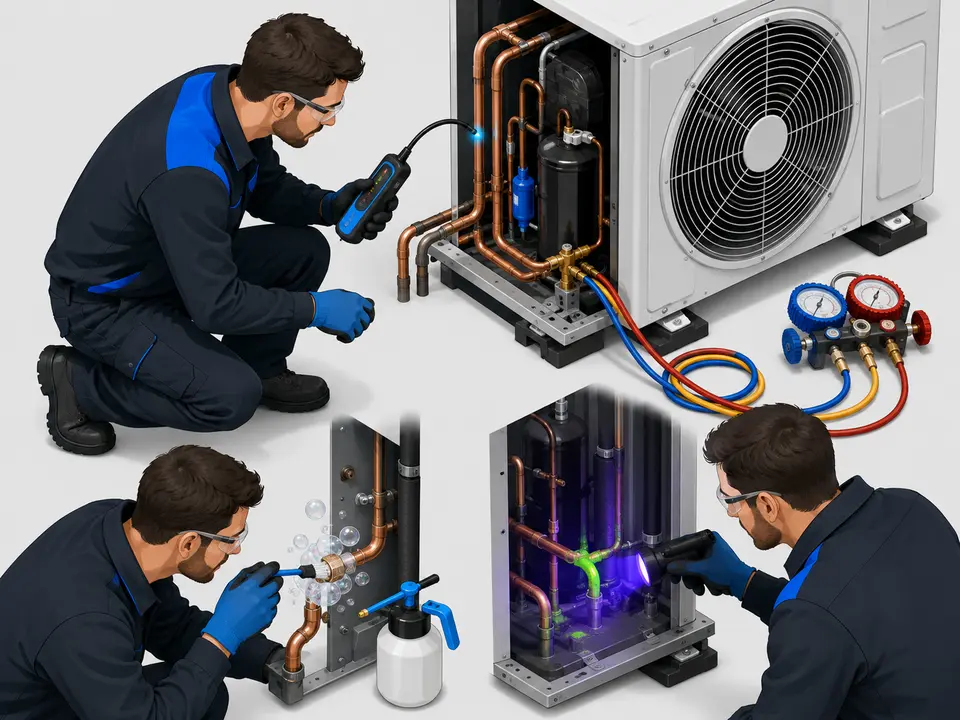
Confirm and locate
We verify the operating condition and select detection methods that fit the leak rate, refrigerant, components, and access.
You get the evidence and the exact repair target - 02
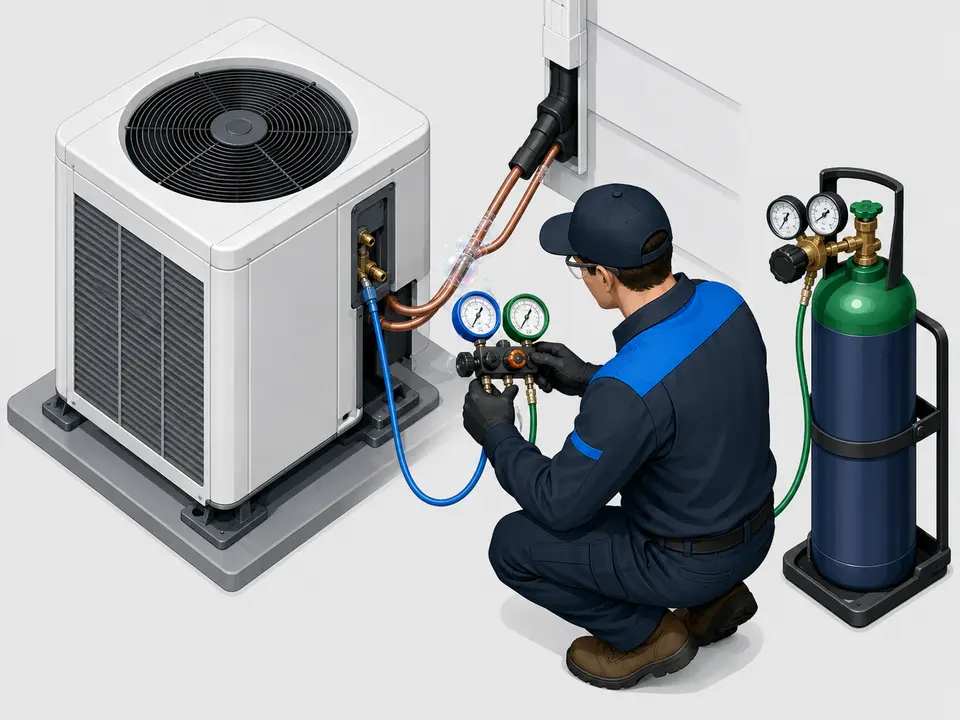
Repair and pressure-test
After approval, refrigerant is handled responsibly and the valve, joint, tubing, coil, or component is repaired or replaced. The circuit is tested for tightness.
You get a repaired circuit—not just added refrigerant - 03
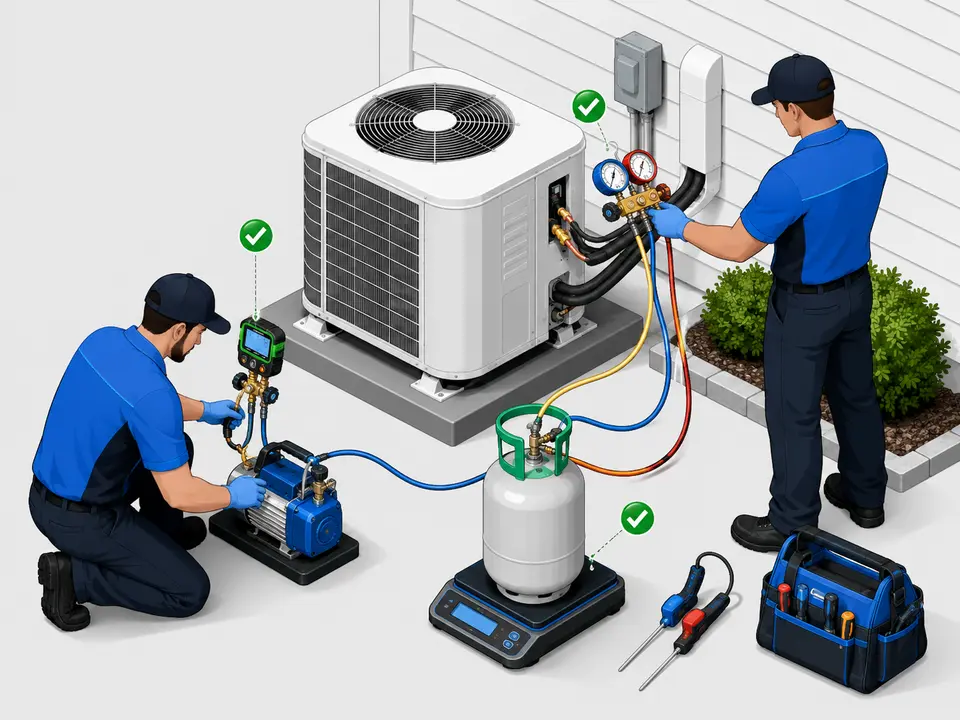
Evacuate, charge, and verify
We remove air and moisture, add the approved refrigerant using the equipment procedure, and check temperatures, pressures, airflow, and operation.
You get documented final performance
Where AC Refrigerant Leaks Are Found
The same warm-air symptom can lead to a small valve—or a complete coil.
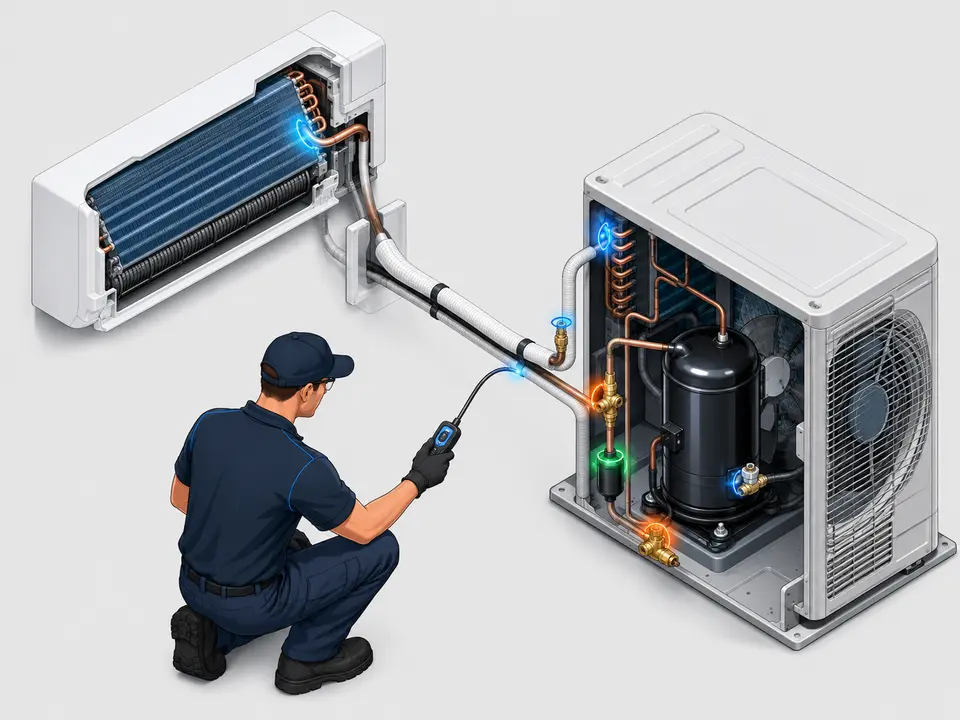
Schrader and service valve leaks
Valve cores, caps, stems, and service fittings can leak. Repair depends on the exact valve condition and access.
Valve and seal repairFlare and brazed-joint leaks
Loose, damaged, contaminated, or stressed connections may be remade after the refrigerant is handled safely.
Connection repairAC line-set leaks
Accessible copper tubing may be repaired or replaced. Hidden lines require route, isolation, and access decisions.
Copper line repairEvaporator coil leaks
A leaking indoor coil often needs matched replacement when corrosion or multiple leak points make a patch unreliable.
Indoor coil optionCondenser coil leaks
Outdoor coil repairability depends on location, construction, corrosion, warranty, and replacement availability.
Outdoor coil optionDrier and compressor fitting leaks
Filter-driers, accumulators, compressor stubs, and fittings need component-specific repair and clean circuit practices.
Circuit component repairA detector signal near a component is a lead. The repair plan should confirm the actual leak point and whether the material can hold a dependable repair.
Should You Repair the Leak, Replace a Coil, or Replace the System?
A small accessible fitting and a corroded coil are different financial decisions.
Repair often makes sense when the system is otherwise sound, the leak is isolated, parts are available, and the total cost is reasonable. Component replacement may be better for a failed coil or valve assembly. Full replacement deserves comparison when the system is older, inefficient, uses costly refrigerant, has repeated failures, or needs a major out-of-warranty component.
What Professional Refrigerant Leak Repair Should Deliver
A gauge reading can show a condition. It cannot show where refrigerant escaped.
The complete system is checked. Airflow, temperature, electrical operation, fans, and coil condition are reviewed before sealed-system work.
The search has a defined goal. Detection tools are used to identify the leaking location or component, not to produce a vague “probably.”
The repair is pressure-tested. The repaired circuit is tested before evacuation and charging.
Air and moisture are removed. Deep evacuation protects performance and reliability.
The correct refrigerant is measured. The equipment data and approved procedure determine charge and verification.
Complete sealed-system service
Why Choose All HVAC California for AC Leak Repair?
A reliable refrigerant leak repair company should show the evidence and the complete scope.
- Measured diagnosis Low charge separated from airflow and electrical problems.
- Targeted detection Method selected for the system, refrigerant, access, and symptom.
- Exact repair options Valve, fitting, line set, coil, or replacement explained.
- Responsible refrigerant handling Recovery and service practices follow applicable requirements.
- Pressure and vacuum verification Tightness and dehydration checked before charging.
- Correct refrigerant procedure Equipment data controls refrigerant and final charge.
- Home protected Indoor work areas, walls, floors, attics, and landscaping handled carefully.
- Documented handover Leak location, work completed, readings, and priorities reviewed.
Areas We Serve Across California
Home is where the heart is. Ours has crews in a lot of neighborhoods.
Search ac maintenance near me and you'll find plenty of vans. We staff local crews who know California homes, heat, and equipment.
Our refrigerant leak repair service near me teams cover every region. Same standards everywhere.
We book fast AC repair slots year round. Reliable AC repair crews carry stock.
Want affordable refrigerant leak repair service without a vague scope? We define the tune-up, cleaning, and any separate repair before extra work.
Looking for local AC repair or a local air conditioning leak repair company you can call twice? Pick your city above.
Other HVAC Services We Offer
One company, one number, everything handled. We carried every bag in one trip.
A sealed-system leak is one repair category. Our complete service menu supports the rest of the equipment. Every service below is done by our own employees. Never subcontracted, never resold.
Air conditioning service for dependable comfort
From a single ductless head to a complete central system, service is matched to the equipment and the property.
- System sizing and equipment matching reviewed
- Refrigerant handled and measured professionally
- Repair findings explained before work
Our Refrigerant Leak Repair Commitments
No invented warranty claims—just clear, verifiable work standards.
The leaking point or component and the limits of the search explained.
Repair, component replacement, refrigerant, and testing stated before work.
Pressure testing and evacuation completed before the final charge.
Work completed, charge procedure, readings, and next steps reviewed.
Refrigerant Leak Repair for AC, Heat Pumps, and Mini Splits
Different circuits require different access, isolation, and charging procedures.
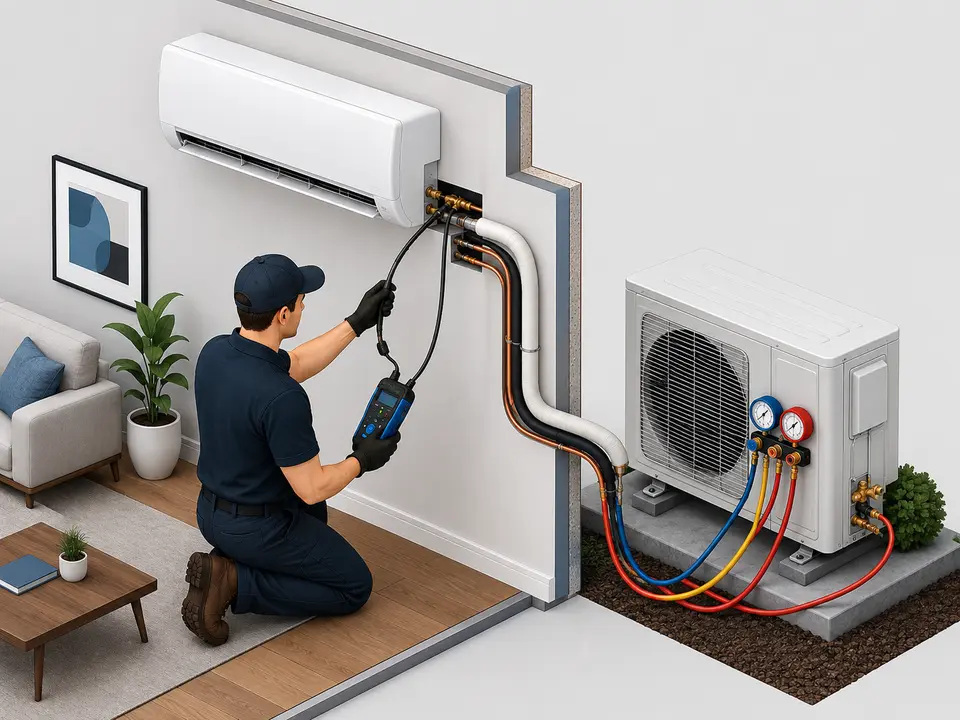
Refrigerant Leak Repair Options by Component
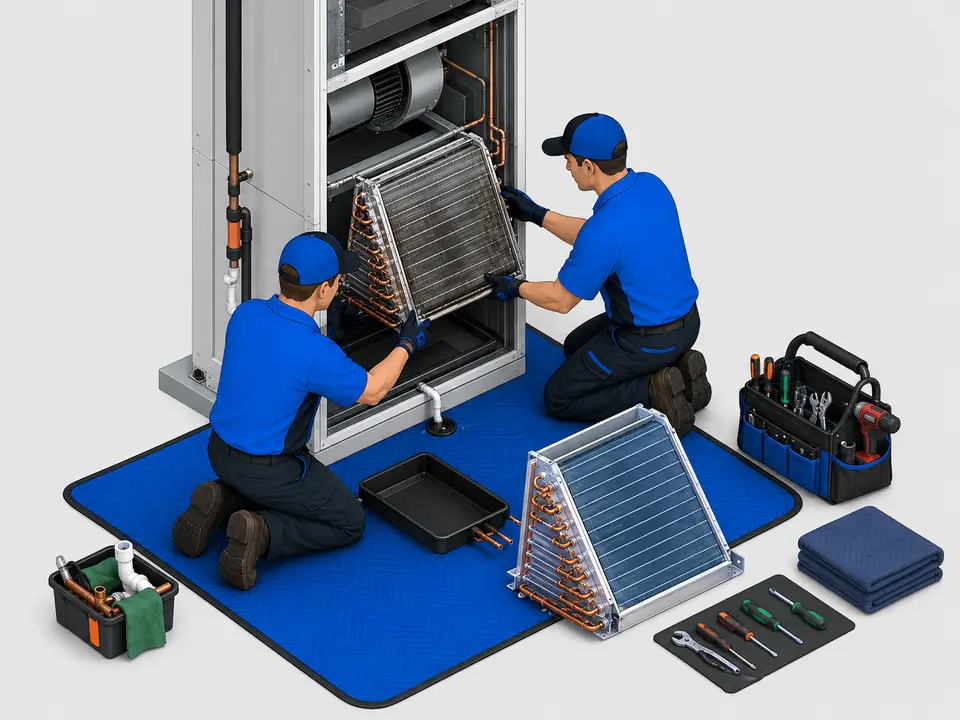
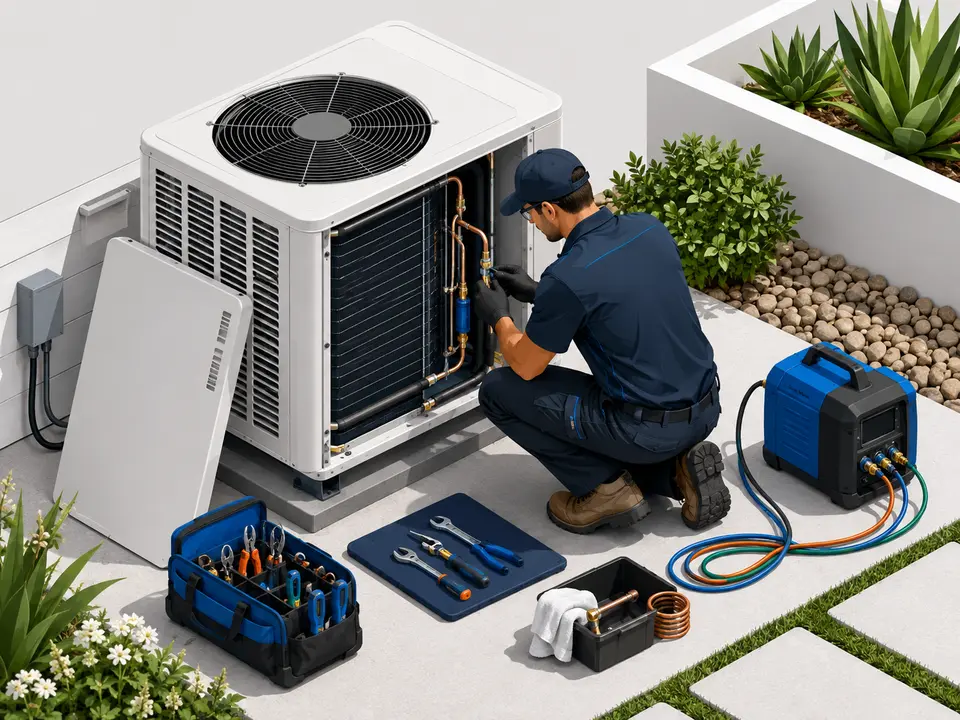
What Better Refrigerant Leak Service Feels Like
These are service standards—not fictional testimonials.
The technician explains why low refrigerant is or is not supported by the readings before recommending a leak search.
You see the leaking location or component, the limits of repair, and a written comparison when coil or system replacement deserves consideration.
The repair is pressure-tested, evacuated, charged correctly, and operated before equipment panels and work areas are closed.
Service Options, Costs, and Questions We Address
Use this service index to identify the installation, repair, cost, equipment, or local-support topic that matches your project.
Need Refrigerant Leak Detection and Repair?
Stop paying for repeated top-offs without understanding where the charge went.
Request professional AC refrigerant leak repair for a central air conditioner, heat pump, or mini split. We will confirm the condition, explain the leak-search scope, and provide repair options before sealed-system work begins.
Refrigerant Leak Repair Questions Answered
A basic refrigerant leak detection visit often plans around $100 to $330. Total refrigerant leak repair cost commonly ranges from about $250 to $1,600, but coil replacement can cost much more. An accessible valve or connection may be relatively minor. A leaking evaporator coil can reach roughly $2,000 to $5,000 or more depending on warranty, equipment, refrigerant, labor, and system design. The written diagnosis controls.
The method depends on the leak rate, equipment, refrigerant, access, and prior service. A technician may use an electronic detector, soap bubbles, existing UV dye evidence, nitrogen pressure testing, isolated circuit testing, visual oil traces, or a combination. A pressure or charge reading can suggest a leak but does not identify its location by itself.
Adding refrigerant may temporarily restore cooling, but it does not repair the cause. Refrigerant is not normally consumed. If charge is low, the practical next step is to confirm the condition, discuss leak-search options, and decide whether repair, component replacement, monitoring, or full system replacement makes sense. Refrigerant work must follow applicable handling rules.
Possible signs include warm air, long cooling cycles, reduced capacity, icing, a hissing or bubbling sound, and repeated low-charge findings. None proves a leak on its own. Dirty filters, blocked airflow, blower faults, metering problems, sensors, and electrical failures can produce similar symptoms, so measurements matter.
Some isolated accessible tubing leaks can be repaired, but many evaporator coil leaks occur in thin coil material, corroded areas, or multiple points. In those cases, a matched coil replacement is usually more dependable. Compare the system age, warranty, refrigerant, coil availability, labor, and complete replacement cost before deciding.
The refrigerant must match the equipment data plate and approved service procedure; refrigerants are not mixed or treated as interchangeable. Availability, recovery requirements, tools, technician qualifications, equipment design, and repair economics differ. We identify the refrigerant and system before presenting options. Section 608 certification is required for technicians who recharge stationary appliances.
Yes. A mini split refrigerant leak may occur at a flare, line set, indoor coil, outdoor coil, valve, or fitting. Heat pumps require testing that respects their reversing operation and multiple modes. Multi-zone systems may need circuit isolation and manufacturer-specific procedures before the responsible repair is clear.
A straightforward detection and accessible fitting repair may be completed in one visit when parts and conditions allow. Intermittent leaks, hidden line sets, multi-zone systems, coil replacement, warranty parts, or difficult access can take longer. Emergency service can restore a safe plan quickly, but a complete repair still needs proper testing, evacuation, charging, and verification.
Refrigerant Leak Repair That Fixes the Source
Low refrigerant is a condition. The real job is finding why it is low.
Our refrigerant leak repair service confirms the cooling problem, performs targeted refrigerant leak detection, identifies the leaking component, and explains the repair options before opening the sealed system. After an approved repair, we pressure-test, evacuate, recharge, and verify operation.
- Leak search before assumptionsLow charge confirmed and the circuit tested methodically
- Repair options separatedValve, line set, coil, or replacement scope explained
- Measured final chargeRepair verified before the system is returned to service
Is Your AC Losing Refrigerant?
Warm air and ice can point toward low charge—but they are not a leak diagnosis.
A sealed air conditioner or heat pump should not need routine refrigerant top-offs. If the system is truly low, refrigerant escaped somewhere or the original charge was incorrect.
Airflow restrictions, dirty coils, failed fans, sensors, metering devices, and electrical problems can mimic AC low refrigerant. That is why a useful visit begins with operating data.
If the evidence supports a leak, the next decision is how far to search and whether the likely repair fits the system's age, condition, warranty, refrigerant, and replacement value.
Switch the system off and request service if the coil is heavily iced, the equipment is repeatedly tripping, or abnormal noise or odor makes operation unsafe.
What Refrigerant Leak Repair Service Includes
Detection, repair, pressure testing, evacuation, and charging are separate steps.
Our refrigerant leak repair services follow the sealed circuit from symptom to verified operation. The exact search depth and repair depend on access, leak rate, system design, refrigerant, warranty, and whether a component should be replaced instead of patched.
From AC Leak Detection to Final Performance Test
AC Refrigerant Leak Repair Cost
The leak's location matters more than the word “leak.”
A national planning range for total AC leak repair cost is roughly $250 to $1,600. Detection alone often plans around $100 to $330. Coil replacement can exceed those ranges. California labor, access, refrigerant, equipment size, and warranty status affect the written price.
What Changes Refrigerant Leak Repair Price?
- Leak location A valve core differs from a corroded evaporator coil.
- Search time Small, intermittent, hidden, or multi-circuit leaks take longer.
- Access Attics, finished walls, rooftops, and concealed lines affect labor.
- System refrigerant R-22, R-410A, R-454B, R-32, and others require the correct procedures.
- Charge quantity Equipment size and line length affect refrigerant amount.
- Component warranty Covered parts may still leave labor, refrigerant, and materials.
- Coil availability Matching, lead time, and conversion requirements affect the option.
- System age Major repair on an aging system may trigger a replacement comparison.
How AC Refrigerant Leak Repair Works
Find the problem, choose the right repair, then prove the circuit is tight.
- 01
Confirm and locate
We verify the operating condition and select detection methods that fit the leak rate, refrigerant, components, and access.
You get the evidence and the exact repair target - 02
Repair and pressure-test
After approval, refrigerant is handled responsibly and the valve, joint, tubing, coil, or component is repaired or replaced. The circuit is tested for tightness.
You get a repaired circuit—not just added refrigerant - 03
Evacuate, charge, and verify
We remove air and moisture, add the approved refrigerant using the equipment procedure, and check temperatures, pressures, airflow, and operation.
You get documented final performance
Where AC Refrigerant Leaks Are Found
The same warm-air symptom can lead to a small valve—or a complete coil.
Schrader and service valve leaks
Valve cores, caps, stems, and service fittings can leak. Repair depends on the exact valve condition and access.
Valve and seal repairFlare and brazed-joint leaks
Loose, damaged, contaminated, or stressed connections may be remade after the refrigerant is handled safely.
Connection repairAC line-set leaks
Accessible copper tubing may be repaired or replaced. Hidden lines require route, isolation, and access decisions.
Copper line repairEvaporator coil leaks
A leaking indoor coil often needs matched replacement when corrosion or multiple leak points make a patch unreliable.
Indoor coil optionCondenser coil leaks
Outdoor coil repairability depends on location, construction, corrosion, warranty, and replacement availability.
Outdoor coil optionDrier and compressor fitting leaks
Filter-driers, accumulators, compressor stubs, and fittings need component-specific repair and clean circuit practices.
Circuit component repairA detector signal near a component is a lead. The repair plan should confirm the actual leak point and whether the material can hold a dependable repair.
Should You Repair the Leak, Replace a Coil, or Replace the System?
A small accessible fitting and a corroded coil are different financial decisions.
Repair often makes sense when the system is otherwise sound, the leak is isolated, parts are available, and the total cost is reasonable. Component replacement may be better for a failed coil or valve assembly. Full replacement deserves comparison when the system is older, inefficient, uses costly refrigerant, has repeated failures, or needs a major out-of-warranty component.
What Professional Refrigerant Leak Repair Should Deliver
A gauge reading can show a condition. It cannot show where refrigerant escaped.
The complete system is checked. Airflow, temperature, electrical operation, fans, and coil condition are reviewed before sealed-system work.
The search has a defined goal. Detection tools are used to identify the leaking location or component, not to produce a vague “probably.”
The repair is pressure-tested. The repaired circuit is tested before evacuation and charging.
Air and moisture are removed. Deep evacuation protects performance and reliability.
The correct refrigerant is measured. The equipment data and approved procedure determine charge and verification.
Complete sealed-system service
Why Choose All HVAC California for AC Leak Repair?
A reliable refrigerant leak repair company should show the evidence and the complete scope.
- Measured diagnosis Low charge separated from airflow and electrical problems.
- Targeted detection Method selected for the system, refrigerant, access, and symptom.
- Exact repair options Valve, fitting, line set, coil, or replacement explained.
- Responsible refrigerant handling Recovery and service practices follow applicable requirements.
- Pressure and vacuum verification Tightness and dehydration checked before charging.
- Correct refrigerant procedure Equipment data controls refrigerant and final charge.
- Home protected Indoor work areas, walls, floors, attics, and landscaping handled carefully.
- Documented handover Leak location, work completed, readings, and priorities reviewed.
Areas We Serve Across California
Home is where the heart is. Ours has crews in a lot of neighborhoods.
Search ac maintenance near me and you'll find plenty of vans. We staff local crews who know California homes, heat, and equipment.
Our refrigerant leak repair service near me teams cover every region. Same standards everywhere.
We book fast AC repair slots year round. Reliable AC repair crews carry stock.
Want affordable refrigerant leak repair service without a vague scope? We define the tune-up, cleaning, and any separate repair before extra work.
Looking for local AC repair or a local air conditioning leak repair company you can call twice? Pick your city above.
Other HVAC Services We Offer
One company, one number, everything handled. We carried every bag in one trip.
A sealed-system leak is one repair category. Our complete service menu supports the rest of the equipment. Every service below is done by our own employees. Never subcontracted, never resold.
Air conditioning service for dependable comfort
From a single ductless head to a complete central system, service is matched to the equipment and the property.
- System sizing and equipment matching reviewed
- Refrigerant handled and measured professionally
- Repair findings explained before work
Our Refrigerant Leak Repair Commitments
No invented warranty claims—just clear, verifiable work standards.
The leaking point or component and the limits of the search explained.
Repair, component replacement, refrigerant, and testing stated before work.
Pressure testing and evacuation completed before the final charge.
Work completed, charge procedure, readings, and next steps reviewed.
Refrigerant Leak Repair for AC, Heat Pumps, and Mini Splits
Different circuits require different access, isolation, and charging procedures.
Refrigerant Leak Repair Options by Component
What Better Refrigerant Leak Service Feels Like
These are service standards—not fictional testimonials.
The technician explains why low refrigerant is or is not supported by the readings before recommending a leak search.
You see the leaking location or component, the limits of repair, and a written comparison when coil or system replacement deserves consideration.
The repair is pressure-tested, evacuated, charged correctly, and operated before equipment panels and work areas are closed.
Need Refrigerant Leak Detection and Repair?
Stop paying for repeated top-offs without understanding where the charge went.
Request professional AC refrigerant leak repair for a central air conditioner, heat pump, or mini split. We will confirm the condition, explain the leak-search scope, and provide repair options before sealed-system work begins.
Refrigerant Leak Repair Questions Answered
A basic refrigerant leak detection visit often plans around $100 to $330. Total refrigerant leak repair cost commonly ranges from about $250 to $1,600, but coil replacement can cost much more. An accessible valve or connection may be relatively minor. A leaking evaporator coil can reach roughly $2,000 to $5,000 or more depending on warranty, equipment, refrigerant, labor, and system design. The written diagnosis controls.
The method depends on the leak rate, equipment, refrigerant, access, and prior service. A technician may use an electronic detector, soap bubbles, existing UV dye evidence, nitrogen pressure testing, isolated circuit testing, visual oil traces, or a combination. A pressure or charge reading can suggest a leak but does not identify its location by itself.
Adding refrigerant may temporarily restore cooling, but it does not repair the cause. Refrigerant is not normally consumed. If charge is low, the practical next step is to confirm the condition, discuss leak-search options, and decide whether repair, component replacement, monitoring, or full system replacement makes sense. Refrigerant work must follow applicable handling rules.
Possible signs include warm air, long cooling cycles, reduced capacity, icing, a hissing or bubbling sound, and repeated low-charge findings. None proves a leak on its own. Dirty filters, blocked airflow, blower faults, metering problems, sensors, and electrical failures can produce similar symptoms, so measurements matter.
Some isolated accessible tubing leaks can be repaired, but many evaporator coil leaks occur in thin coil material, corroded areas, or multiple points. In those cases, a matched coil replacement is usually more dependable. Compare the system age, warranty, refrigerant, coil availability, labor, and complete replacement cost before deciding.
The refrigerant must match the equipment data plate and approved service procedure; refrigerants are not mixed or treated as interchangeable. Availability, recovery requirements, tools, technician qualifications, equipment design, and repair economics differ. We identify the refrigerant and system before presenting options. Section 608 certification is required for technicians who recharge stationary appliances.
Yes. A mini split refrigerant leak may occur at a flare, line set, indoor coil, outdoor coil, valve, or fitting. Heat pumps require testing that respects their reversing operation and multiple modes. Multi-zone systems may need circuit isolation and manufacturer-specific procedures before the responsible repair is clear.
A straightforward detection and accessible fitting repair may be completed in one visit when parts and conditions allow. Intermittent leaks, hidden line sets, multi-zone systems, coil replacement, warranty parts, or difficult access can take longer. Emergency service can restore a safe plan quickly, but a complete repair still needs proper testing, evacuation, charging, and verification.