Heat Pump Replacement Built Around the Whole Home
Replace an aging or failed heat pump with a correctly sized, fully matched system. We evaluate repair value, comfort, ducts, electrical capacity, equipment options, and commissioning before the old unit comes out.
Signs You May Need a New Heat Pump
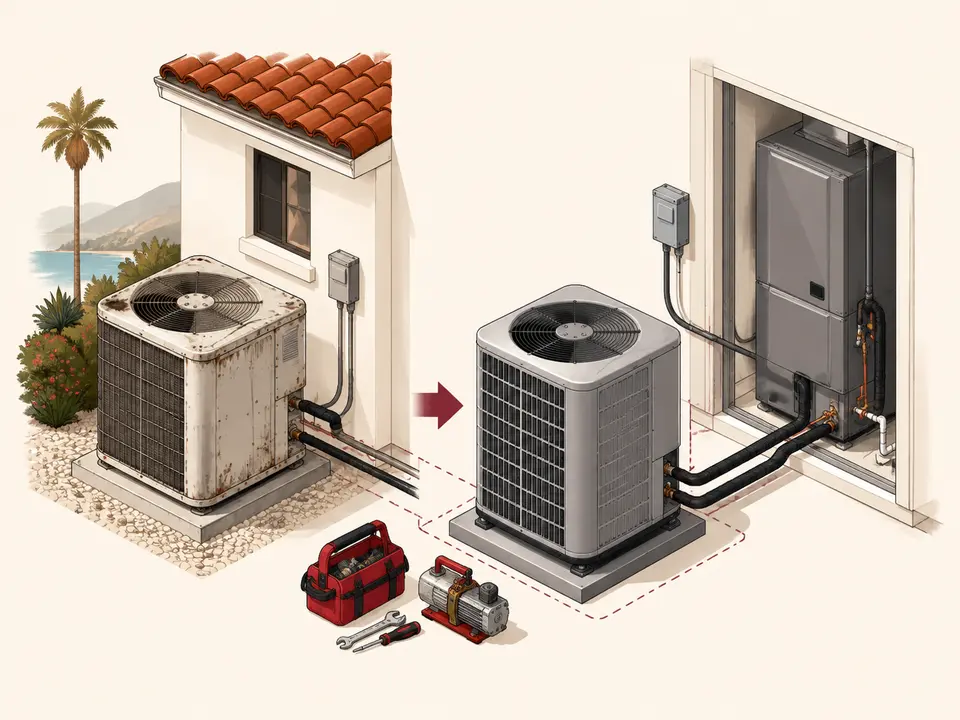
One symptom does not always mean replacement. A pattern of age, major repairs, comfort problems, and high operating demand deserves a complete evaluation.
Start With a Diagnosis, Not a Sales Assumption
A heat pump that will not heat or cool may have an electrical, airflow, thermostat, refrigerant, defrost, or compressor fault. Some failures are reasonable to repair. Others expose aging coils, unavailable parts, repeated leaks, or a mismatched system. A replacement assessment should document what failed, what still works, and what the repair would leave behind.
What Professional Heat Pump Replacement Includes
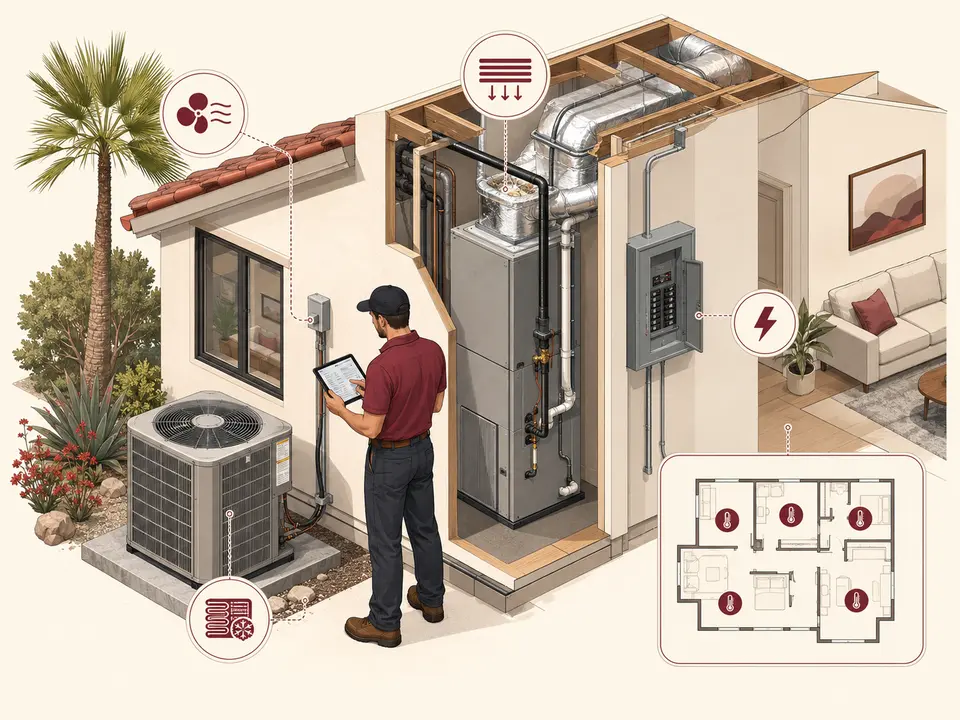
A complete replacement covers more than the outdoor unit. It connects diagnosis, sizing, equipment matching, removal, installation, and testing.
Heat Pump Replacement Cost in 2026
A current manufacturer planning guide places many installed heat-pump projects between $6,000 and $25,000 nationally. California conditions can move a quote below or above that broad range.
Air-source and common residential projects. Not a California bid or guaranteed price.
Efficiency, air handler, controls, ducts, panel, access, permits, and labor can outweigh tonnage.
Loop condition, pumps, drilling, roof work, zoning, electrical upgrades, and commercial phasing need inspection.
What Changes the Final Replacement Price?
- System size and efficiency Load-based capacity, variable speed, cold-climate data, SEER2, and HSPF2.
- Indoor equipment Air handler, coil, blower, electric heat kit, furnace, filters, and drain work.
- Distribution Duct repair, sealing, insulation, returns, registers, zoning, or ductless heads.
- Refrigerant work Recovery, line-set condition, flushing or replacement, evacuation, and charge.
- Electrical work Breaker, conductors, disconnect, controls, panel capacity, and backup heat.
- Site conditions Roof, crawlspace, attic, crane, access, pad, clearances, noise, and corrosion exposure.
- Project administration Permits, inspections, disposal, testing, documentation, and trade coordination.
- Incentives Federal, state, utility, and local programs must be verified before the contract.
From Old Heat Pump to Commissioned Replacement
The process protects comfort by making the replacement decision before the equipment swap.
- 01
Diagnose, measure, and compare
We review the failure, repair estimate, age, loads, ducts, electricity, controls, climate, and replacement choices.
You get a repair-or-replace basis - 02
Remove and replace the matched system
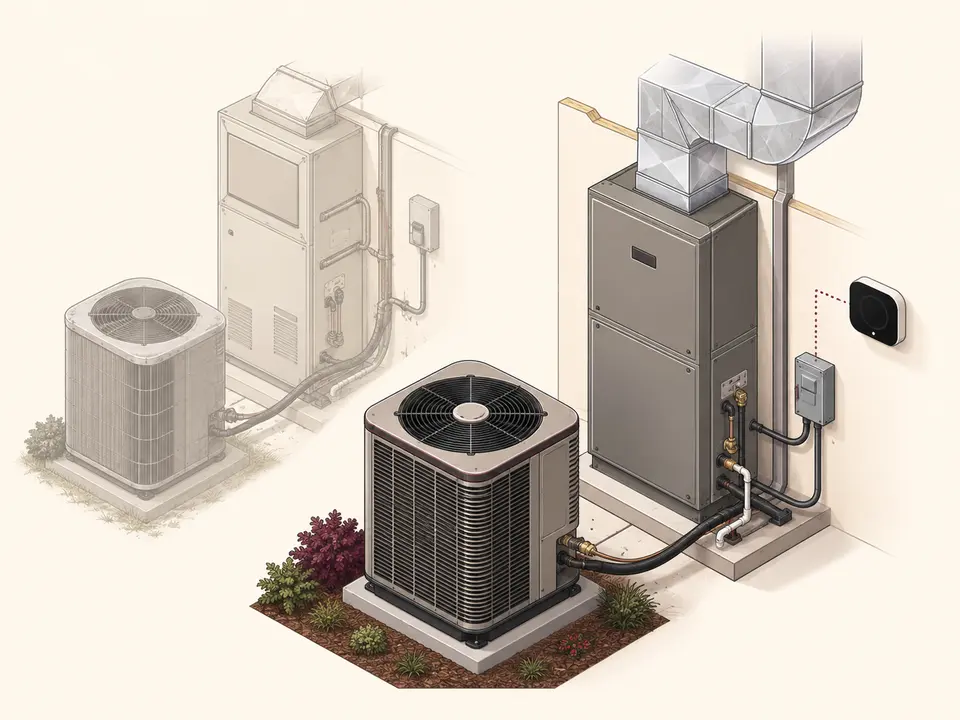
The crew recovers refrigerant, removes old equipment, prepares locations, installs components, connects services, and configures controls.
You get the approved system and written scope - 03
Commission and hand over
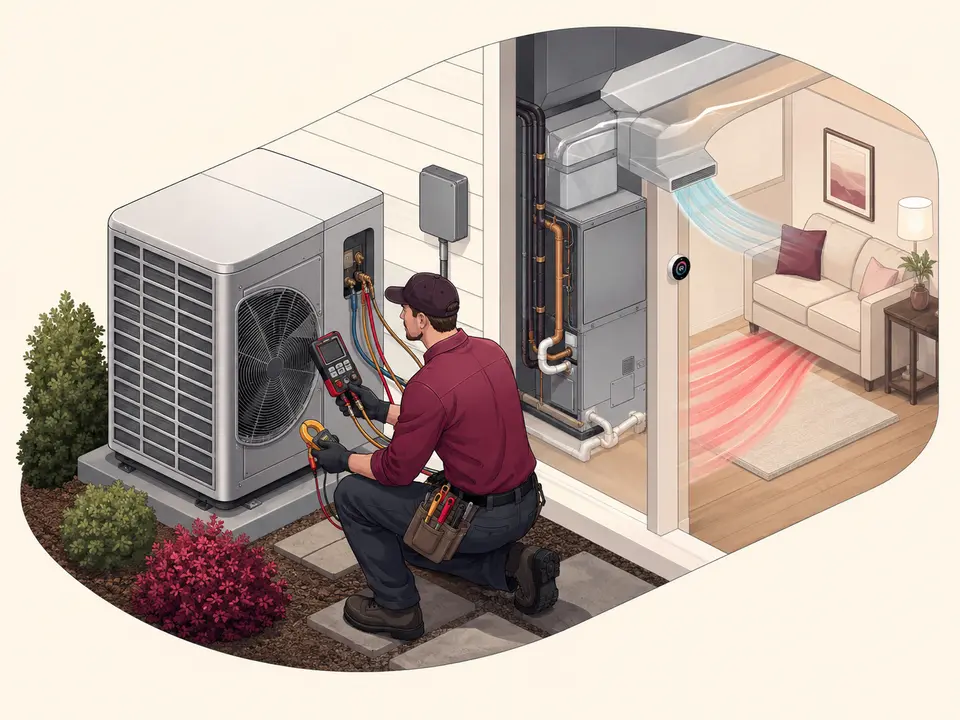
The technician verifies airflow, refrigerant, temperatures, heating, cooling, backup stages, defrost, controls, drainage, and safeties.
You get measured startup results
Air-Source, Ductless, Dual-Fuel, and Geothermal Replacement
Existing distribution and property conditions shape the practical replacement path.
Air-source split-system replacement
Replaces an outdoor heat pump and indoor air handler or coil. Duct condition and equipment matching drive performance.
Site-specific replacementDuctless heat pump replacement
Replaces single-zone or multi-zone mini-split equipment. Head compatibility, line sets, controls, drains, and zoning need review.
Site-specific replacementCold-climate inverter replacement
Uses variable capacity and stronger low-temperature performance. Heating data at local design temperatures matters.
Site-specific replacementDual-fuel heat pump replacement
Pairs a heat pump with a furnace. Balance-point controls and both heating systems must be commissioned together.
Site-specific replacementGeothermal heat pump replacement
May reuse viable ground loops while replacing the indoor unit, pumps, controls, or other components after loop testing.
Site-specific replacementCommercial or packaged replacement
Coordinates roof, curb, ducts, controls, lifting, electrical service, access, occupancy, and downtime.
Site-specific replacementShould You Repair or Replace Your Heat Pump?
Compare the verified repair with the equipment that will remain after that repair.
- Repair may fit The system is newer, otherwise sound, and has an isolated electrical, control, drain, or minor airflow fault.
- Replacement may fit A major compressor, coil, or refrigerant repair lands on an older system with other wear.
- History matters Repeated service calls, multiple leaks, or recurring comfort issues reduce the value of another repair.
- Compatibility matters A failed component may not pair correctly with the remaining indoor or outdoor equipment.
- Home changes matter Remodeling, envelope work, electrification, solar, or new room use may change the required capacity.
- Written numbers matter Compare repair price, full replacement price, included work, and likely remaining life.
Do Not Use a Fixed Percentage Rule Alone
Rules that multiply age by repair cost can be a quick screen, but they cannot see coil condition, refrigerant availability, parts support, ducts, electrical needs, comfort, or the exact failure. Use a documented diagnosis and complete replacement scope.
Why Replacing Only the Outdoor Unit Can Fall Short
Heat-pump ratings belong to tested combinations of indoor and outdoor equipment.
Capacity must fit the home. Old tonnage may have been wrong or the building may have changed.
Indoor and outdoor units must match. Coil, blower, expansion device, controls, and refrigerant work affect operation.
Ducts must move required airflow. Restriction and leakage can erase comfort gains from new equipment.
Electrical scope must fit the selected system. Breakers, conductors, disconnects, controls, and heat kits follow model data.
Commissioning must prove operation. Airflow, charge, temperatures, stages, defrost, drainage, and safeties need testing.
Replacement quality check
Why Choose All HVAC California for Heat Pump Replacement?
A reliable replacement company should explain the failure, design, equipment, price, and startup checks.
- Repair-or-replace review The current fault and remaining-system condition are documented.
- Load-based sizing The new capacity follows present heating and cooling needs.
- System paths compared Ducted, ductless, cold-climate, dual-fuel, and geothermal options explained.
- Matched models checked Complete indoor and outdoor combinations verified through published data.
- Transparent scope Equipment, removal, permits, electrical, ducts, controls, and exclusions identified.
- Current incentive guidance Expired, reserved, and local programs clearly separated.
- Measured commissioning Airflow, refrigerant, temperatures, defrost, stages, drainage, and safeties tested.
- Documented handover Model data, settings, filter guidance, records, and maintenance needs reviewed.
Local Heat Pump Replacement Across California
Coastal, valley, desert, and mountain homes place different demands on replacement equipment.
Homeowners searching for heat pump replacement near me, a heat pump replacement company, or local replacement contractors need site-specific design. Climate, wildfire smoke, salt exposure, elevation, utility territory, building age, ducts, and electrical capacity can change the right scope.
- Coastal properties Corrosion exposure, moisture, sound, equipment location, and mild-season modulation.
- Central Valley and desert homes Strong cooling loads, attic ducts, solar gain, filtration, and electrical demand.
- Mountain communities Low-temperature capacity, defrost, snow clearance, drainage, elevation, and backup heat.
- Older buildings Panels, ducts, insulation, windows, air leakage, asbestos procedures, and access.
- Ductless homes Head compatibility, zone loads, line routes, condensate, controls, and aesthetics.
- Commercial sites Roofs, curbs, cranes, controls, phasing, occupants, access, and downtime.
Related Services for the Heat Pump Decision
A diagnosis, ductless option, furnace decision, or maintenance plan may change the project.
Our Heat Pump Replacement Commitments
No invented savings, rebates, warranties, availability, or plan benefits.
The current fault and remaining-system condition are reviewed before replacement.
Outdoor unit, indoor equipment, controls, and accessories are verified together.
Removal, equipment, permits, electrical work, ducts, exclusions, and responsibilities are identified.
Airflow, refrigerant, temperatures, controls, stages, drainage, and safeties are tested.
Residential and Commercial Heat Pump Replacement
Property type changes equipment, distribution, removal, access, electrical work, and permit needs.
Heat Pump Replacement From Diagnosis to Startup
What Better Heat Pump Replacement Feels Like
These are service standards—not fictional testimonials.
The recommendation explains the failure, repair alternative, age, loads, ducts, electrical needs, and remaining-system condition.
Complete model numbers, efficiency data, price, removal, permits, electrical work, duct needs, and exclusions appear in writing.
The new system completes heating and cooling tests. You receive settings, filter guidance, model data, records, and maintenance needs.
Service Options, Costs, and Questions We Address
Use this service index to identify the installation, repair, cost, equipment, or local-support topic that matches your project.
Ready to Request a Heat Pump Replacement Assessment?
Share the model numbers, system age, symptoms, repair history, home size, ducts, panel, and comfort concerns.
Request a professional heat pump replacement assessment for an air-source system, ductless mini-split, cold-climate inverter, dual-fuel system, geothermal unit, packaged equipment, or commercial property. Timing depends on diagnosis, design, permits, equipment, site conditions, inspections, and trade coordination.
Heat Pump Replacement Questions Answered
A current 2026 manufacturer planning guide places many installed heat-pump projects around $6,000 to $25,000. California quotes can fall outside that broad range. Capacity, efficiency, indoor equipment, ducts, electrical work, access, permits, controls, refrigerant transition, backup heat, and labor shape the final cost. Treat national figures as planning data, not a local quote.
Tonnage affects equipment price, but a trustworthy estimate cannot come from tonnage alone. A 2-ton or 2.5-ton system may still cost more than a basic 4-ton system when efficiency, controls, ducts, panel work, access, or zoning differ. Ask for a room-by-room load calculation and a complete matched-system quote instead of multiplying a per-ton price.
Many heat pumps reach roughly 10 to 15 years, while operating hours, climate, coastal exposure, maintenance, airflow, refrigerant charge, installation quality, and repair history can shorten or extend service life. ENERGY STAR advises considering replacement once a heat pump is more than 10 years old, especially when comfort or reliability has declined.
Compare the verified fault, repair price, age, condition of the compressor and coils, refrigerant type, parts access, prior repairs, comfort, efficiency, and remaining life. Repair often makes sense for a sound newer system with an isolated fault. Replacement becomes more reasonable when a major repair lands on an older or repeatedly failing system.
Often, yes. The outdoor unit and indoor coil or air handler form a tested combination. Mixing components can reduce capacity, efficiency, dehumidification, control compatibility, and warranty eligibility. A proposal should show complete model numbers and an AHRI reference when applicable. Reuse should be supported by published compatibility data.
The IRS says the Section 25C Energy Efficient Home Improvement Credit applies to qualifying property placed in service before December 31, 2025. It does not cover new 2026 heat-pump replacements under current law. California says HEEHRA single-family retrofit rebates were fully reserved statewide as of February 24, 2026. Utility and local offers can change, so verify them before contracting.
A straightforward matched split-system replacement may take one to three working days. Duct changes, electrical upgrades, roof work, multiple ductless zones, permits, asbestos procedures, geothermal loop work, or commercial phasing can extend the schedule. Separate crew time from permit, inspection, utility, and equipment lead time.
Sometimes. A qualified assessment can test loop pressure, flow, antifreeze condition, pumps, heat exchanger, controls, water quality, and capacity. A sound, correctly sized loop may remain while the heat-pump unit changes. Leaks, poor flow, corrosion, scaling, undersizing, or incompatible equipment can expand the scope.
The best replacement is a properly sized, matched system with suitable heating capacity, SEER2 and HSPF2 performance, sound data, controls, service access, parts support, and a clear commissioning plan. Compare complete combinations from Carrier, Bosch, Goodman, Lennox, Trane, and other qualified manufacturers. Brand cannot correct poor design or airflow.
Possibly. Ductless replacement can serve additions, problem rooms, or homes where ducts are unusable. Compare room loads, head locations, line routes, condensate, filtration, sound, aesthetics, zoning, electrical needs, and total cost. Some homes use a ducted central system with one or two ductless zones.
Heat Pump Replacement Built Around the Whole Home
Replace an aging or failed heat pump with a correctly sized, fully matched system. We evaluate repair value, comfort, ducts, electrical capacity, equipment options, and commissioning before the old unit comes out.
Signs You May Need a New Heat Pump
One symptom does not always mean replacement. A pattern of age, major repairs, comfort problems, and high operating demand deserves a complete evaluation.
Start With a Diagnosis, Not a Sales Assumption
A heat pump that will not heat or cool may have an electrical, airflow, thermostat, refrigerant, defrost, or compressor fault. Some failures are reasonable to repair. Others expose aging coils, unavailable parts, repeated leaks, or a mismatched system. A replacement assessment should document what failed, what still works, and what the repair would leave behind.
What Professional Heat Pump Replacement Includes
A complete replacement covers more than the outdoor unit. It connects diagnosis, sizing, equipment matching, removal, installation, and testing.
Heat Pump Replacement Cost in 2026
A current manufacturer planning guide places many installed heat-pump projects between $6,000 and $25,000 nationally. California conditions can move a quote below or above that broad range.
Air-source and common residential projects. Not a California bid or guaranteed price.
Efficiency, air handler, controls, ducts, panel, access, permits, and labor can outweigh tonnage.
Loop condition, pumps, drilling, roof work, zoning, electrical upgrades, and commercial phasing need inspection.
What Changes the Final Replacement Price?
- System size and efficiency Load-based capacity, variable speed, cold-climate data, SEER2, and HSPF2.
- Indoor equipment Air handler, coil, blower, electric heat kit, furnace, filters, and drain work.
- Distribution Duct repair, sealing, insulation, returns, registers, zoning, or ductless heads.
- Refrigerant work Recovery, line-set condition, flushing or replacement, evacuation, and charge.
- Electrical work Breaker, conductors, disconnect, controls, panel capacity, and backup heat.
- Site conditions Roof, crawlspace, attic, crane, access, pad, clearances, noise, and corrosion exposure.
- Project administration Permits, inspections, disposal, testing, documentation, and trade coordination.
- Incentives Federal, state, utility, and local programs must be verified before the contract.
From Old Heat Pump to Commissioned Replacement
The process protects comfort by making the replacement decision before the equipment swap.
- 01
Diagnose, measure, and compare
We review the failure, repair estimate, age, loads, ducts, electricity, controls, climate, and replacement choices.
You get a repair-or-replace basis - 02
Remove and replace the matched system
The crew recovers refrigerant, removes old equipment, prepares locations, installs components, connects services, and configures controls.
You get the approved system and written scope - 03
Commission and hand over
The technician verifies airflow, refrigerant, temperatures, heating, cooling, backup stages, defrost, controls, drainage, and safeties.
You get measured startup results
Air-Source, Ductless, Dual-Fuel, and Geothermal Replacement
Existing distribution and property conditions shape the practical replacement path.
Air-source split-system replacement
Replaces an outdoor heat pump and indoor air handler or coil. Duct condition and equipment matching drive performance.
Site-specific replacementDuctless heat pump replacement
Replaces single-zone or multi-zone mini-split equipment. Head compatibility, line sets, controls, drains, and zoning need review.
Site-specific replacementCold-climate inverter replacement
Uses variable capacity and stronger low-temperature performance. Heating data at local design temperatures matters.
Site-specific replacementDual-fuel heat pump replacement
Pairs a heat pump with a furnace. Balance-point controls and both heating systems must be commissioned together.
Site-specific replacementGeothermal heat pump replacement
May reuse viable ground loops while replacing the indoor unit, pumps, controls, or other components after loop testing.
Site-specific replacementCommercial or packaged replacement
Coordinates roof, curb, ducts, controls, lifting, electrical service, access, occupancy, and downtime.
Site-specific replacementShould You Repair or Replace Your Heat Pump?
Compare the verified repair with the equipment that will remain after that repair.
- Repair may fit The system is newer, otherwise sound, and has an isolated electrical, control, drain, or minor airflow fault.
- Replacement may fit A major compressor, coil, or refrigerant repair lands on an older system with other wear.
- History matters Repeated service calls, multiple leaks, or recurring comfort issues reduce the value of another repair.
- Compatibility matters A failed component may not pair correctly with the remaining indoor or outdoor equipment.
- Home changes matter Remodeling, envelope work, electrification, solar, or new room use may change the required capacity.
- Written numbers matter Compare repair price, full replacement price, included work, and likely remaining life.
Do Not Use a Fixed Percentage Rule Alone
Rules that multiply age by repair cost can be a quick screen, but they cannot see coil condition, refrigerant availability, parts support, ducts, electrical needs, comfort, or the exact failure. Use a documented diagnosis and complete replacement scope.
Why Replacing Only the Outdoor Unit Can Fall Short
Heat-pump ratings belong to tested combinations of indoor and outdoor equipment.
Capacity must fit the home. Old tonnage may have been wrong or the building may have changed.
Indoor and outdoor units must match. Coil, blower, expansion device, controls, and refrigerant work affect operation.
Ducts must move required airflow. Restriction and leakage can erase comfort gains from new equipment.
Electrical scope must fit the selected system. Breakers, conductors, disconnects, controls, and heat kits follow model data.
Commissioning must prove operation. Airflow, charge, temperatures, stages, defrost, drainage, and safeties need testing.
Replacement quality check
Why Choose All HVAC California for Heat Pump Replacement?
A reliable replacement company should explain the failure, design, equipment, price, and startup checks.
- Repair-or-replace review The current fault and remaining-system condition are documented.
- Load-based sizing The new capacity follows present heating and cooling needs.
- System paths compared Ducted, ductless, cold-climate, dual-fuel, and geothermal options explained.
- Matched models checked Complete indoor and outdoor combinations verified through published data.
- Transparent scope Equipment, removal, permits, electrical, ducts, controls, and exclusions identified.
- Current incentive guidance Expired, reserved, and local programs clearly separated.
- Measured commissioning Airflow, refrigerant, temperatures, defrost, stages, drainage, and safeties tested.
- Documented handover Model data, settings, filter guidance, records, and maintenance needs reviewed.
Local Heat Pump Replacement Across California
Coastal, valley, desert, and mountain homes place different demands on replacement equipment.
Homeowners searching for heat pump replacement near me, a heat pump replacement company, or local replacement contractors need site-specific design. Climate, wildfire smoke, salt exposure, elevation, utility territory, building age, ducts, and electrical capacity can change the right scope.
- Coastal properties Corrosion exposure, moisture, sound, equipment location, and mild-season modulation.
- Central Valley and desert homes Strong cooling loads, attic ducts, solar gain, filtration, and electrical demand.
- Mountain communities Low-temperature capacity, defrost, snow clearance, drainage, elevation, and backup heat.
- Older buildings Panels, ducts, insulation, windows, air leakage, asbestos procedures, and access.
- Ductless homes Head compatibility, zone loads, line routes, condensate, controls, and aesthetics.
- Commercial sites Roofs, curbs, cranes, controls, phasing, occupants, access, and downtime.
Related Services for the Heat Pump Decision
A diagnosis, ductless option, furnace decision, or maintenance plan may change the project.
Our Heat Pump Replacement Commitments
No invented savings, rebates, warranties, availability, or plan benefits.
The current fault and remaining-system condition are reviewed before replacement.
Outdoor unit, indoor equipment, controls, and accessories are verified together.
Removal, equipment, permits, electrical work, ducts, exclusions, and responsibilities are identified.
Airflow, refrigerant, temperatures, controls, stages, drainage, and safeties are tested.
Residential and Commercial Heat Pump Replacement
Property type changes equipment, distribution, removal, access, electrical work, and permit needs.
Heat Pump Replacement From Diagnosis to Startup
What Better Heat Pump Replacement Feels Like
These are service standards—not fictional testimonials.
The recommendation explains the failure, repair alternative, age, loads, ducts, electrical needs, and remaining-system condition.
Complete model numbers, efficiency data, price, removal, permits, electrical work, duct needs, and exclusions appear in writing.
The new system completes heating and cooling tests. You receive settings, filter guidance, model data, records, and maintenance needs.
Ready to Request a Heat Pump Replacement Assessment?
Share the model numbers, system age, symptoms, repair history, home size, ducts, panel, and comfort concerns.
Request a professional heat pump replacement assessment for an air-source system, ductless mini-split, cold-climate inverter, dual-fuel system, geothermal unit, packaged equipment, or commercial property. Timing depends on diagnosis, design, permits, equipment, site conditions, inspections, and trade coordination.
Heat Pump Replacement Questions Answered
A current 2026 manufacturer planning guide places many installed heat-pump projects around $6,000 to $25,000. California quotes can fall outside that broad range. Capacity, efficiency, indoor equipment, ducts, electrical work, access, permits, controls, refrigerant transition, backup heat, and labor shape the final cost. Treat national figures as planning data, not a local quote.
Tonnage affects equipment price, but a trustworthy estimate cannot come from tonnage alone. A 2-ton or 2.5-ton system may still cost more than a basic 4-ton system when efficiency, controls, ducts, panel work, access, or zoning differ. Ask for a room-by-room load calculation and a complete matched-system quote instead of multiplying a per-ton price.
Many heat pumps reach roughly 10 to 15 years, while operating hours, climate, coastal exposure, maintenance, airflow, refrigerant charge, installation quality, and repair history can shorten or extend service life. ENERGY STAR advises considering replacement once a heat pump is more than 10 years old, especially when comfort or reliability has declined.
Compare the verified fault, repair price, age, condition of the compressor and coils, refrigerant type, parts access, prior repairs, comfort, efficiency, and remaining life. Repair often makes sense for a sound newer system with an isolated fault. Replacement becomes more reasonable when a major repair lands on an older or repeatedly failing system.
Often, yes. The outdoor unit and indoor coil or air handler form a tested combination. Mixing components can reduce capacity, efficiency, dehumidification, control compatibility, and warranty eligibility. A proposal should show complete model numbers and an AHRI reference when applicable. Reuse should be supported by published compatibility data.
The IRS says the Section 25C Energy Efficient Home Improvement Credit applies to qualifying property placed in service before December 31, 2025. It does not cover new 2026 heat-pump replacements under current law. California says HEEHRA single-family retrofit rebates were fully reserved statewide as of February 24, 2026. Utility and local offers can change, so verify them before contracting.
A straightforward matched split-system replacement may take one to three working days. Duct changes, electrical upgrades, roof work, multiple ductless zones, permits, asbestos procedures, geothermal loop work, or commercial phasing can extend the schedule. Separate crew time from permit, inspection, utility, and equipment lead time.
Sometimes. A qualified assessment can test loop pressure, flow, antifreeze condition, pumps, heat exchanger, controls, water quality, and capacity. A sound, correctly sized loop may remain while the heat-pump unit changes. Leaks, poor flow, corrosion, scaling, undersizing, or incompatible equipment can expand the scope.
The best replacement is a properly sized, matched system with suitable heating capacity, SEER2 and HSPF2 performance, sound data, controls, service access, parts support, and a clear commissioning plan. Compare complete combinations from Carrier, Bosch, Goodman, Lennox, Trane, and other qualified manufacturers. Brand cannot correct poor design or airflow.
Possibly. Ductless replacement can serve additions, problem rooms, or homes where ducts are unusable. Compare room loads, head locations, line routes, condensate, filtration, sound, aesthetics, zoning, electrical needs, and total cost. Some homes use a ducted central system with one or two ductless zones.