Heat Pump Repair That Starts With the Actual Fault
When a heat pump stops heating, cooling, defrosting, or starting, the symptom is only the first clue. We test controls, electricity, airflow, refrigerant, components, drainage, and complete system operation before recommending the repair.
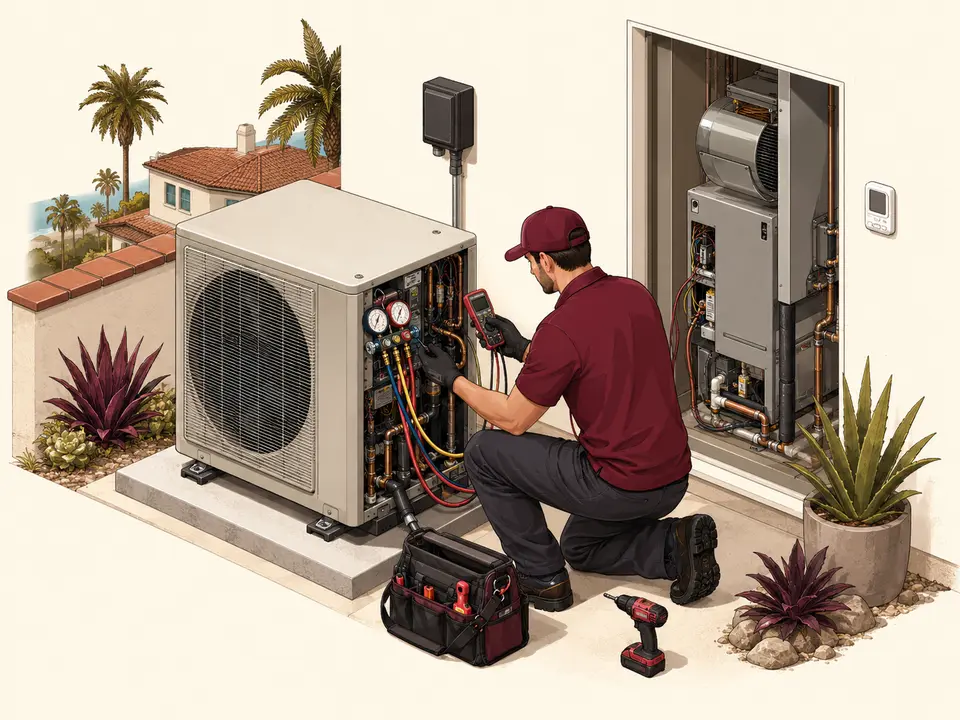
Heat Pump Not Heating, Cooling, Starting, or Defrosting?
The same symptom can come from several systems. Ordered testing prevents unnecessary parts and repeat visits.
Safety First for Burning Smells, Breaker Trips, and Loud Mechanical Noise
Turn the heat pump off if you smell burning, see smoke, find melted wiring, hear grinding, or the breaker trips again. Do not keep resetting protection devices. Water near electrical parts also needs immediate shutdown. A brief defrost sound or a short cool-air period can be normal, but persistent ice, noise, or cold air needs diagnosis.
What Professional Heat Pump Repair Service Includes
A useful diagnosis connects the thermostat request with the equipment response and measured system conditions.
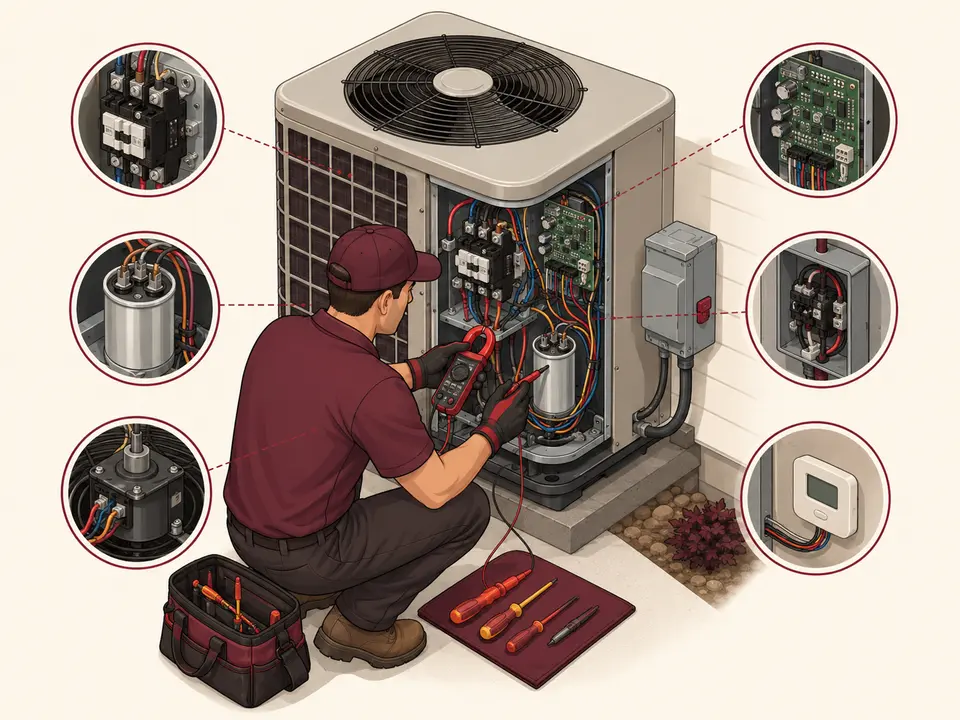
Heat Pump Repair Cost and Common Component Ranges
Online ranges help with early planning. The correct price follows testing, equipment identification, parts availability, access, refrigerant requirements, and a written scope.
Model, access, testing, related contactor or wiring work, and local labor can change the total.
Some projects cost more when recovery, brazing, filter-drier, evacuation, charge, or difficult access is required.
Compare a major repair with system age, coils, refrigerant, matched equipment, and full replacement cost.
More Current National Planning Ranges
- Circuit board About $75–$600.
- Defrost control About $200–$650.
- Fan motor About $200–$700.
- Fuses and relays About $75–$290.
- Refrigerant leak repair Often $300–$1,200 in current consumer data.
- Evaporator or condenser coil Can reach $1,000–$5,000 or more.
- Air handler A full replacement is a larger project, not a small repair.
- Geothermal and commercial Loop, pump, roof, control, and access needs change pricing.
These figures are broad national planning data. They are not All HVAC California prices, promises, or estimates.
From Heat Pump Symptom to Verified Repair
The process follows evidence: reproduce the fault, isolate the cause, complete approved work, then retest the system.
- 01
Reproduce and isolate
The technician reviews symptoms and tests thermostat, power, controls, electrical components, airflow, refrigerant, defrost, drainage, and operating sequence.
You get findings tied to measurements - 02
Explain and repair
We identify the failed part, root cause, related risks, repair scope, price, and repair-versus-replacement context before approved work begins.
You get a clear decision and scope - 03
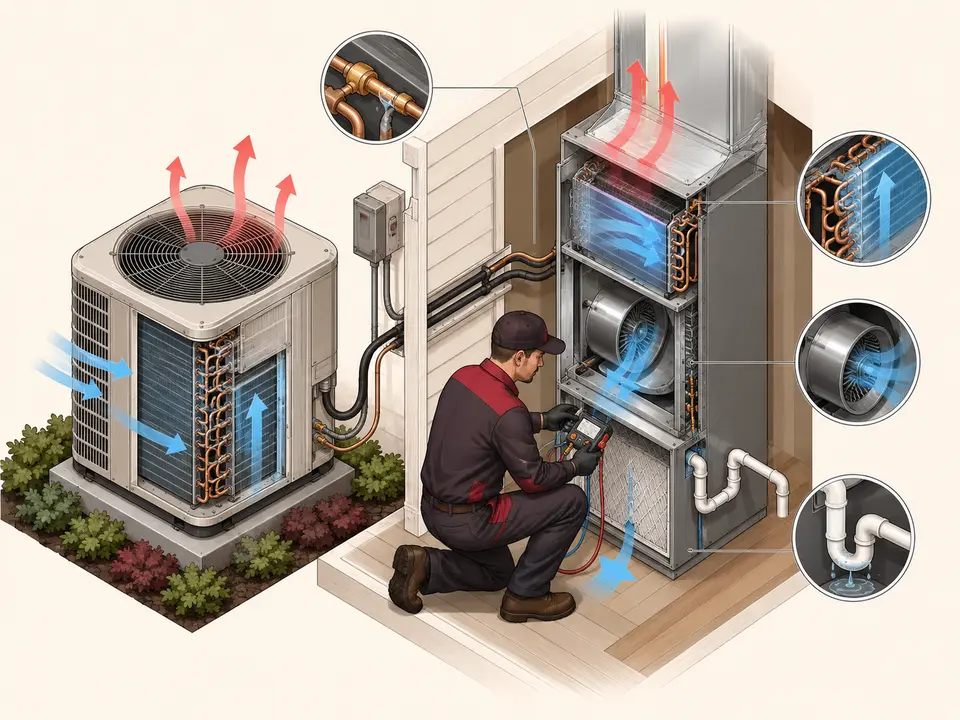
Retest complete operation
The system is checked in the available modes. Airflow, temperatures, electrical load, refrigerant, controls, drainage, defrost, and safeties are verified.
You get repair results, not only a replaced part
Heat Pump Repairs for Electrical, Defrost, Refrigerant, and Airflow Faults
Reliable heat pump service looks at the interacting system instead of guessing from one symptom.
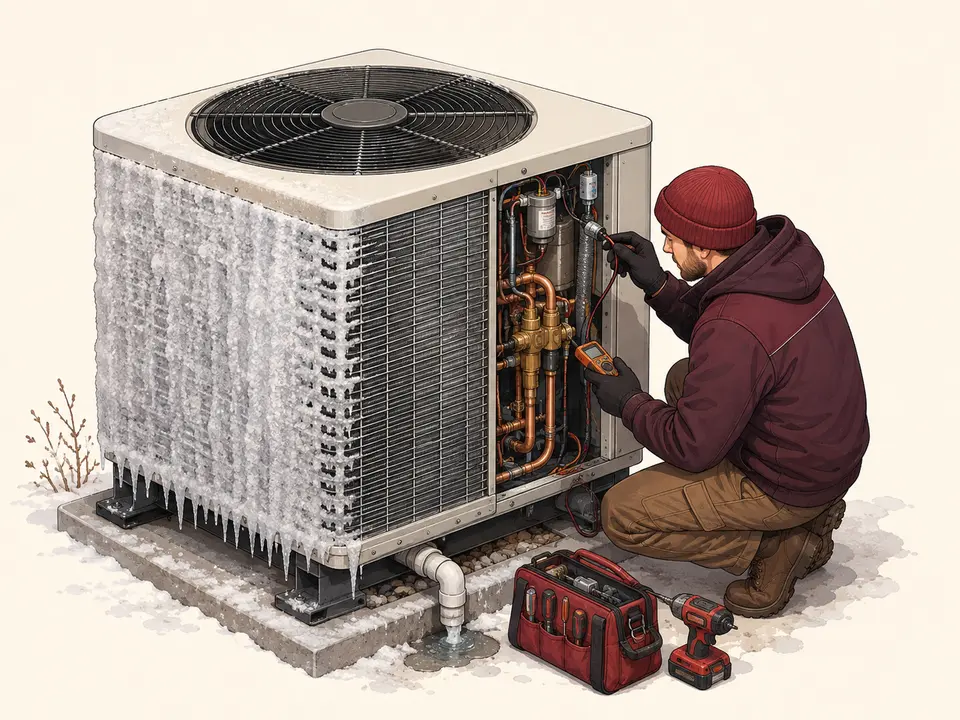
Electrical and starting repairs
Capacitors, contactors, fuses, relays, wiring, disconnects, transformers, sensors, boards, and approved starting components.
Diagnosis before repairFan, blower, and airflow repairs
Outdoor fan motors, indoor blower motors, wheels, modules, filters, coils, ducts, returns, and static-pressure problems.
Diagnosis before repairDefrost and cold-weather repairs
Defrost sensors, control boards, reversing operation, outdoor airflow, drainage, base-pan ice, and auxiliary heat.
Diagnosis before repairRefrigerant leak and charge work
Leak detection, repair, filter-drier, evacuation, weighed charge, line sets, coils, service valves, and metering devices.
Diagnosis before repairCompressor and reversing-valve work
Electrical and mechanical diagnosis before major refrigerant-circuit components are quoted or replaced.
Diagnosis before repairDuctless, geothermal, and commercial repair
Mini-split controls, water loops, pumps, packaged units, rooftop access, building controls, phasing, and occupancy needs.
Diagnosis before repairShould You Repair or Replace the Heat Pump?
Compare the verified repair with the condition and value of the system that remains.
- Repair often fits Newer matched equipment, one isolated fault, available parts, and otherwise sound coils, compressor, controls, and distribution.
- Major repair needs context Compressor, coil, reversing valve, refrigerant, or air-handler work can approach replacement value.
- History changes the decision Repeat leaks, breaker trips, board failures, short cycling, or comfort issues weaken another repair.
- Age matters ENERGY STAR suggests considering replacement once heat-pump equipment is more than 10 years old.
- Compatibility matters Obsolete refrigerant, unavailable parts, or mismatched components can limit a durable repair.
- Home changes matter Remodeling, ducts, envelope work, electrification, solar, and room use may change the correct system.
Use a Documented Repair Estimate and a Complete Replacement Proposal
Do not rely on age, a fixed percentage, or one rule alone. Compare fault evidence, repair scope, remaining condition, likely service life, comfort, operating needs, and a load-based replacement option.
What Professional Heat Pump Diagnosis Should Prove
A fault code or symptom points toward a test. It does not automatically prove a failed component.
Demand is confirmed. The thermostat, control sequence, and equipment response are compared.
Electrical values are measured. Voltage, capacitance, resistance, current, windings, controls, and safeties are tested.
Airflow is verified. Filter, blower, coil, static pressure, ducts, zones, and registers are reviewed.
Refrigerant evidence is interpreted. Temperatures, pressures, superheat, subcooling, coil conditions, and leak evidence are connected.
The completed repair is retested. Heating, cooling, defrost, controls, drainage, and safety operation are verified.
Heat pump repair standard
Why Choose All HVAC California for Heat Pump Repair?
A dependable repair company should show how the evidence supports the recommendation.
- Whole-system testing Thermostat, controls, electricity, airflow, refrigerant, defrost, drainage, and distribution reviewed.
- Cause before component The failed part and the condition that damaged it are separated.
- Model-specific work Equipment data, error history, published sequences, and compatible parts used where available.
- Clear findings Symptoms, measurements, fault, repair, risks, and limits explained in plain language.
- Repair options compared Minor, major, temporary, and replacement paths separated when appropriate.
- Refrigerant discipline Leaks are addressed before recharge, with recovery, evacuation, and charge steps scoped correctly.
- Performance retested Heating, cooling, airflow, temperatures, electrical load, controls, drainage, and safeties checked.
- Documented handover Completed work, operating notes, filters, observations, and next maintenance needs reviewed.
Local Heat Pump Repair Across California
Heat-pump faults can look different across coastal, valley, desert, and mountain conditions.
People searching for heat pump repair near me, a heat pump technician near me, or local heating repair need model-specific diagnosis. Climate, salt exposure, wildfire smoke, elevation, frost, extreme heat, utility controls, ducts, and building age can shape the fault.
- Coastal properties Corrosion, moisture, coil condition, electrical connections, drainage, and outdoor placement.
- Central Valley and desert homes Long cooling hours, dirty coils, attic ducts, high head pressure, motors, and capacitors.
- Mountain communities Defrost, snow clearance, sensors, drainage, auxiliary heat, low-temperature capacity, and controls.
- Older buildings Panels, wiring, ducts, insulation, controls, refrigerant, access, and prior modifications.
- Ductless homes Error codes, head filters, condensate pumps, sensors, boards, communications, and zone demand.
- Commercial sites Packaged units, roofs, controls, occupancy, phasing, access, drainage, and downtime planning.
Related Services for Heat Pump Performance
A leak, compressor, ductless, replacement, or maintenance need may sit behind the same symptom.
Our Heat Pump Repair Commitments
No invented response times, availability, savings, ratings, warranties, or plan benefits.
Symptoms are connected to thermostat, electrical, airflow, refrigerant, control, and system measurements.
The failed part, root cause, repair scope, risks, and alternatives are separated.
Parts, labor, refrigerant, access, exclusions, and responsibilities are identified before work.
Heating, cooling, airflow, refrigerant, controls, defrost, drainage, and safeties are retested.
Residential and Commercial Heat Pump Repair
Equipment type and property access change the diagnostic path, parts, controls, and repair scope.
Heat Pump Repair From Symptom to Verified Operation
What Better Heat Pump Repair Feels Like
These are service standards—not fictional testimonials.
The technician reproduces the symptom and measures the system. A fault code guides testing but does not replace it.
The findings explain the failed component, root cause, repair scope, price, risks, limits, and repair-versus-replacement context.
The repaired heat pump completes operating checks. You receive completed work, settings, observations, filter guidance, and next maintenance needs.
Service Options, Costs, and Questions We Address
Use this service index to identify the installation, repair, cost, equipment, or local-support topic that matches your project.
Ready to Request Heat Pump Repair?
Share the model, age, thermostat setting, symptom, error code, noise, ice, water, breaker behavior, and recent work.
Request professional heat pump repair for an air-source system, ductless mini-split, inverter, cold-climate unit, dual-fuel setup, geothermal heat pump, packaged equipment, residential property, or commercial site. Scheduling depends on site access, diagnosis, parts, equipment, refrigerant, repair scope, and trade coordination.
Heat Pump Repair Questions Answered
Repair cost depends on the fault, access, equipment, parts, refrigerant, testing, and local labor. Current national planning guides place many common repairs from roughly $100 to $700. Compressor, coil, refrigerant, air-handler, and complex control work can reach $900 to several thousand dollars. A diagnostic visit and written estimate are more useful than a flat online average.
Start with thermostat mode, setpoint, batteries, filter, vents, power, and outdoor clearance. A heat pump normally supplies gentler warm air than a furnace. Persistent cold air can involve low airflow, defrost operation, auxiliary heat, refrigerant loss, a stuck reversing valve, controls, or compressor trouble. Diagnosis should compare demand with actual equipment operation.
Check cooling mode, setpoint, filter, registers, breakers, disconnect, and outdoor fan. If the system runs without cooling, possible causes include restricted airflow, a dirty or frozen coil, low refrigerant from a leak, reversing-valve trouble, fan failure, metering problems, or compressor faults. Temperature and refrigerant measurements identify the cause.
A light frost during heating can be normal and should clear during defrost. Ice that grows or remains can point to a failed sensor, defrost control, fan problem, blocked coil, drainage issue, low refrigerant, or reversing-valve trouble. Do not chip ice from the coil. Turn the system off if the fan or compressor sounds distressed.
The thermostat, breaker, disconnect, fuse, condensate safety, contactor, capacitor, transformer, control board, wiring, motor, or compressor may interrupt operation. Reset a breaker only once after checking for an obvious cause. Repeated trips, burning smells, buzzing, or damaged wiring require the system to remain off until inspected.
Short cycling can come from a thermostat location or control problem, restricted airflow, a dirty coil, refrigerant loss, an oversized system, pressure safeties, electrical faults, or compressor protection. Record cycle length, outdoor temperature, thermostat behavior, and any error code. The repair should address the cause rather than only the symptom.
A current manufacturer planning guide lists compressor repair or replacement around $900 to $2,900 nationally. California pricing can differ. Refrigerant recovery, filter-drier, brazing, evacuation, charge, electrical work, access, and system condition affect the quote. Compare the compressor estimate with full-system age, coil condition, refrigerant type, and replacement cost.
A current manufacturer guide lists a national planning range around $400 to $700, while other guides show wider totals. Access, refrigerant recovery, brazing, filter-drier, evacuation, charge, and diagnosis change the price. Confirm that the fault is the valve itself rather than its coil, wiring, control signal, or refrigerant condition.
Repair often fits a newer, matched system with an isolated and affordable fault. Replacement becomes more reasonable when a major compressor, coil, or refrigerant repair lands on equipment over 10 years old, parts are scarce, failures repeat, or comfort remains poor. Compare a verified repair estimate with a complete load-based replacement proposal.
The service scope covers ductless mini-split, air-source, ducted, inverter, cold-climate, dual-fuel, geothermal, water-source, packaged, residential, and commercial heat-pump diagnosis. The exact repair depends on model support, parts, loop or duct condition, controls, refrigerant requirements, access, and the verified fault.
Heat Pump Repair That Starts With the Actual Fault
When a heat pump stops heating, cooling, defrosting, or starting, the symptom is only the first clue. We test controls, electricity, airflow, refrigerant, components, drainage, and complete system operation before recommending the repair.
Heat Pump Not Heating, Cooling, Starting, or Defrosting?
The same symptom can come from several systems. Ordered testing prevents unnecessary parts and repeat visits.
Safety First for Burning Smells, Breaker Trips, and Loud Mechanical Noise
Turn the heat pump off if you smell burning, see smoke, find melted wiring, hear grinding, or the breaker trips again. Do not keep resetting protection devices. Water near electrical parts also needs immediate shutdown. A brief defrost sound or a short cool-air period can be normal, but persistent ice, noise, or cold air needs diagnosis.
What Professional Heat Pump Repair Service Includes
A useful diagnosis connects the thermostat request with the equipment response and measured system conditions.
Heat Pump Repair Cost and Common Component Ranges
Online ranges help with early planning. The correct price follows testing, equipment identification, parts availability, access, refrigerant requirements, and a written scope.
Model, access, testing, related contactor or wiring work, and local labor can change the total.
Some projects cost more when recovery, brazing, filter-drier, evacuation, charge, or difficult access is required.
Compare a major repair with system age, coils, refrigerant, matched equipment, and full replacement cost.
More Current National Planning Ranges
- Circuit board About $75–$600.
- Defrost control About $200–$650.
- Fan motor About $200–$700.
- Fuses and relays About $75–$290.
- Refrigerant leak repair Often $300–$1,200 in current consumer data.
- Evaporator or condenser coil Can reach $1,000–$5,000 or more.
- Air handler A full replacement is a larger project, not a small repair.
- Geothermal and commercial Loop, pump, roof, control, and access needs change pricing.
These figures are broad national planning data. They are not All HVAC California prices, promises, or estimates.
From Heat Pump Symptom to Verified Repair
The process follows evidence: reproduce the fault, isolate the cause, complete approved work, then retest the system.
- 01
Reproduce and isolate
The technician reviews symptoms and tests thermostat, power, controls, electrical components, airflow, refrigerant, defrost, drainage, and operating sequence.
You get findings tied to measurements - 02
Explain and repair
We identify the failed part, root cause, related risks, repair scope, price, and repair-versus-replacement context before approved work begins.
You get a clear decision and scope - 03
Retest complete operation
The system is checked in the available modes. Airflow, temperatures, electrical load, refrigerant, controls, drainage, defrost, and safeties are verified.
You get repair results, not only a replaced part
Heat Pump Repairs for Electrical, Defrost, Refrigerant, and Airflow Faults
Reliable heat pump service looks at the interacting system instead of guessing from one symptom.
Electrical and starting repairs
Capacitors, contactors, fuses, relays, wiring, disconnects, transformers, sensors, boards, and approved starting components.
Diagnosis before repairFan, blower, and airflow repairs
Outdoor fan motors, indoor blower motors, wheels, modules, filters, coils, ducts, returns, and static-pressure problems.
Diagnosis before repairDefrost and cold-weather repairs
Defrost sensors, control boards, reversing operation, outdoor airflow, drainage, base-pan ice, and auxiliary heat.
Diagnosis before repairRefrigerant leak and charge work
Leak detection, repair, filter-drier, evacuation, weighed charge, line sets, coils, service valves, and metering devices.
Diagnosis before repairCompressor and reversing-valve work
Electrical and mechanical diagnosis before major refrigerant-circuit components are quoted or replaced.
Diagnosis before repairDuctless, geothermal, and commercial repair
Mini-split controls, water loops, pumps, packaged units, rooftop access, building controls, phasing, and occupancy needs.
Diagnosis before repairShould You Repair or Replace the Heat Pump?
Compare the verified repair with the condition and value of the system that remains.
- Repair often fits Newer matched equipment, one isolated fault, available parts, and otherwise sound coils, compressor, controls, and distribution.
- Major repair needs context Compressor, coil, reversing valve, refrigerant, or air-handler work can approach replacement value.
- History changes the decision Repeat leaks, breaker trips, board failures, short cycling, or comfort issues weaken another repair.
- Age matters ENERGY STAR suggests considering replacement once heat-pump equipment is more than 10 years old.
- Compatibility matters Obsolete refrigerant, unavailable parts, or mismatched components can limit a durable repair.
- Home changes matter Remodeling, ducts, envelope work, electrification, solar, and room use may change the correct system.
Use a Documented Repair Estimate and a Complete Replacement Proposal
Do not rely on age, a fixed percentage, or one rule alone. Compare fault evidence, repair scope, remaining condition, likely service life, comfort, operating needs, and a load-based replacement option.
What Professional Heat Pump Diagnosis Should Prove
A fault code or symptom points toward a test. It does not automatically prove a failed component.
Demand is confirmed. The thermostat, control sequence, and equipment response are compared.
Electrical values are measured. Voltage, capacitance, resistance, current, windings, controls, and safeties are tested.
Airflow is verified. Filter, blower, coil, static pressure, ducts, zones, and registers are reviewed.
Refrigerant evidence is interpreted. Temperatures, pressures, superheat, subcooling, coil conditions, and leak evidence are connected.
The completed repair is retested. Heating, cooling, defrost, controls, drainage, and safety operation are verified.
Heat pump repair standard
Why Choose All HVAC California for Heat Pump Repair?
A dependable repair company should show how the evidence supports the recommendation.
- Whole-system testing Thermostat, controls, electricity, airflow, refrigerant, defrost, drainage, and distribution reviewed.
- Cause before component The failed part and the condition that damaged it are separated.
- Model-specific work Equipment data, error history, published sequences, and compatible parts used where available.
- Clear findings Symptoms, measurements, fault, repair, risks, and limits explained in plain language.
- Repair options compared Minor, major, temporary, and replacement paths separated when appropriate.
- Refrigerant discipline Leaks are addressed before recharge, with recovery, evacuation, and charge steps scoped correctly.
- Performance retested Heating, cooling, airflow, temperatures, electrical load, controls, drainage, and safeties checked.
- Documented handover Completed work, operating notes, filters, observations, and next maintenance needs reviewed.
Local Heat Pump Repair Across California
Heat-pump faults can look different across coastal, valley, desert, and mountain conditions.
People searching for heat pump repair near me, a heat pump technician near me, or local heating repair need model-specific diagnosis. Climate, salt exposure, wildfire smoke, elevation, frost, extreme heat, utility controls, ducts, and building age can shape the fault.
- Coastal properties Corrosion, moisture, coil condition, electrical connections, drainage, and outdoor placement.
- Central Valley and desert homes Long cooling hours, dirty coils, attic ducts, high head pressure, motors, and capacitors.
- Mountain communities Defrost, snow clearance, sensors, drainage, auxiliary heat, low-temperature capacity, and controls.
- Older buildings Panels, wiring, ducts, insulation, controls, refrigerant, access, and prior modifications.
- Ductless homes Error codes, head filters, condensate pumps, sensors, boards, communications, and zone demand.
- Commercial sites Packaged units, roofs, controls, occupancy, phasing, access, drainage, and downtime planning.
Related Services for Heat Pump Performance
A leak, compressor, ductless, replacement, or maintenance need may sit behind the same symptom.
Our Heat Pump Repair Commitments
No invented response times, availability, savings, ratings, warranties, or plan benefits.
Symptoms are connected to thermostat, electrical, airflow, refrigerant, control, and system measurements.
The failed part, root cause, repair scope, risks, and alternatives are separated.
Parts, labor, refrigerant, access, exclusions, and responsibilities are identified before work.
Heating, cooling, airflow, refrigerant, controls, defrost, drainage, and safeties are retested.
Residential and Commercial Heat Pump Repair
Equipment type and property access change the diagnostic path, parts, controls, and repair scope.
Heat Pump Repair From Symptom to Verified Operation
What Better Heat Pump Repair Feels Like
These are service standards—not fictional testimonials.
The technician reproduces the symptom and measures the system. A fault code guides testing but does not replace it.
The findings explain the failed component, root cause, repair scope, price, risks, limits, and repair-versus-replacement context.
The repaired heat pump completes operating checks. You receive completed work, settings, observations, filter guidance, and next maintenance needs.
Ready to Request Heat Pump Repair?
Share the model, age, thermostat setting, symptom, error code, noise, ice, water, breaker behavior, and recent work.
Request professional heat pump repair for an air-source system, ductless mini-split, inverter, cold-climate unit, dual-fuel setup, geothermal heat pump, packaged equipment, residential property, or commercial site. Scheduling depends on site access, diagnosis, parts, equipment, refrigerant, repair scope, and trade coordination.
Heat Pump Repair Questions Answered
Repair cost depends on the fault, access, equipment, parts, refrigerant, testing, and local labor. Current national planning guides place many common repairs from roughly $100 to $700. Compressor, coil, refrigerant, air-handler, and complex control work can reach $900 to several thousand dollars. A diagnostic visit and written estimate are more useful than a flat online average.
Start with thermostat mode, setpoint, batteries, filter, vents, power, and outdoor clearance. A heat pump normally supplies gentler warm air than a furnace. Persistent cold air can involve low airflow, defrost operation, auxiliary heat, refrigerant loss, a stuck reversing valve, controls, or compressor trouble. Diagnosis should compare demand with actual equipment operation.
Check cooling mode, setpoint, filter, registers, breakers, disconnect, and outdoor fan. If the system runs without cooling, possible causes include restricted airflow, a dirty or frozen coil, low refrigerant from a leak, reversing-valve trouble, fan failure, metering problems, or compressor faults. Temperature and refrigerant measurements identify the cause.
A light frost during heating can be normal and should clear during defrost. Ice that grows or remains can point to a failed sensor, defrost control, fan problem, blocked coil, drainage issue, low refrigerant, or reversing-valve trouble. Do not chip ice from the coil. Turn the system off if the fan or compressor sounds distressed.
The thermostat, breaker, disconnect, fuse, condensate safety, contactor, capacitor, transformer, control board, wiring, motor, or compressor may interrupt operation. Reset a breaker only once after checking for an obvious cause. Repeated trips, burning smells, buzzing, or damaged wiring require the system to remain off until inspected.
Short cycling can come from a thermostat location or control problem, restricted airflow, a dirty coil, refrigerant loss, an oversized system, pressure safeties, electrical faults, or compressor protection. Record cycle length, outdoor temperature, thermostat behavior, and any error code. The repair should address the cause rather than only the symptom.
A current manufacturer planning guide lists compressor repair or replacement around $900 to $2,900 nationally. California pricing can differ. Refrigerant recovery, filter-drier, brazing, evacuation, charge, electrical work, access, and system condition affect the quote. Compare the compressor estimate with full-system age, coil condition, refrigerant type, and replacement cost.
A current manufacturer guide lists a national planning range around $400 to $700, while other guides show wider totals. Access, refrigerant recovery, brazing, filter-drier, evacuation, charge, and diagnosis change the price. Confirm that the fault is the valve itself rather than its coil, wiring, control signal, or refrigerant condition.
Repair often fits a newer, matched system with an isolated and affordable fault. Replacement becomes more reasonable when a major compressor, coil, or refrigerant repair lands on equipment over 10 years old, parts are scarce, failures repeat, or comfort remains poor. Compare a verified repair estimate with a complete load-based replacement proposal.
The service scope covers ductless mini-split, air-source, ducted, inverter, cold-climate, dual-fuel, geothermal, water-source, packaged, residential, and commercial heat-pump diagnosis. The exact repair depends on model support, parts, loop or duct condition, controls, refrigerant requirements, access, and the verified fault.