Boiler Repair That Starts With the Actual Fault
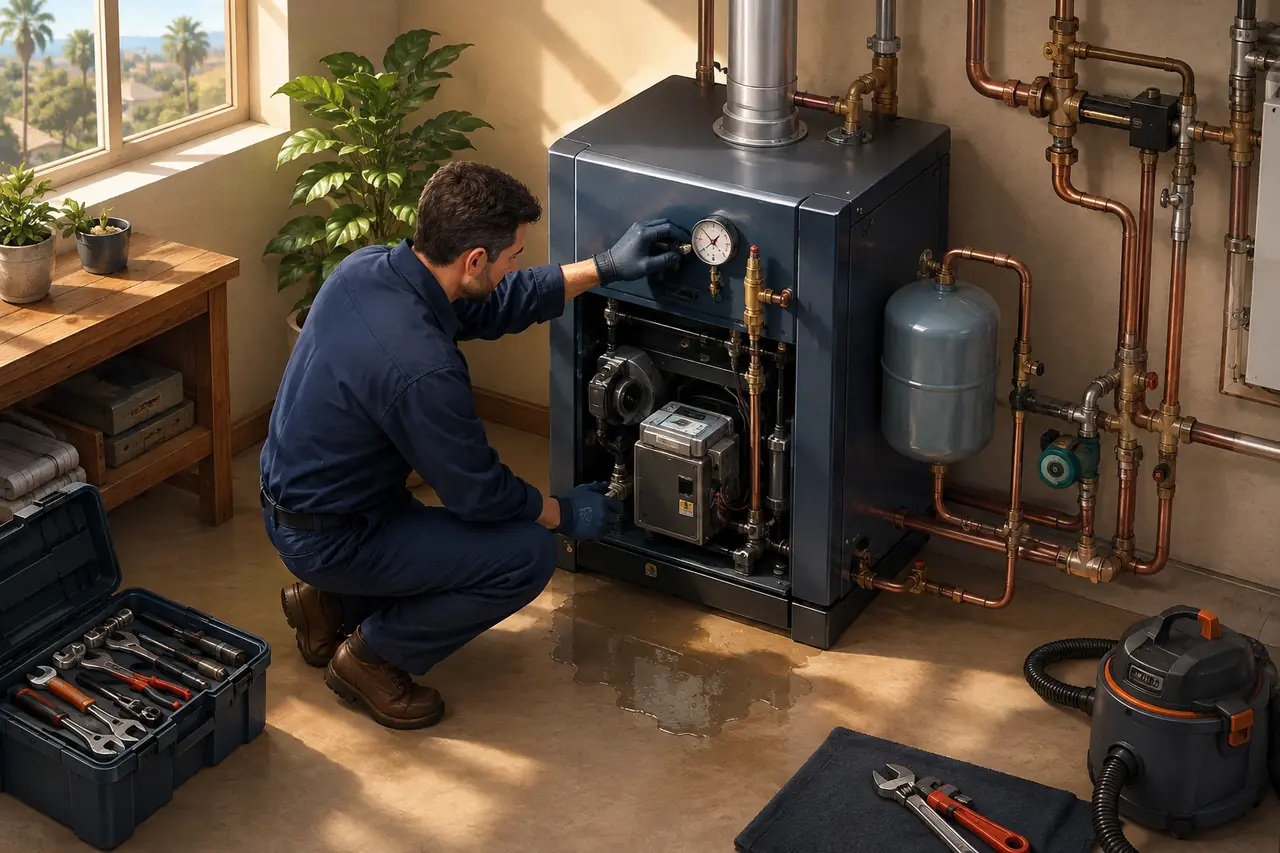
A boiler that leaks, locks out, loses pressure, makes noise, or runs without delivering heat needs a complete system diagnosis. We trace the call for heat through controls, combustion or electrical input, pressure, water or steam movement, zones, emitters, and safety response before repair options are written.
When Boiler Trouble Is a Safety Issue
Boilers combine fuel or high electrical load with hot water, steam, pressure, and venting. Some symptoms call for shutdown and evacuation rather than troubleshooting.
- Natural-gas odor Leave the building immediately. Do not switch lights, use electronics, start a vehicle nearby, or search for the leak. Call the gas utility or 911 from a safe location.
- Carbon-monoxide alarm or symptoms Move everyone to fresh air and contact emergency services. Carbon monoxide is colorless and odorless; a normal-looking boiler does not rule out a venting or combustion hazard.
- Heavy water or steam release Keep away from hot water, steam, and wet electrical equipment. If it can be done without approaching the hazard, stop the system and water supply.
- Soot, scorch marks, delayed ignition, or flame rollout Stop operation and arrange qualified evaluation. Do not bypass a switch or repeatedly reset a lockout.
- Relief valve discharge or extreme pressure Never plug or cap the relief line. The valve may be protecting the boiler from an expansion or control problem.
- Electrical burning smell or repeated breaker trip Turn the boiler off at a safe disconnect and leave the circuit off until the electrical fault is inspected.
SoCalGas directs customers who smell natural gas or suspect a leak to evacuate immediately and call from a safe location. Service scheduling through this page is not a substitute for utility or emergency response.
What Boiler Repair Diagnosis Includes
The failed component is only part of the answer. A useful diagnosis shows what caused the symptom, what must be repaired, and how the system will be tested afterward.
How Much Does Boiler Repair Cost in 2026?
Current national consumer data can frame a budget, but an accurate California boiler repair price requires the fault, parts, labor, access, system type, and verification scope.
Angi’s 2026 consumer guide reports this range for professional boiler repair, from simple corrections to substantial component work.
Reported service cost depends on the type of boiler, the cause, parts, and labor required for diagnosis and correction.
Major pumps, gas valves, coils, heat exchangers, controls, or difficult access can move a job beyond typical repairs.
What Changes the Written Boiler Repair Estimate?
- Fault and testing Intermittent lockouts, hidden leaks, distribution problems, and control interactions may require more diagnostic time than an obvious failed part.
- Boiler type Gas, oil, propane, electric, steam, hot-water, combi, condensing, and commercial equipment use different parts and procedures.
- Parts and model support Availability, shipping, manufacturer requirements, obsolete controls, proprietary assemblies, and warranty status affect price and timing.
- Connected system Pumps, valves, radiators, radiant manifolds, piping, venting, condensate, chimney, fuel, and electrical faults may sit outside the cabinet.
- Access and water condition Tight boiler rooms, draining, purging, scale, corrosion, frozen piping, hazardous materials, and cleanup change labor.
- Timing and permits Regular scheduling, after-hours availability, inspection, and code-related work can change total cost. Availability is confirmed when requested.
These are national planning figures, not All HVAC California prices or promises. A repair quote should identify the diagnostic basis, part, labor, exclusions, and post-repair test.
Our Boiler Repair Process
The sequence moves from symptom and safety review to measured diagnosis, scoped repair, and a full operating-cycle check.
- 01
Document and isolate
We record the symptom, age, model, code, pressure, reset history, noises, leaks, zones, recent work, and safety conditions. Then we reproduce the fault when safe and trace the operating sequence instead of guessing from a symptom alone.
You get an explained diagnostic basis - 02
Test and scope
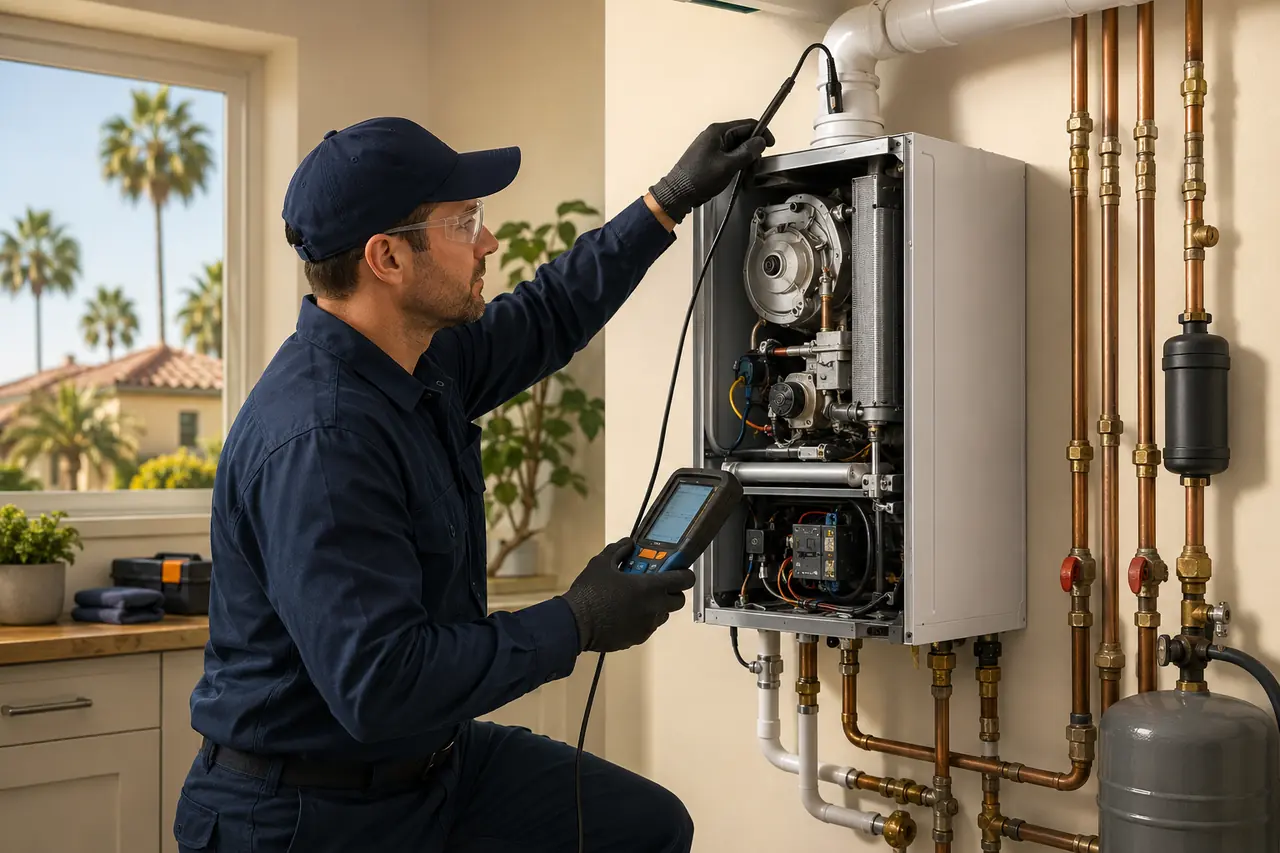
Measurements are compared with the model documentation and system conditions. The proposed repair identifies the failed or out-of-range item, contributing conditions, parts, labor, limitations, and any separate distribution or code issue.
You get repair options before work proceeds - 03
Repair and verify
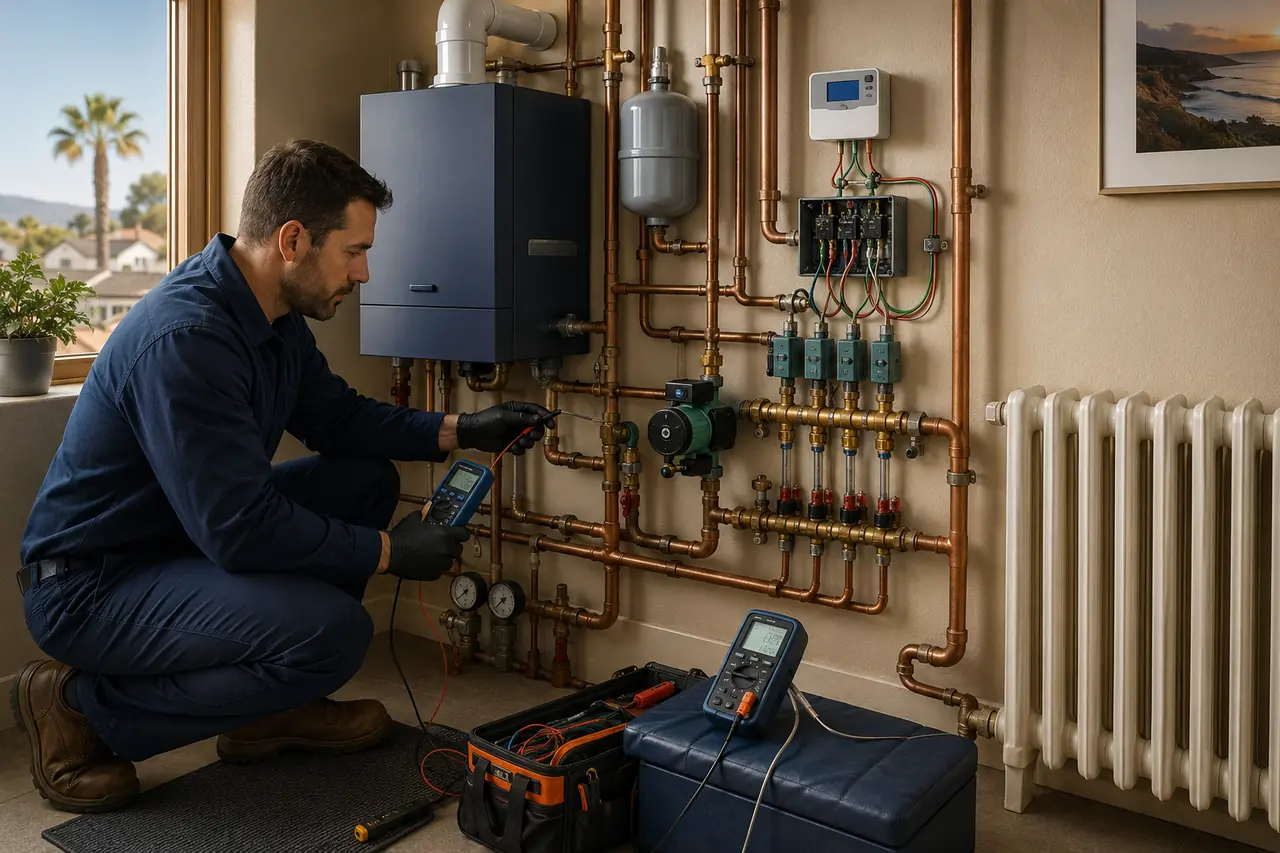
After the approved work, the boiler is operated through a complete call for heat. Pressure, temperature, flow, combustion where applicable, zones, hot water, leaks, safeties, shutdown, and the original complaint are rechecked.
You get the result, not only a replaced part
Boiler Types and Systems We Diagnose
Repair methods change with the fuel, heat exchanger, burner or element, venting, controls, water or steam distribution, and domestic hot-water arrangement.
Gas and propane boilers
Ignition, flame proving, gas valve, pressure, burner, venting, combustion air, combustion performance, safeties, pumps, and controls.
Fuel and venting matterOil-fired boilers
Tank and line supply, filter, pump, nozzle, electrodes, transformer or igniter, draft, smoke, combustion, soot, chimney, and controls.
Burner setup measuredElectric boilers
Breakers, contactors, relays, elements, sequencers, limits, transformers, sensors, controls, pumps, and hydronic conditions.
Power and load checkedCondensing and combi boilers
Ignition, fan, gas-air controls, heat exchanger, condensate trap, neutralizer, sensors, diverter or priority control, flow, scale, and codes.
Model sequence followedHot-water and radiant systems
Circulators, zone valves, air, expansion, fill, relief, mixing, manifolds, balancing, emitters, thermostats, outdoor reset, and water quality.
Heat delivery tracedSteam boilers
Waterline, low-water cutoff, pressure controls, gauge, near-boiler piping, vents, traps, main and return pitch, condensate, burner, and chimney.
Steam conditions observedRead the Symptoms Before Replacing Parts
The same symptom can have several causes. Testing the complete sequence prevents a thermostat, pump, control, or pressure problem from being mistaken for a failed boiler.
- Boiler will not turn on Power, thermostat, low-water or pressure safety, limit, condensate switch, transformer, control board, fuel supply, and ignition all belong in the sequence.
- Boiler starts and stops Short cycling can follow oversizing, low flow, control settings, air, pump trouble, blocked heat transfer, sensor error, or a small active zone.
- Boiler runs but no heat Circulation, zone valves, airlocks, mixing, closed valves, pump control, thermostat, sensor, low flow, and distribution faults are common paths.
- No domestic hot water A combi or indirect system may have a flow sensor, diverter, aquastat, priority, scale, mixing valve, pump, or tank problem.
- Pressure changes The gauge, expansion tank, fill valve, relief valve, water leak, air vent, and temperature rise need to be evaluated together.
- Noise or vibration Air, scale, cavitation, poor flow, loose components, delayed ignition, steam condensate, excessive pressure, and piping movement sound different under test.
Boiler Leaks and Pressure Problems
A wet floor does not automatically mean the boiler block or heat exchanger has failed. Water can migrate from a valve, pump, vent, expansion component, condensate path, pipe joint, or nearby equipment.
- Relief-valve discharge Can follow overpressure, failed expansion, overfeeding, temperature control trouble, a damaged valve, or an incorrect system condition.
- Pressure keeps dropping Visible or hidden leaks, air vents, relief discharge, heat-exchanger loss, distribution damage, or an inaccurate gauge require isolation.
- Water from the bottom Condensate, pump seals, drain valves, internal piping, boiler sections, and water traveling along the jacket are inspected before conclusions are made.
- Expansion-tank problem Precharge, diaphragm integrity, isolation, tank sizing, system fill pressure, and temperature rise determine whether the tank can absorb expansion.
- Frequent makeup water Repeatedly adding water can accelerate corrosion and scale. The loss should be located rather than normalized.
- Leak repair verification The corrected system is filled, purged, brought to temperature, and observed for hot pressure, relief response, and renewed moisture.
Ignition, Flame, Gas Valve, and Lockout Repair
A no-ignition or flame-failure code describes where the sequence stopped, not necessarily which component failed.
Call for heat. Thermostat, zone control, end switch, operating control, water or pressure safety, and limits must permit the cycle.
Purge and proving. Fan operation, air-pressure switch, intake, vent, condensate path, chimney draft, and model-specific proving signals are checked.
Ignition and flame. Igniter, pilot, electrodes, flame rod, grounding, fuel pressure, gas valve or oil burner, wiring, and control timing are evaluated.
Combustion and shutdown. Where applicable, combustion is measured and compared with equipment requirements; flame loss, safety shutdown, and venting response are confirmed.
Evidence before parts
Circulator, Zone, Thermostat, and No-Heat Repair
A boiler can fire correctly while the building remains cold. Hydronic heat depends on moving the right flow through the right zone at the right temperature.
Steam Boiler Noise, Waterline, and Venting Problems
Steam systems reveal faults through pressure, waterline behavior, venting, condensate return, radiator timing, and sound. Each must be watched while the system runs.
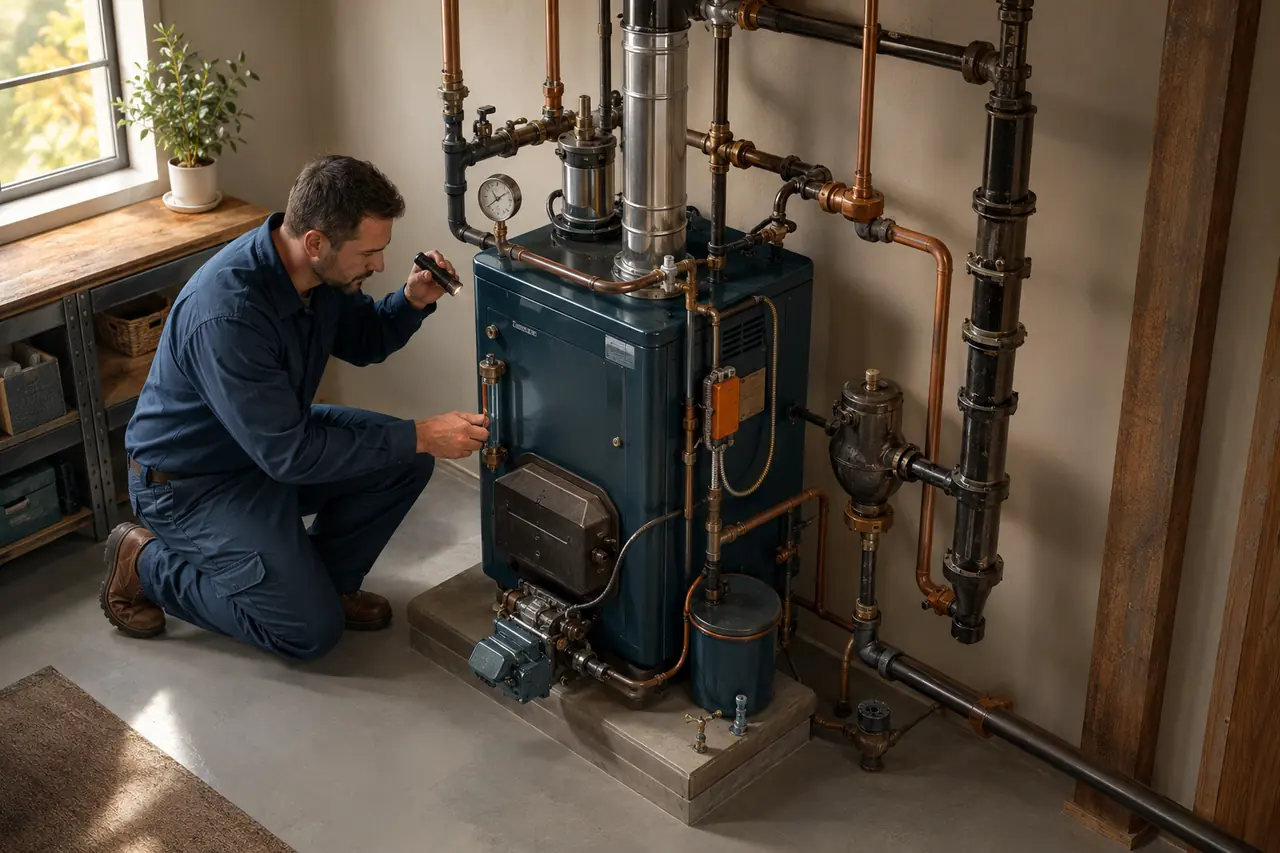
- Banging or hammer Trapped condensate, incorrect pipe pitch, high pressure, fast valves, poor near-boiler piping, or wet steam can create impact noise.
- Uneven or slow radiators Main vents, radiator vents, traps, pressure, piping, balance, and thermostat cycle rate affect how steam reaches the building.
- Unstable waterline Dirty water, oils, surging, incorrect piping, return restrictions, overfilling, or a failing feeder can move the sight-glass level.
- Low-water cutoff and feeder The control must sense the correct water level and safely interrupt the burner. Automatic feeding should not conceal a leak or return problem.
- Pressure controls Operating and limit controls, pigtails, gauges, and setpoints are verified rather than adjusted blindly.
- Venting and combustion Boiler room air, burner, draft, chimney, vent connectors, spillage, and combustion are inspected for the installed fuel and appliance.
Repair or Replace Your Boiler?
A defensible decision compares the present fault, boiler condition, remaining support, connected distribution, safety, efficiency, and complete replacement scope.
- Repair can make sense The heat exchanger or boiler sections are sound, the fault is isolated, parts are available, repeat breakdowns are limited, and the repair restores safe dependable operation.
- Plan replacement soon The boiler is aging, parts are becoming difficult, corrosion is progressing, the system is poorly controlled, or the present repair is only one of several foreseeable needs.
- Compare replacement now Internal leakage, cracked sections or heat exchanger, major combustion damage, obsolete controls, severe corrosion, unsafe venting, repeated failures, or a high repair-to-value ratio can justify a full option.
- Keep the distribution in view Sound radiators, baseboards, radiant loops, steam mains, and piping may remain valuable even when the boiler is replaced.
- Do not use age alone Many boilers serve 15 to 20 years or longer, but water quality, runtime, maintenance, fuel, installation, parts, and system stress influence actual life.
- Compare complete scopes Repair cost should be weighed against properly sized replacement equipment, piping changes, venting, fuel or electrical work, controls, permits, removal, and commissioning.
What a Defensible Boiler Diagnosis Should Prove
These are repair-process standards, not invented ratings, response times, warranties, savings, or availability promises.
The symptom, fault code, pressure, leak, noise, no-heat condition, or lockout is documented under safe operating conditions.
Control sequence, voltage, current, pressure, temperature, flow, combustion, draft, or model inputs are checked as applicable.
Parts, labor, contributing conditions, limits, separate system work, cost, timing, and replacement comparison are presented clearly.
The original symptom and relevant safety, pressure, temperature, flow, combustion, zone, hot-water, leak, and shutdown conditions are rechecked.
Residential, Radiant, and Commercial Boiler Repair
Property and equipment type change access, downtime, documentation, controls, redundancy, pressure, distribution, water treatment, and repair planning.
Model-Specific Documentation Matters
Navien, Laars, Lochinvar, Peerless, Burnham, Bosch, Weil-McLain, Viessmann, Utica, NTI, Crown, and other boiler families use different sequences, controls, sensors, service procedures, and parts. Familiarity with a brand name does not replace the correct manual, model and serial identification, applicable service bulletins, safe test methods, and verified parts compatibility. Brand references do not imply factory authorization.
Boiler Repair Visual Guide
Service Options, Costs, and Questions We Address
Use this service index to identify the installation, repair, cost, equipment, or local-support topic that matches your project.
Ready to Diagnose Your Boiler?
Share the city, property type, boiler fuel and model, age, fault code, pressure reading, leak location, noise, affected zones, heat or hot-water symptoms, resets, and photos if available.
Request boiler repair assessment for gas, propane, oil, electric, combi, condensing, hot-water, steam, radiant, residential, multifamily, commercial, or light-industrial equipment. Scheduling, response timing, parts, and repair scope depend on safety, location, access, diagnosis, model support, materials, and current availability.
Boiler Repair Questions Answered
Angi’s 2026 national consumer data places many professional boiler repairs between $95 and $1,500, with boiler service averaging about $425 and common repairs often falling between $150 and $750. A California quote can differ because fuel type, fault, model, parts availability, access, labor, permits, system pressure, distribution work, and after-hours timing affect the total. The service-call charge, diagnostic labor, parts, taxes, and any follow-up testing should be shown clearly.
A boiler may leak from a relief valve, expansion tank, circulator flange, pump seal, air vent, drain, fill valve, heat exchanger, condensate assembly, pipe joint, or nearby hydronic component. The puddle location alone does not identify the failed part because water can travel along piping or the cabinet. Shut the system down if water is reaching electrical components, the leak is heavy, or pressure is unstable, and arrange a diagnosis before repeatedly adding water.
Falling pressure can come from a visible leak, a relief valve discharge, a failed expansion tank, an automatic air vent, a hidden distribution leak, or a pressure-control problem. Repressurizing repeatedly without finding the loss can introduce fresh oxygen and minerals that accelerate corrosion. A technician should inspect the boiler and distribution, verify the gauge, test expansion-tank charge and operation, and identify where system water is leaving.
High pressure may result from an expansion tank that has lost its air charge, a failed diaphragm, an overfeeding fill valve, an incorrect cold fill pressure, a domestic-water crossover in certain systems, or a faulty gauge. A relief valve that opens is responding to a condition that needs diagnosis. Do not cap, plug, or isolate a safety relief discharge. Let the boiler cool and have the pressure and expansion controls tested.
Possible causes include thermostat or control demand, loss of power, a tripped safety, low water or pressure, a blocked condensate path, ignition failure, flame-sensor contamination, gas-valve or oil-burner trouble, vent or air-pressure faults, control-board issues, or a model-specific lockout. One reset may be appropriate only when the manufacturer’s instructions allow it. Repeated resets can mask unsafe or damaging conditions and should be avoided.
The burner may be operating while heat fails to move through the building because of a circulator, zone valve, airlock, closed valve, control, thermostat, sensor, mixing valve, low-flow, scale, or distribution problem. Combi and indirect-water-heater systems also use priority controls and sensors that can affect domestic hot water. Diagnosis should trace the call for heat from the control through the boiler, pump, zones, supply and return temperatures, and emitters.
Noise is a symptom rather than a part diagnosis. Kettling can relate to scale, restricted flow, overheating, or poor circulation. Gurgling may indicate air or condensate trouble. Banging in steam systems can come from trapped condensate, pitch, pressure, venting, or near-boiler piping. Pump cavitation, loose components, delayed ignition, and expanding pipework create different sounds. The system should be observed through a complete operating cycle before a repair is selected.
Some pump problems come from power, relays, seized rotors, air, isolation valves, incorrect speed, control settings, or failed capacitors; others require circulator replacement. The technician should verify voltage, control output, motor current, flow evidence, temperature change, valve position, pump orientation, and system pressure. Replacing a pump without checking the circuit and hydronic conditions can leave the original no-heat problem unresolved.
Homeowners can usually confirm the thermostat setting, check the electrical panel, note the displayed error code, look for visible water, and follow a single manufacturer-authorized reset. Do not open fuel components, bypass safeties, plug relief piping, repeatedly add water, or work on combustion, gas, oil, high-temperature water, steam, or live electrical parts. If you smell natural gas, leave immediately and call the gas utility or 911 from a safe location.
Repair often makes sense when the fault is isolated, the heat exchanger and boiler body are sound, parts are available, the system is not near the end of its service life, and the repair restores dependable operation. Replacement deserves comparison when the boiler is old, leaking internally, repeatedly failing, poorly matched, difficult to support, or facing a major heat-exchanger or control expense. Compare the complete repair scope with a properly designed replacement—not only the equipment price.
Boiler Repair That Starts With the Actual Fault
A boiler that leaks, locks out, loses pressure, makes noise, or runs without delivering heat needs a complete system diagnosis. We trace the call for heat through controls, combustion or electrical input, pressure, water or steam movement, zones, emitters, and safety response before repair options are written.
When Boiler Trouble Is a Safety Issue
Boilers combine fuel or high electrical load with hot water, steam, pressure, and venting. Some symptoms call for shutdown and evacuation rather than troubleshooting.
- Natural-gas odor Leave the building immediately. Do not switch lights, use electronics, start a vehicle nearby, or search for the leak. Call the gas utility or 911 from a safe location.
- Carbon-monoxide alarm or symptoms Move everyone to fresh air and contact emergency services. Carbon monoxide is colorless and odorless; a normal-looking boiler does not rule out a venting or combustion hazard.
- Heavy water or steam release Keep away from hot water, steam, and wet electrical equipment. If it can be done without approaching the hazard, stop the system and water supply.
- Soot, scorch marks, delayed ignition, or flame rollout Stop operation and arrange qualified evaluation. Do not bypass a switch or repeatedly reset a lockout.
- Relief valve discharge or extreme pressure Never plug or cap the relief line. The valve may be protecting the boiler from an expansion or control problem.
- Electrical burning smell or repeated breaker trip Turn the boiler off at a safe disconnect and leave the circuit off until the electrical fault is inspected.
SoCalGas directs customers who smell natural gas or suspect a leak to evacuate immediately and call from a safe location. Service scheduling through this page is not a substitute for utility or emergency response.
What Boiler Repair Diagnosis Includes
The failed component is only part of the answer. A useful diagnosis shows what caused the symptom, what must be repaired, and how the system will be tested afterward.
How Much Does Boiler Repair Cost in 2026?
Current national consumer data can frame a budget, but an accurate California boiler repair price requires the fault, parts, labor, access, system type, and verification scope.
Angi’s 2026 consumer guide reports this range for professional boiler repair, from simple corrections to substantial component work.
Reported service cost depends on the type of boiler, the cause, parts, and labor required for diagnosis and correction.
Major pumps, gas valves, coils, heat exchangers, controls, or difficult access can move a job beyond typical repairs.
What Changes the Written Boiler Repair Estimate?
- Fault and testing Intermittent lockouts, hidden leaks, distribution problems, and control interactions may require more diagnostic time than an obvious failed part.
- Boiler type Gas, oil, propane, electric, steam, hot-water, combi, condensing, and commercial equipment use different parts and procedures.
- Parts and model support Availability, shipping, manufacturer requirements, obsolete controls, proprietary assemblies, and warranty status affect price and timing.
- Connected system Pumps, valves, radiators, radiant manifolds, piping, venting, condensate, chimney, fuel, and electrical faults may sit outside the cabinet.
- Access and water condition Tight boiler rooms, draining, purging, scale, corrosion, frozen piping, hazardous materials, and cleanup change labor.
- Timing and permits Regular scheduling, after-hours availability, inspection, and code-related work can change total cost. Availability is confirmed when requested.
These are national planning figures, not All HVAC California prices or promises. A repair quote should identify the diagnostic basis, part, labor, exclusions, and post-repair test.
Our Boiler Repair Process
The sequence moves from symptom and safety review to measured diagnosis, scoped repair, and a full operating-cycle check.
- 01
Document and isolate
We record the symptom, age, model, code, pressure, reset history, noises, leaks, zones, recent work, and safety conditions. Then we reproduce the fault when safe and trace the operating sequence instead of guessing from a symptom alone.
You get an explained diagnostic basis - 02
Test and scope
Measurements are compared with the model documentation and system conditions. The proposed repair identifies the failed or out-of-range item, contributing conditions, parts, labor, limitations, and any separate distribution or code issue.
You get repair options before work proceeds - 03
Repair and verify
After the approved work, the boiler is operated through a complete call for heat. Pressure, temperature, flow, combustion where applicable, zones, hot water, leaks, safeties, shutdown, and the original complaint are rechecked.
You get the result, not only a replaced part
Boiler Types and Systems We Diagnose
Repair methods change with the fuel, heat exchanger, burner or element, venting, controls, water or steam distribution, and domestic hot-water arrangement.
Gas and propane boilers
Ignition, flame proving, gas valve, pressure, burner, venting, combustion air, combustion performance, safeties, pumps, and controls.
Fuel and venting matterOil-fired boilers
Tank and line supply, filter, pump, nozzle, electrodes, transformer or igniter, draft, smoke, combustion, soot, chimney, and controls.
Burner setup measuredElectric boilers
Breakers, contactors, relays, elements, sequencers, limits, transformers, sensors, controls, pumps, and hydronic conditions.
Power and load checkedCondensing and combi boilers
Ignition, fan, gas-air controls, heat exchanger, condensate trap, neutralizer, sensors, diverter or priority control, flow, scale, and codes.
Model sequence followedHot-water and radiant systems
Circulators, zone valves, air, expansion, fill, relief, mixing, manifolds, balancing, emitters, thermostats, outdoor reset, and water quality.
Heat delivery tracedSteam boilers
Waterline, low-water cutoff, pressure controls, gauge, near-boiler piping, vents, traps, main and return pitch, condensate, burner, and chimney.
Steam conditions observedRead the Symptoms Before Replacing Parts
The same symptom can have several causes. Testing the complete sequence prevents a thermostat, pump, control, or pressure problem from being mistaken for a failed boiler.
- Boiler will not turn on Power, thermostat, low-water or pressure safety, limit, condensate switch, transformer, control board, fuel supply, and ignition all belong in the sequence.
- Boiler starts and stops Short cycling can follow oversizing, low flow, control settings, air, pump trouble, blocked heat transfer, sensor error, or a small active zone.
- Boiler runs but no heat Circulation, zone valves, airlocks, mixing, closed valves, pump control, thermostat, sensor, low flow, and distribution faults are common paths.
- No domestic hot water A combi or indirect system may have a flow sensor, diverter, aquastat, priority, scale, mixing valve, pump, or tank problem.
- Pressure changes The gauge, expansion tank, fill valve, relief valve, water leak, air vent, and temperature rise need to be evaluated together.
- Noise or vibration Air, scale, cavitation, poor flow, loose components, delayed ignition, steam condensate, excessive pressure, and piping movement sound different under test.
Boiler Leaks and Pressure Problems
A wet floor does not automatically mean the boiler block or heat exchanger has failed. Water can migrate from a valve, pump, vent, expansion component, condensate path, pipe joint, or nearby equipment.
- Relief-valve discharge Can follow overpressure, failed expansion, overfeeding, temperature control trouble, a damaged valve, or an incorrect system condition.
- Pressure keeps dropping Visible or hidden leaks, air vents, relief discharge, heat-exchanger loss, distribution damage, or an inaccurate gauge require isolation.
- Water from the bottom Condensate, pump seals, drain valves, internal piping, boiler sections, and water traveling along the jacket are inspected before conclusions are made.
- Expansion-tank problem Precharge, diaphragm integrity, isolation, tank sizing, system fill pressure, and temperature rise determine whether the tank can absorb expansion.
- Frequent makeup water Repeatedly adding water can accelerate corrosion and scale. The loss should be located rather than normalized.
- Leak repair verification The corrected system is filled, purged, brought to temperature, and observed for hot pressure, relief response, and renewed moisture.
Ignition, Flame, Gas Valve, and Lockout Repair
A no-ignition or flame-failure code describes where the sequence stopped, not necessarily which component failed.
Call for heat. Thermostat, zone control, end switch, operating control, water or pressure safety, and limits must permit the cycle.
Purge and proving. Fan operation, air-pressure switch, intake, vent, condensate path, chimney draft, and model-specific proving signals are checked.
Ignition and flame. Igniter, pilot, electrodes, flame rod, grounding, fuel pressure, gas valve or oil burner, wiring, and control timing are evaluated.
Combustion and shutdown. Where applicable, combustion is measured and compared with equipment requirements; flame loss, safety shutdown, and venting response are confirmed.
Evidence before parts
Circulator, Zone, Thermostat, and No-Heat Repair
A boiler can fire correctly while the building remains cold. Hydronic heat depends on moving the right flow through the right zone at the right temperature.
Steam Boiler Noise, Waterline, and Venting Problems
Steam systems reveal faults through pressure, waterline behavior, venting, condensate return, radiator timing, and sound. Each must be watched while the system runs.
- Banging or hammer Trapped condensate, incorrect pipe pitch, high pressure, fast valves, poor near-boiler piping, or wet steam can create impact noise.
- Uneven or slow radiators Main vents, radiator vents, traps, pressure, piping, balance, and thermostat cycle rate affect how steam reaches the building.
- Unstable waterline Dirty water, oils, surging, incorrect piping, return restrictions, overfilling, or a failing feeder can move the sight-glass level.
- Low-water cutoff and feeder The control must sense the correct water level and safely interrupt the burner. Automatic feeding should not conceal a leak or return problem.
- Pressure controls Operating and limit controls, pigtails, gauges, and setpoints are verified rather than adjusted blindly.
- Venting and combustion Boiler room air, burner, draft, chimney, vent connectors, spillage, and combustion are inspected for the installed fuel and appliance.
Repair or Replace Your Boiler?
A defensible decision compares the present fault, boiler condition, remaining support, connected distribution, safety, efficiency, and complete replacement scope.
- Repair can make sense The heat exchanger or boiler sections are sound, the fault is isolated, parts are available, repeat breakdowns are limited, and the repair restores safe dependable operation.
- Plan replacement soon The boiler is aging, parts are becoming difficult, corrosion is progressing, the system is poorly controlled, or the present repair is only one of several foreseeable needs.
- Compare replacement now Internal leakage, cracked sections or heat exchanger, major combustion damage, obsolete controls, severe corrosion, unsafe venting, repeated failures, or a high repair-to-value ratio can justify a full option.
- Keep the distribution in view Sound radiators, baseboards, radiant loops, steam mains, and piping may remain valuable even when the boiler is replaced.
- Do not use age alone Many boilers serve 15 to 20 years or longer, but water quality, runtime, maintenance, fuel, installation, parts, and system stress influence actual life.
- Compare complete scopes Repair cost should be weighed against properly sized replacement equipment, piping changes, venting, fuel or electrical work, controls, permits, removal, and commissioning.
What a Defensible Boiler Diagnosis Should Prove
These are repair-process standards, not invented ratings, response times, warranties, savings, or availability promises.
The symptom, fault code, pressure, leak, noise, no-heat condition, or lockout is documented under safe operating conditions.
Control sequence, voltage, current, pressure, temperature, flow, combustion, draft, or model inputs are checked as applicable.
Parts, labor, contributing conditions, limits, separate system work, cost, timing, and replacement comparison are presented clearly.
The original symptom and relevant safety, pressure, temperature, flow, combustion, zone, hot-water, leak, and shutdown conditions are rechecked.
Residential, Radiant, and Commercial Boiler Repair
Property and equipment type change access, downtime, documentation, controls, redundancy, pressure, distribution, water treatment, and repair planning.
Model-Specific Documentation Matters
Navien, Laars, Lochinvar, Peerless, Burnham, Bosch, Weil-McLain, Viessmann, Utica, NTI, Crown, and other boiler families use different sequences, controls, sensors, service procedures, and parts. Familiarity with a brand name does not replace the correct manual, model and serial identification, applicable service bulletins, safe test methods, and verified parts compatibility. Brand references do not imply factory authorization.
Boiler Repair Visual Guide
Ready to Diagnose Your Boiler?
Share the city, property type, boiler fuel and model, age, fault code, pressure reading, leak location, noise, affected zones, heat or hot-water symptoms, resets, and photos if available.
Request boiler repair assessment for gas, propane, oil, electric, combi, condensing, hot-water, steam, radiant, residential, multifamily, commercial, or light-industrial equipment. Scheduling, response timing, parts, and repair scope depend on safety, location, access, diagnosis, model support, materials, and current availability.
Boiler Repair Questions Answered
Angi’s 2026 national consumer data places many professional boiler repairs between $95 and $1,500, with boiler service averaging about $425 and common repairs often falling between $150 and $750. A California quote can differ because fuel type, fault, model, parts availability, access, labor, permits, system pressure, distribution work, and after-hours timing affect the total. The service-call charge, diagnostic labor, parts, taxes, and any follow-up testing should be shown clearly.
A boiler may leak from a relief valve, expansion tank, circulator flange, pump seal, air vent, drain, fill valve, heat exchanger, condensate assembly, pipe joint, or nearby hydronic component. The puddle location alone does not identify the failed part because water can travel along piping or the cabinet. Shut the system down if water is reaching electrical components, the leak is heavy, or pressure is unstable, and arrange a diagnosis before repeatedly adding water.
Falling pressure can come from a visible leak, a relief valve discharge, a failed expansion tank, an automatic air vent, a hidden distribution leak, or a pressure-control problem. Repressurizing repeatedly without finding the loss can introduce fresh oxygen and minerals that accelerate corrosion. A technician should inspect the boiler and distribution, verify the gauge, test expansion-tank charge and operation, and identify where system water is leaving.
High pressure may result from an expansion tank that has lost its air charge, a failed diaphragm, an overfeeding fill valve, an incorrect cold fill pressure, a domestic-water crossover in certain systems, or a faulty gauge. A relief valve that opens is responding to a condition that needs diagnosis. Do not cap, plug, or isolate a safety relief discharge. Let the boiler cool and have the pressure and expansion controls tested.
Possible causes include thermostat or control demand, loss of power, a tripped safety, low water or pressure, a blocked condensate path, ignition failure, flame-sensor contamination, gas-valve or oil-burner trouble, vent or air-pressure faults, control-board issues, or a model-specific lockout. One reset may be appropriate only when the manufacturer’s instructions allow it. Repeated resets can mask unsafe or damaging conditions and should be avoided.
The burner may be operating while heat fails to move through the building because of a circulator, zone valve, airlock, closed valve, control, thermostat, sensor, mixing valve, low-flow, scale, or distribution problem. Combi and indirect-water-heater systems also use priority controls and sensors that can affect domestic hot water. Diagnosis should trace the call for heat from the control through the boiler, pump, zones, supply and return temperatures, and emitters.
Noise is a symptom rather than a part diagnosis. Kettling can relate to scale, restricted flow, overheating, or poor circulation. Gurgling may indicate air or condensate trouble. Banging in steam systems can come from trapped condensate, pitch, pressure, venting, or near-boiler piping. Pump cavitation, loose components, delayed ignition, and expanding pipework create different sounds. The system should be observed through a complete operating cycle before a repair is selected.
Some pump problems come from power, relays, seized rotors, air, isolation valves, incorrect speed, control settings, or failed capacitors; others require circulator replacement. The technician should verify voltage, control output, motor current, flow evidence, temperature change, valve position, pump orientation, and system pressure. Replacing a pump without checking the circuit and hydronic conditions can leave the original no-heat problem unresolved.
Homeowners can usually confirm the thermostat setting, check the electrical panel, note the displayed error code, look for visible water, and follow a single manufacturer-authorized reset. Do not open fuel components, bypass safeties, plug relief piping, repeatedly add water, or work on combustion, gas, oil, high-temperature water, steam, or live electrical parts. If you smell natural gas, leave immediately and call the gas utility or 911 from a safe location.
Repair often makes sense when the fault is isolated, the heat exchanger and boiler body are sound, parts are available, the system is not near the end of its service life, and the repair restores dependable operation. Replacement deserves comparison when the boiler is old, leaking internally, repeatedly failing, poorly matched, difficult to support, or facing a major heat-exchanger or control expense. Compare the complete repair scope with a properly designed replacement—not only the equipment price.