Whole-House Humidifier Installation for Balanced Indoor Humidity
A central humidifier adds controlled moisture through your HVAC system. We assess the home, select compatible equipment, and verify water, drain, electrical, airflow, and control operation.
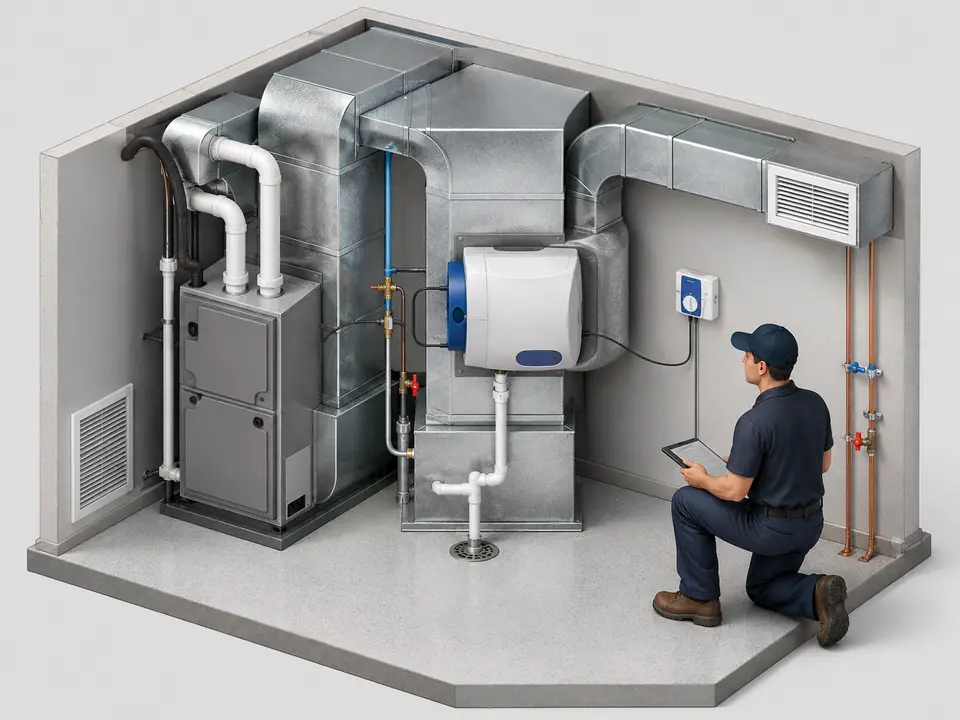
How a Whole-House Humidifier Works
A whole-home humidifier connects to the central HVAC system. It adds moisture when the control calls and operating conditions allow.
Balanced Humidity Depends on the Home
EPA guidance commonly identifies 30% to 50% relative humidity as an ideal indoor range. The safe setting still depends on outdoor temperature, windows, insulation, air leakage, moisture sources, and hidden cold surfaces. Condensation means the setting or building condition needs attention.
Complete Whole-Home Humidifier Services
We support new installations, replacements, repairs, maintenance, controls, water panels, canisters, and connected HVAC operation.
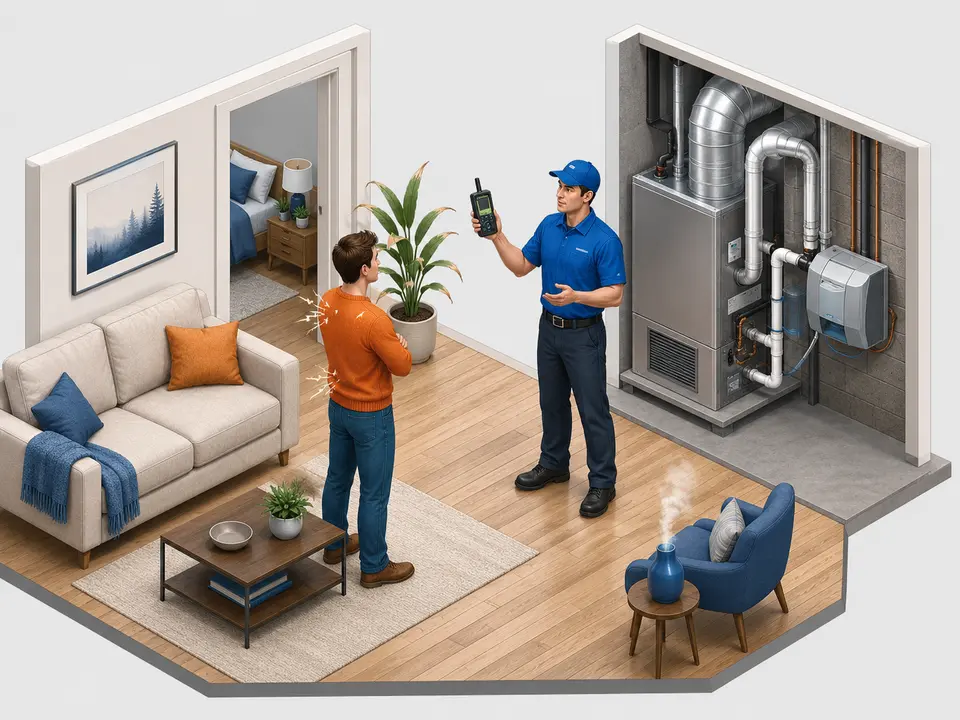
What Affects Whole-House Humidifier Cost?
Whole-house humidifier installation cost depends on the selected technology and the work needed around the HVAC system.
Each method needs different equipment, power, duct space, drainage, and maintenance.
Floor area alone cannot define output. Climate, envelope, leakage, and setpoint matter.
Access, distance, materials, controls, permits, and corrections shape labor.
What Belongs in a Humidifier Installation Quote
- Humidifier equipment Cabinet, media, fan, canister, dispersion tube, transformer, and controls.
- Ductwork Opening, bypass duct, damper, transitions, sealing, supports, and service clearance.
- Water connection Approved valve, tubing, fittings, pressure needs, protection, and shutoff access.
- Drainage Route, slope, trap where required, air gap, tempering, freeze risk, and termination.
- Electrical scope Voltage, circuit, disconnect, transformer, interlocks, thermostat, and humidistat wiring.
- Control strategy Manual or automatic adjustment, outdoor sensor, blower operation, and limits.
- Removal and restoration Old unit, abandoned openings, panels, wiring, water lines, and patching.
- Commissioning Water flow, drain, leakage, power, fan signal, output, controls, and homeowner guidance.
A written site-based estimate is more useful than a price based only on square footage.
From Home Assessment to Controlled Humidity
A complete installation connects moisture output with the building and HVAC system.
- 01
Assess and size
We review readings, dry-air concerns, the envelope, HVAC equipment, ducts, utilities, and access.
You get a defined system basis - 02
Select and install
We coordinate the cabinet, duct path, water, drain, power, controls, and maintenance access.
You get a connected installation - 03

Test and hand over
We verify water, drain, leakage, power, blower signal, humidistat response, and safe settings.
You get measured operating checks
Bypass, Fan-Powered, and Steam Humidifiers
The best whole-house humidifier depends on required output, HVAC operation, utilities, duct space, and maintenance preferences.
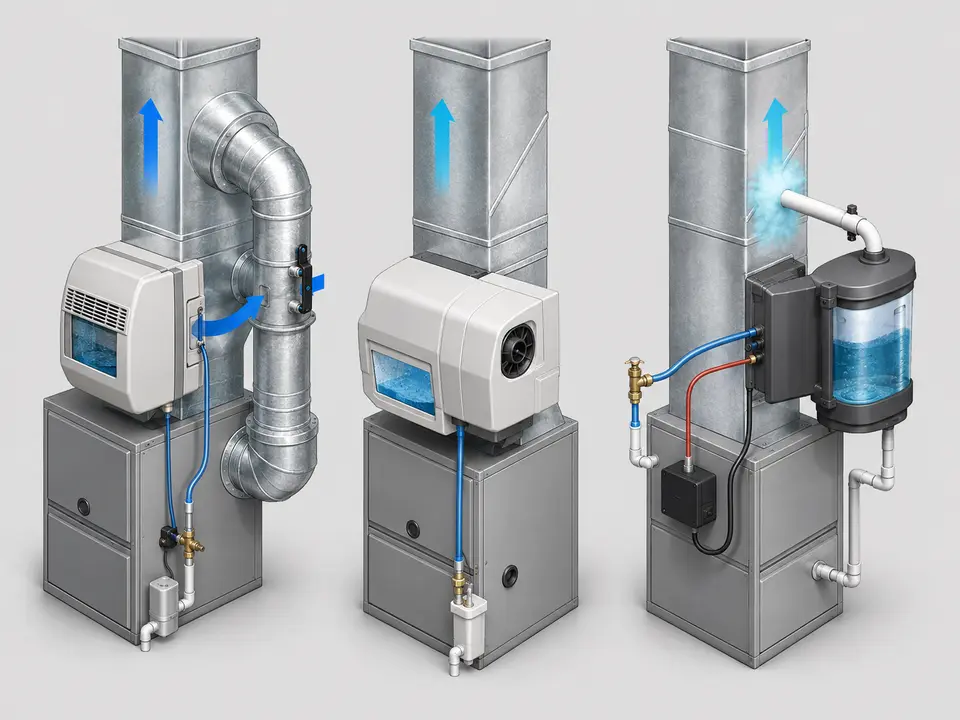
Bypass humidifier
HVAC air moves through wetted media and returns through a bypass duct.
Simple evaporative optionFan-powered humidifier
An internal fan moves warm duct air across the water panel without a bypass.
Higher evaporative outputSteam humidifier
A canister or electrode system produces steam for controlled duct distribution.
Independent moisture generationAutomatic humidity control
Compatible controls can adjust demand using indoor and outdoor conditions.
Reduced manual adjustmentFurnace application
Available heat, blower signals, duct space, and seasonal operation guide the choice.
Common central installationHeat pump or air handler
Lower supply temperatures and equipment runtime may change capacity or favor steam.
Compatibility review neededWhat Size Whole-House Humidifier Do You Need?
Humidifier sizing should consider moisture loss, not only the home’s floor area.
- Conditioned volume Square footage, ceiling height, open areas, additions, and connected rooms shape demand.
- Air leakage Outdoor air entering through gaps carries indoor moisture away during dry conditions.
- Local weather California coastal, inland, mountain, and desert conditions create different needs.
- Envelope quality Windows, insulation, air sealing, vapor control, and cold surfaces affect safe operation.
- HVAC runtime Evaporative systems depend on available air temperature and blower operation.
- Desired setpoint Higher targets require more capacity and may raise condensation risk.
- Water conditions Hardness, conductivity, pressure, temperature, and supply affect maintenance and output.
- Occupant moisture Cooking, bathing, laundry, plants, and occupancy add moisture to the home.
Oversizing Does Not Remove the Need for Controls
A larger unit can add moisture faster. It can also create condensation when control settings ignore outdoor conditions and cold surfaces. Capacity and control strategy must be selected together.
How Much Humidity Should You Add?
Indoor humidity should remain controlled. More moisture is not always better.
Measure relative humidity. Use reliable readings in representative rooms before changing the setting.
Watch windows and cold surfaces. Condensation signals excessive moisture or a cold-surface problem.
Adjust for weather. A lower setting may be necessary when outdoor temperatures fall.
Keep the system clean. Standing water, scale, dirty media, and blocked drains need correction.
Control other moisture sources. Bathrooms, cooking, laundry, leaks, crawlspaces, and basements can add humidity.
Stay below excessive levels. EPA recommends keeping indoor humidity below 60% and ideally around 30% to 50%.
Humidity-control standard
Whole-House Humidifier Repair and Maintenance
Low output, leaks, scale, and control problems need diagnosis before parts are replaced.
- Humidifier not working Check demand, furnace or blower signal, transformer, wiring, valve, water, and controls.
- Low humidity Inspect capacity, runtime, media, water flow, duct temperature, bypass damper, and leakage.
- Water leaks Find failed tubing, fittings, valves, trays, panels, canisters, seals, drains, or cabinet damage.
- Solenoid valve problems Test voltage, coil, debris, water pressure, inlet screen, and control demand.
- Water panel replacement Match the correct media and inspect the distribution tray, scale, drain, and orientation.
- Steam canister service Follow model requirements for canister condition, conductivity, drain cycles, and safe power isolation.
- Humidistat problems Compare the control with independent readings and verify wiring, placement, and settings.
- Seasonal maintenance Clean scale, inspect water and drain lines, close or open bypass dampers, and test operation.
Mineral Scale Changes Humidifier Performance
Evaporating water leaves minerals behind. Scale can restrict valves, trays, panels, probes, drains, and canisters. Maintenance frequency depends on water quality, use, equipment type, and manufacturer instructions.
Humidifier vs. Dehumidifier
A humidifier adds moisture. A dehumidifier removes moisture. Some homes need different control during different seasons.
- Use a humidifier When measured indoor air stays too dry during applicable operating conditions.
- Use a dehumidifier When measured humidity stays high and cooling or ventilation cannot control it.
- Investigate first Leaks, wet crawlspaces, unvented appliances, bathroom moisture, and envelope problems need correction.
- Avoid opposing operation Controls should prevent humidification and dehumidification from fighting each other.
- Whole-home system Treats air through central equipment and connected duct distribution.
- Portable unit Targets one room and requires filling, draining, cleaning, and local placement.
- Basement conditions A damp basement usually needs moisture removal, not added humidity.
- Seasonal strategy Settings should follow outdoor weather, indoor readings, and condensation signs.
Do not add humidity to solve dryness without confirming the home’s actual relative humidity.
Aprilaire, Honeywell, Resideo, GeneralAire, and HVAC Humidifiers
Homeowners often ask about Aprilaire 600, 700, and 800 systems, Honeywell or Resideo humidifiers, GeneralAire, Carrier, Bryant, Lennox, Trane, Rheem, Ruud, Skuttle, Nortec, Condair, and similar products.
- Model capacity Compare published output under conditions that resemble the actual installation.
- Equipment type Confirm bypass, fan-powered, flow-through, reservoir, steam, or commercial design.
- HVAC compatibility Check supply temperature, blower operation, duct size, cabinet location, and controls.
- Utility requirements Verify water quality, pressure, drain, voltage, circuit, and safe connection methods.
- Replacement parts Confirm water panels, canisters, valves, sensors, transformers, and controls remain available.
- Maintenance needs Compare media changes, scale cleaning, drain service, seasonal shutdown, and annual cost.
- Warranty requirements Follow approved installation, registration, water, electrical, service, and replacement instructions.
- Complete value Compare equipment price with installation complexity, output, control quality, and upkeep.
Brand names identify requested equipment. They do not imply a dealership, endorsement, or manufacturer affiliation.
Why Choose All HVAC California for Humidifier Installation?
A dependable humidifier installer should understand the HVAC system, utilities, controls, and building moisture risk.
- Measured planning Humidity readings and building conditions guide the recommendation.
- Home-specific sizing Volume, leakage, climate, HVAC runtime, setpoint, and moisture sources receive review.
- System comparison Bypass, fan-powered, and steam options receive clear tradeoff explanations.
- Connected installation Ductwork, water, drain, power, blower signals, thermostat, and humidistat work together.
- Condensation awareness Windows, cold surfaces, outdoor temperature, controls, and safe settings receive attention.
- Clear written scope Equipment, labor, utilities, modifications, parts, testing, and exclusions stay separated.
- Service access Panels, canisters, valves, drains, controls, and shutoffs remain reachable.
- Verified handover Water, drain, leakage, power, blower demand, humidity response, and maintenance receive checks.
Services Supporting Whole-Home Humidity Control
Humidity interacts with filtration, ventilation, ducts, equipment condition, and seasonal HVAC operation.
Our Whole-House Humidifier Commitments
These are process standards, not invented health, comfort, savings, or protection guarantees.
Readings, dry-air concerns, condensation, weather, envelope, HVAC, and moisture sources guide planning.
Capacity, system type, ducts, water, drain, power, controls, runtime, and access receive review.
Equipment, labor, modifications, utilities, permits, testing, supplies, and exclusions stay defined.
Water, drain, leakage, power, blower signal, controls, output, and maintenance needs receive checks.
Whole-Home and Commercial Humidification Systems
Capacity, control accuracy, water, drainage, duty cycle, and maintenance change by property.
Whole-Home Humidification From Assessment to Service
What Better Humidifier Installation Feels Like
These are service standards, not fictional testimonials.
The recommendation connects humidity readings, the home, HVAC operation, system type, capacity, and moisture risk.
Equipment, ductwork, water, drain, electrical work, controls, supplies, testing, and exclusions remain clear.
The finished installation receives water, drain, leakage, power, blower, control, and humidity-response checks.
Service Options, Costs, and Questions We Address
Use this service index to identify the installation, repair, cost, equipment, or local-support topic that matches your project.
Ready to Plan Whole-House Humidifier Installation?
Share the city, property size, HVAC type, humidity concerns, current equipment, water conditions, and project timing.
Request humidifier installation, replacement, repair, maintenance, water-panel service, steam-canister service, or control diagnosis. Recommendations depend on readings, climate, envelope, equipment, ducts, utilities, access, and product availability.
Whole-House Humidifier Questions Answered
Cost depends on system type, capacity, duct modifications, water connection, drain route, electrical work, controls, access, permits, and removal needs. Bypass, fan-powered, and steam systems have different installation and maintenance requirements. A site review creates a useful written estimate.
It can be useful when measured indoor humidity stays too low and the home has compatible central HVAC equipment. Value depends on climate, dry-air duration, comfort goals, maintenance, water use, electrical use, and building conditions. Confirm the problem with humidity readings first.
A control calls for humidity. Water flows to evaporative media or a steam canister. The HVAC blower distributes moisture through the ducts. The exact sequence depends on the humidifier, furnace, thermostat, humidistat, and wiring.
Bypass units offer a straightforward evaporative design. Fan-powered units can provide more evaporative output without a bypass duct. Steam units generate moisture independently and often need dedicated electrical capacity. The best choice depends on output, HVAC temperatures, duct space, utilities, controls, and maintenance.
Often, yes. Heat pumps may deliver lower supply-air temperatures than furnaces. That can reduce evaporative humidifier output. Blower operation, auxiliary heat, air-handler layout, capacity, controls, water, drain, and steam options need review.
Sizing depends on conditioned volume, air leakage, local weather, envelope quality, HVAC runtime, water conditions, indoor moisture sources, and target humidity. Square footage is only one input.
EPA guidance commonly identifies 30% to 50% relative humidity as an ideal range and recommends staying below 60%. Your safe winter setting may need to be lower. Watch outdoor temperature, windows, walls, and other cold surfaces. Reduce the setting if condensation appears.
Possible causes include loose tubing, a failed fitting, excessive water flow, a blocked drain, a damaged tray, misaligned media, scale, a stuck solenoid valve, a cracked canister, or cabinet damage. Shut off water when needed and arrange diagnosis.
Follow the exact manufacturer schedule and inspect the part during the operating season. Water quality, use, scale, output, and equipment design change service life. Replace loaded, damaged, or spent components before they restrict operation or cause leaks.
A humidifier adds moisture when indoor air is too dry. A dehumidifier removes moisture when humidity is too high. Measure first. Do not run both systems against each other, and correct leaks or other building moisture sources.
Whole-House Humidifier Installation for Balanced Indoor Humidity
A central humidifier adds controlled moisture through your HVAC system. We assess the home, select compatible equipment, and verify water, drain, electrical, airflow, and control operation.
How a Whole-House Humidifier Works
A whole-home humidifier connects to the central HVAC system. It adds moisture when the control calls and operating conditions allow.
Balanced Humidity Depends on the Home
EPA guidance commonly identifies 30% to 50% relative humidity as an ideal indoor range. The safe setting still depends on outdoor temperature, windows, insulation, air leakage, moisture sources, and hidden cold surfaces. Condensation means the setting or building condition needs attention.
Complete Whole-Home Humidifier Services
We support new installations, replacements, repairs, maintenance, controls, water panels, canisters, and connected HVAC operation.
What Affects Whole-House Humidifier Cost?
Whole-house humidifier installation cost depends on the selected technology and the work needed around the HVAC system.
Each method needs different equipment, power, duct space, drainage, and maintenance.
Floor area alone cannot define output. Climate, envelope, leakage, and setpoint matter.
Access, distance, materials, controls, permits, and corrections shape labor.
What Belongs in a Humidifier Installation Quote
- Humidifier equipment Cabinet, media, fan, canister, dispersion tube, transformer, and controls.
- Ductwork Opening, bypass duct, damper, transitions, sealing, supports, and service clearance.
- Water connection Approved valve, tubing, fittings, pressure needs, protection, and shutoff access.
- Drainage Route, slope, trap where required, air gap, tempering, freeze risk, and termination.
- Electrical scope Voltage, circuit, disconnect, transformer, interlocks, thermostat, and humidistat wiring.
- Control strategy Manual or automatic adjustment, outdoor sensor, blower operation, and limits.
- Removal and restoration Old unit, abandoned openings, panels, wiring, water lines, and patching.
- Commissioning Water flow, drain, leakage, power, fan signal, output, controls, and homeowner guidance.
A written site-based estimate is more useful than a price based only on square footage.
From Home Assessment to Controlled Humidity
A complete installation connects moisture output with the building and HVAC system.
- 01
Assess and size
We review readings, dry-air concerns, the envelope, HVAC equipment, ducts, utilities, and access.
You get a defined system basis - 02
Select and install
We coordinate the cabinet, duct path, water, drain, power, controls, and maintenance access.
You get a connected installation - 03
Test and hand over
We verify water, drain, leakage, power, blower signal, humidistat response, and safe settings.
You get measured operating checks
Bypass, Fan-Powered, and Steam Humidifiers
The best whole-house humidifier depends on required output, HVAC operation, utilities, duct space, and maintenance preferences.
Bypass humidifier
HVAC air moves through wetted media and returns through a bypass duct.
Simple evaporative optionFan-powered humidifier
An internal fan moves warm duct air across the water panel without a bypass.
Higher evaporative outputSteam humidifier
A canister or electrode system produces steam for controlled duct distribution.
Independent moisture generationAutomatic humidity control
Compatible controls can adjust demand using indoor and outdoor conditions.
Reduced manual adjustmentFurnace application
Available heat, blower signals, duct space, and seasonal operation guide the choice.
Common central installationHeat pump or air handler
Lower supply temperatures and equipment runtime may change capacity or favor steam.
Compatibility review neededWhat Size Whole-House Humidifier Do You Need?
Humidifier sizing should consider moisture loss, not only the home’s floor area.
- Conditioned volume Square footage, ceiling height, open areas, additions, and connected rooms shape demand.
- Air leakage Outdoor air entering through gaps carries indoor moisture away during dry conditions.
- Local weather California coastal, inland, mountain, and desert conditions create different needs.
- Envelope quality Windows, insulation, air sealing, vapor control, and cold surfaces affect safe operation.
- HVAC runtime Evaporative systems depend on available air temperature and blower operation.
- Desired setpoint Higher targets require more capacity and may raise condensation risk.
- Water conditions Hardness, conductivity, pressure, temperature, and supply affect maintenance and output.
- Occupant moisture Cooking, bathing, laundry, plants, and occupancy add moisture to the home.
Oversizing Does Not Remove the Need for Controls
A larger unit can add moisture faster. It can also create condensation when control settings ignore outdoor conditions and cold surfaces. Capacity and control strategy must be selected together.
How Much Humidity Should You Add?
Indoor humidity should remain controlled. More moisture is not always better.
Measure relative humidity. Use reliable readings in representative rooms before changing the setting.
Watch windows and cold surfaces. Condensation signals excessive moisture or a cold-surface problem.
Adjust for weather. A lower setting may be necessary when outdoor temperatures fall.
Keep the system clean. Standing water, scale, dirty media, and blocked drains need correction.
Control other moisture sources. Bathrooms, cooking, laundry, leaks, crawlspaces, and basements can add humidity.
Stay below excessive levels. EPA recommends keeping indoor humidity below 60% and ideally around 30% to 50%.
Humidity-control standard
Whole-House Humidifier Repair and Maintenance
Low output, leaks, scale, and control problems need diagnosis before parts are replaced.
- Humidifier not working Check demand, furnace or blower signal, transformer, wiring, valve, water, and controls.
- Low humidity Inspect capacity, runtime, media, water flow, duct temperature, bypass damper, and leakage.
- Water leaks Find failed tubing, fittings, valves, trays, panels, canisters, seals, drains, or cabinet damage.
- Solenoid valve problems Test voltage, coil, debris, water pressure, inlet screen, and control demand.
- Water panel replacement Match the correct media and inspect the distribution tray, scale, drain, and orientation.
- Steam canister service Follow model requirements for canister condition, conductivity, drain cycles, and safe power isolation.
- Humidistat problems Compare the control with independent readings and verify wiring, placement, and settings.
- Seasonal maintenance Clean scale, inspect water and drain lines, close or open bypass dampers, and test operation.
Mineral Scale Changes Humidifier Performance
Evaporating water leaves minerals behind. Scale can restrict valves, trays, panels, probes, drains, and canisters. Maintenance frequency depends on water quality, use, equipment type, and manufacturer instructions.
Humidifier vs. Dehumidifier
A humidifier adds moisture. A dehumidifier removes moisture. Some homes need different control during different seasons.
- Use a humidifier When measured indoor air stays too dry during applicable operating conditions.
- Use a dehumidifier When measured humidity stays high and cooling or ventilation cannot control it.
- Investigate first Leaks, wet crawlspaces, unvented appliances, bathroom moisture, and envelope problems need correction.
- Avoid opposing operation Controls should prevent humidification and dehumidification from fighting each other.
- Whole-home system Treats air through central equipment and connected duct distribution.
- Portable unit Targets one room and requires filling, draining, cleaning, and local placement.
- Basement conditions A damp basement usually needs moisture removal, not added humidity.
- Seasonal strategy Settings should follow outdoor weather, indoor readings, and condensation signs.
Do not add humidity to solve dryness without confirming the home’s actual relative humidity.
Aprilaire, Honeywell, Resideo, GeneralAire, and HVAC Humidifiers
Homeowners often ask about Aprilaire 600, 700, and 800 systems, Honeywell or Resideo humidifiers, GeneralAire, Carrier, Bryant, Lennox, Trane, Rheem, Ruud, Skuttle, Nortec, Condair, and similar products.
- Model capacity Compare published output under conditions that resemble the actual installation.
- Equipment type Confirm bypass, fan-powered, flow-through, reservoir, steam, or commercial design.
- HVAC compatibility Check supply temperature, blower operation, duct size, cabinet location, and controls.
- Utility requirements Verify water quality, pressure, drain, voltage, circuit, and safe connection methods.
- Replacement parts Confirm water panels, canisters, valves, sensors, transformers, and controls remain available.
- Maintenance needs Compare media changes, scale cleaning, drain service, seasonal shutdown, and annual cost.
- Warranty requirements Follow approved installation, registration, water, electrical, service, and replacement instructions.
- Complete value Compare equipment price with installation complexity, output, control quality, and upkeep.
Brand names identify requested equipment. They do not imply a dealership, endorsement, or manufacturer affiliation.
Why Choose All HVAC California for Humidifier Installation?
A dependable humidifier installer should understand the HVAC system, utilities, controls, and building moisture risk.
- Measured planning Humidity readings and building conditions guide the recommendation.
- Home-specific sizing Volume, leakage, climate, HVAC runtime, setpoint, and moisture sources receive review.
- System comparison Bypass, fan-powered, and steam options receive clear tradeoff explanations.
- Connected installation Ductwork, water, drain, power, blower signals, thermostat, and humidistat work together.
- Condensation awareness Windows, cold surfaces, outdoor temperature, controls, and safe settings receive attention.
- Clear written scope Equipment, labor, utilities, modifications, parts, testing, and exclusions stay separated.
- Service access Panels, canisters, valves, drains, controls, and shutoffs remain reachable.
- Verified handover Water, drain, leakage, power, blower demand, humidity response, and maintenance receive checks.
Services Supporting Whole-Home Humidity Control
Humidity interacts with filtration, ventilation, ducts, equipment condition, and seasonal HVAC operation.
Our Whole-House Humidifier Commitments
These are process standards, not invented health, comfort, savings, or protection guarantees.
Readings, dry-air concerns, condensation, weather, envelope, HVAC, and moisture sources guide planning.
Capacity, system type, ducts, water, drain, power, controls, runtime, and access receive review.
Equipment, labor, modifications, utilities, permits, testing, supplies, and exclusions stay defined.
Water, drain, leakage, power, blower signal, controls, output, and maintenance needs receive checks.
Whole-Home and Commercial Humidification Systems
Capacity, control accuracy, water, drainage, duty cycle, and maintenance change by property.
Whole-Home Humidification From Assessment to Service
What Better Humidifier Installation Feels Like
These are service standards, not fictional testimonials.
The recommendation connects humidity readings, the home, HVAC operation, system type, capacity, and moisture risk.
Equipment, ductwork, water, drain, electrical work, controls, supplies, testing, and exclusions remain clear.
The finished installation receives water, drain, leakage, power, blower, control, and humidity-response checks.
Ready to Plan Whole-House Humidifier Installation?
Share the city, property size, HVAC type, humidity concerns, current equipment, water conditions, and project timing.
Request humidifier installation, replacement, repair, maintenance, water-panel service, steam-canister service, or control diagnosis. Recommendations depend on readings, climate, envelope, equipment, ducts, utilities, access, and product availability.
Whole-House Humidifier Questions Answered
Cost depends on system type, capacity, duct modifications, water connection, drain route, electrical work, controls, access, permits, and removal needs. Bypass, fan-powered, and steam systems have different installation and maintenance requirements. A site review creates a useful written estimate.
It can be useful when measured indoor humidity stays too low and the home has compatible central HVAC equipment. Value depends on climate, dry-air duration, comfort goals, maintenance, water use, electrical use, and building conditions. Confirm the problem with humidity readings first.
A control calls for humidity. Water flows to evaporative media or a steam canister. The HVAC blower distributes moisture through the ducts. The exact sequence depends on the humidifier, furnace, thermostat, humidistat, and wiring.
Bypass units offer a straightforward evaporative design. Fan-powered units can provide more evaporative output without a bypass duct. Steam units generate moisture independently and often need dedicated electrical capacity. The best choice depends on output, HVAC temperatures, duct space, utilities, controls, and maintenance.
Often, yes. Heat pumps may deliver lower supply-air temperatures than furnaces. That can reduce evaporative humidifier output. Blower operation, auxiliary heat, air-handler layout, capacity, controls, water, drain, and steam options need review.
Sizing depends on conditioned volume, air leakage, local weather, envelope quality, HVAC runtime, water conditions, indoor moisture sources, and target humidity. Square footage is only one input.
EPA guidance commonly identifies 30% to 50% relative humidity as an ideal range and recommends staying below 60%. Your safe winter setting may need to be lower. Watch outdoor temperature, windows, walls, and other cold surfaces. Reduce the setting if condensation appears.
Possible causes include loose tubing, a failed fitting, excessive water flow, a blocked drain, a damaged tray, misaligned media, scale, a stuck solenoid valve, a cracked canister, or cabinet damage. Shut off water when needed and arrange diagnosis.
Follow the exact manufacturer schedule and inspect the part during the operating season. Water quality, use, scale, output, and equipment design change service life. Replace loaded, damaged, or spent components before they restrict operation or cause leaks.
A humidifier adds moisture when indoor air is too dry. A dehumidifier removes moisture when humidity is too high. Measure first. Do not run both systems against each other, and correct leaks or other building moisture sources.