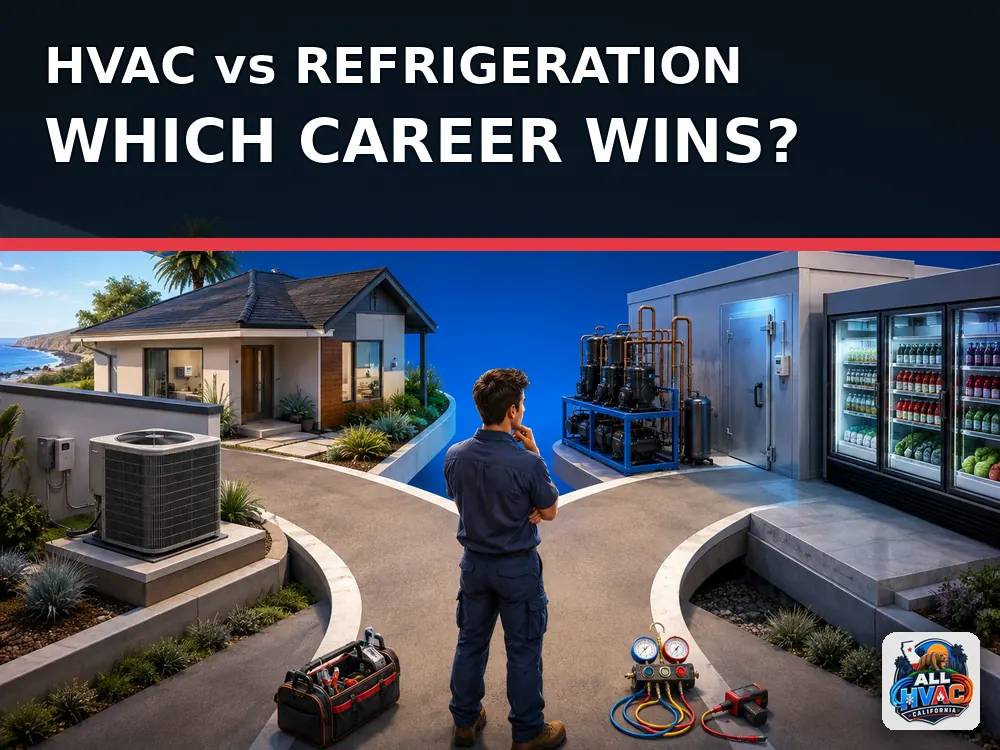
HVAC is the better broad career, while refrigeration offers deeper specialization. Neither path wins for everyone.
Residential HVAC usually brings more customer contact and seasonal service calls. Refrigeration often serves restaurants, markets, warehouses, and industrial sites. Your preferred equipment and schedule should decide the choice.
Is HVAC or Refrigeration a Better Career?
HVAC is better for variety and wider entry opportunities. Refrigeration is better for technical depth and commercial specialization. Different strokes suit different folks.

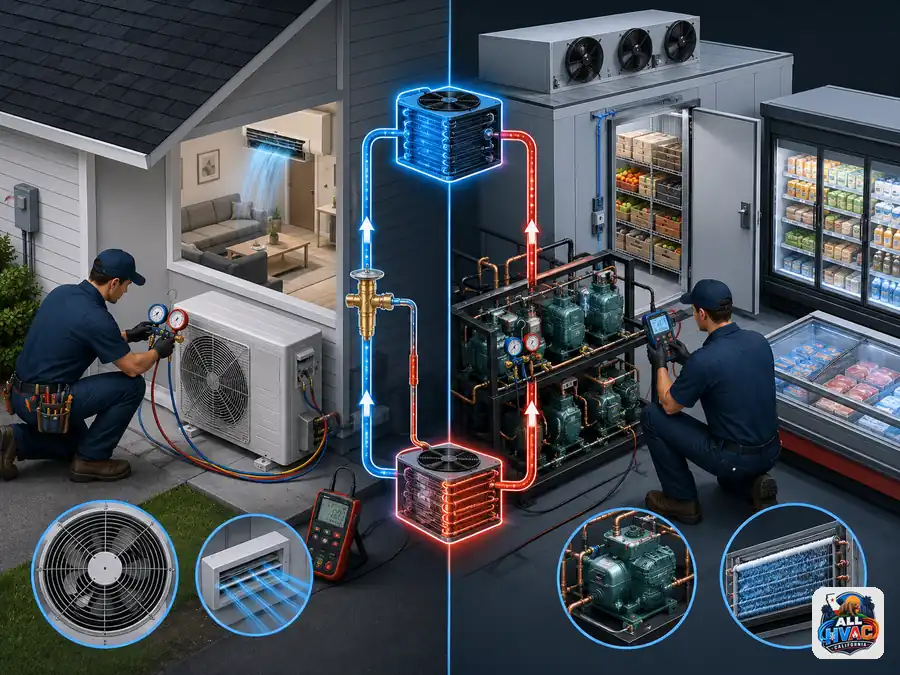
Both careers use the refrigeration cycle. HVAC focuses mainly on human comfort. Refrigeration protects food, medicine, products, and industrial processes.
The stakes can feel different. A warm house is urgent. A failed supermarket rack can threaten thousands of dollars in inventory.
Did You Know?
Refrigeration is part of the HVACR field. Many technicians begin with comfort cooling, then specialize in commercial refrigeration.
What Is the Difference Between HVAC and Refrigeration?
HVAC controls comfort, ventilation, and indoor air. Refrigeration maintains lower temperatures for products and processes. That is the heart of the matter.
- HVAC equipment: Air conditioners, furnaces, heat pumps, ducts, and controls.
- Refrigeration equipment: Walk-ins, reach-ins, ice machines, cases, racks, and chillers.
- Shared systems: Compressors, coils, metering devices, refrigerants, and electrical controls.
Which Career Is Easier to Enter?
HVAC is usually easier to enter because more schools and residential employers recruit beginners. Refrigeration employers may prefer proven HVAC skills. You must walk before you can run.
The BLS HVACR career profile combines both occupations. It lists postsecondary nondegree training as typical. Programs often last six months to two years.
A beginner can start in maintenance or installation. Strong electrical and refrigeration skills can later support specialization.
HVAC Versus Refrigeration Career Comparison
The better career depends on daily conditions, not titles alone. Read the fine print before signing. The devil is in the details.
| Career Factor | HVAC | Refrigeration |
|---|---|---|
| Main purpose | Human comfort and air quality | Product and process cooling |
| Common customers | Homes and businesses | Stores, restaurants, warehouses |
| Entry access | Broader | Often more specialized |
| On-call pressure | Seasonal emergencies | Inventory-critical emergencies |
| System complexity | Broad | Deep refrigeration focus |
| Customer contact | Often frequent | Usually business-facing |
Which Career Pays More?
Commercial refrigeration can pay more because the systems are complex and urgent. Pay still depends on experience, location, overtime, and specialty. Money does not grow on trees.
Technicians who understand rack systems, controls, and low-temperature equipment can become valuable. On-call hours may also increase total earnings.
Our guide to the highest-paying HVAC fields explains why specialization matters.
Which Path Has Better Job Security?
Both paths offer durable demand because buildings need temperature control. Refrigeration protects essential food and medical supply chains. Make hay while the sun shines.
The national HVACR outlook remains strong. California also has homes, offices, restaurants, groceries, logistics centers, and food production.
HVAC offers a wider customer base. Refrigeration offers essential business demand. A versatile technician can work across both.
Which Career Has Better Hours?
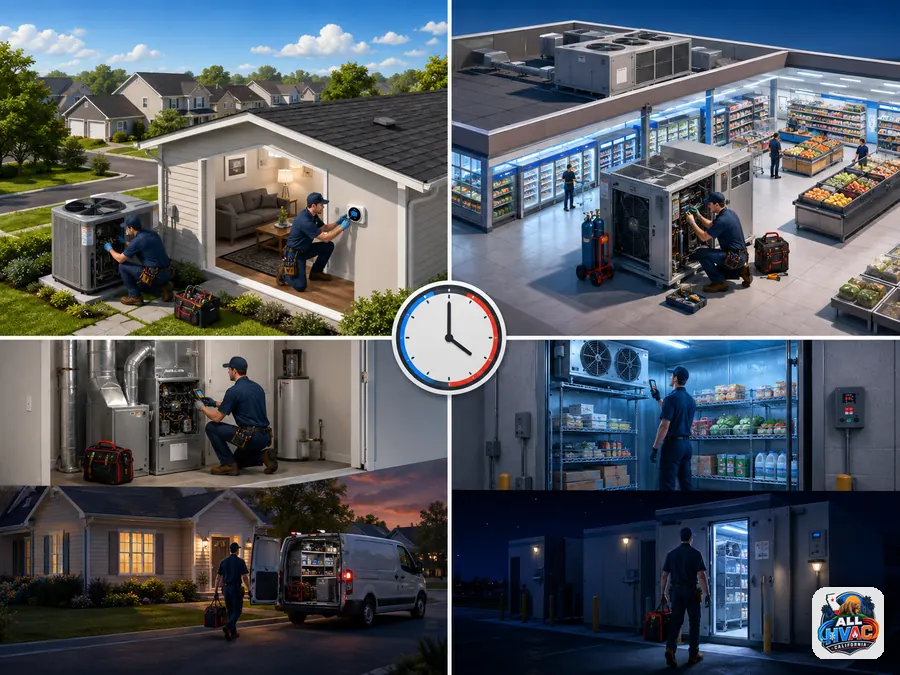
HVAC may offer better hours in maintenance or installation roles. Refrigeration service often brings urgent nights and weekends. Every rose has its thorn.
A failed walk-in cannot always wait until Monday. Food safety and inventory risks create pressure. Residential HVAC also becomes hectic during heat waves.
Review HVAC work-life balance before comparing employers. Ask who carries the phone and how often.
What Certifications Do Refrigeration Technicians Need?
Technicians who handle regulated refrigerants need EPA Section 608 certification. Employers may require additional training for specialized equipment. Better safe than sorry.
The EPA Section 608 certification page explains the federal requirement. Certification does not expire, but technicians should keep learning.
Manufacturer training can help with controls, rack systems, and specific equipment. Safety training also matters around pressure, electricity, and refrigerant.
Who Should Choose General HVAC?
Choose general HVAC if you enjoy variety and customer-facing work. It offers several ways to build a career. Variety is the spice of life.
- You want residential and light commercial options.
- You enjoy airflow, comfort, heating, and cooling.
- You prefer a wider entry market.
- You may want sales, installation, service, or management.
Start with our honest guide on whether HVAC is a good career.
Who Should Choose Refrigeration?
Choose refrigeration if you enjoy deep technical diagnosis and commercial systems. It suits calm people who handle urgent calls. Cool heads prevail.
- You enjoy refrigeration theory and electrical controls.
- You want grocery, restaurant, warehouse, or industrial work.
- You can accept on-call responsibility.
- You want to build a valuable technical specialty.
Can You Move Between HVAC and Refrigeration?
You can move between HVAC and refrigeration because the foundations overlap. Specialized training still matters. Do not count your chickens before they hatch.
Comfort-cooling technicians already understand compressors, coils, refrigerants, and controls. Refrigeration adds different temperatures, defrost systems, product risks, and system layouts.
A strong foundation makes the move easier. Our guide on why HVAC can be challenging explains the learning curve.
Frequently Asked Questions
What Refrigeration Equipment Would You Service?
Refrigeration technicians service equipment that protects products at controlled temperatures. Systems range from small cases to large racks. Big things often start small.
Beginners may see reach-ins, prep tables, ice machines, and walk-in coolers. Advanced technicians may handle supermarket racks, chillers, controls, and remote monitoring.
Each system adds new defrost, drainage, control, and product requirements. Documentation becomes essential when several compressors share a load.
Which Path Offers Better Advancement?
Both paths offer advancement, but refrigeration rewards rare technical depth. HVAC offers more branches across service and management. The cream rises to the top.
Experienced workers can move into controls, commissioning, estimating, supervision, sales, or training. Commercial technicians may also manage large customer accounts.
Strong documentation and communication support advancement. Managers need technicians who explain complex failures without drama.
How Stressful Is Refrigeration Work?
Refrigeration work can become stressful during product-threatening failures. The technician must diagnose carefully while managers watch the clock. Cool heads prevail.
Good employers reduce stress through training, parts support, realistic coverage, and senior backup. Poor dispatch systems make normal problems feel chaotic.
Ask how after-hours calls get escalated. One person should not carry every difficult problem alone.
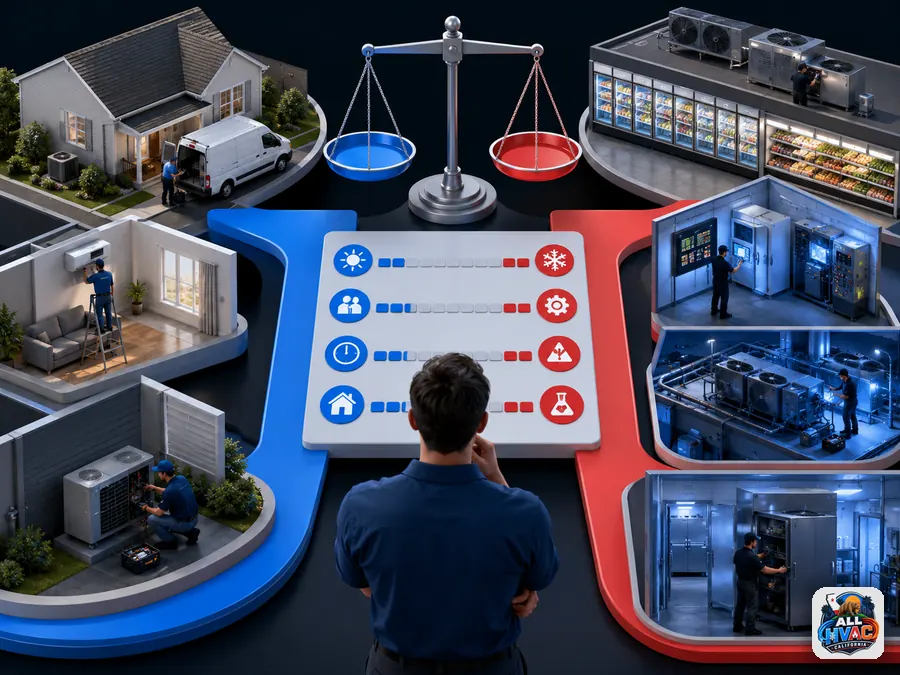
A Quick HVAC or Refrigeration Fit Test
A short fit test can clarify the better path. Picture the ordinary shift, not only top pay. The truth will out.
- Do you prefer homes or commercial facilities?
- Can you accept inventory-critical emergencies?
- Do low-temperature systems hold your attention?
- How much on-call work can your life support?
- Do you want breadth or specialization?
Which Path Uses More Advanced Controls?
Commercial refrigeration often uses complex controls across connected equipment. Modern HVAC also uses communicating and building automation systems. The future is already knocking.
A supermarket rack may coordinate compressors, condensers, defrost, cases, alarms, and energy controls. One sensor problem can affect several areas.
Commercial HVAC can link rooftop units, pumps, air handlers, and ventilation. Technicians must understand sequences, inputs, outputs, and network communication.
Learn electrical basics before chasing software. A control screen cannot fix weak measurement habits.
Which Career Uses More Math?
Both paths use similar core math. Refrigeration may demand more detailed pressure-temperature and load thinking. Numbers tell a story.
Technicians calculate temperature split, superheat, subcooling, airflow, and electrical values. Refrigeration adds box temperature, product load, defrost, and low-temperature conditions.
Advanced design roles use more mathematics than service roles. Most daily diagnosis uses formulas, charts, and measured evidence.
Memorizing numbers without understanding creates mistakes. Learn what each reading means inside the system.
How Do Customer Relationships Differ?
Residential HVAC serves homeowners and property managers. Refrigeration usually serves business owners and facility teams. Know your audience.
Homeowners care about comfort, price, noise, energy use, and trust. They may need simple explanations during stressful weather.
Business customers care about product safety, downtime, documentation, and operating cost. They may expect updates for several decision-makers.
Both paths reward clear communication. Technical skill loses value when nobody understands the recommendation.
How Do Environmental Rules Affect the Work?
Refrigerant rules affect both HVAC and refrigeration careers. Technicians must prevent releases and handle materials correctly. Better safe than sorry.
Equipment types and refrigerants continue changing. Flammability, pressure, recovery, and documentation may require new procedures.
Employers should provide current training and suitable tools. Technicians should never assume yesterday’s method fits every new system.
Change creates a learning burden. It also creates value for workers who stay current.
Which Tools Do Refrigeration Technicians Use?
Refrigeration technicians use electrical, pressure, temperature, and evacuation tools. Some systems also require control software. A worker is only as good as the evidence gathered.
- Digital multimeter and clamp meter
- Pressure gauges and temperature probes
- Vacuum pump and micron gauge
- Recovery equipment and refrigerant scale
- Leak detection equipment
- Airflow and temperature instruments
- Manufacturer control interfaces
Tools need calibration, care, and correct use. A bad probe can send diagnosis in the wrong direction.
What Makes a Good Refrigeration Employer?
A good employer provides training, parts support, and senior backup. Refrigeration emergencies should not become solo guessing contests. Many hands make light work.
- A fair and documented on-call rotation
- Paid technical training
- Senior support for difficult systems
- Safe vehicles and organized inventory
- Clear overtime and travel rules
- Modern recovery and testing equipment
- Time for accurate documentation
Ask how callbacks get reviewed. A learning culture improves both safety and customer results.
A Three-Stage Refrigeration Career Roadmap
A staged roadmap builds skill without skipping foundations. Start broad, then specialize carefully. Crawl before you walk.
Stage one: Learn electrical safety, refrigeration basics, airflow, and measurement. Complete maintenance and basic repairs under supervision.
Stage two: Work on walk-ins, reach-ins, defrost systems, and controls. Improve documentation and customer updates.
Stage three: Add rack systems, advanced controls, commissioning, or leadership. Choose one specialty that local employers value.
Progress should follow demonstrated skill, not calendar time alone. Honest self-assessment prevents dangerous overconfidence.
How Can You Avoid Early Burnout?
Burnout often grows from poor schedules, weak support, and constant emergencies. Personal toughness cannot fix a broken system. Do not burn the candle at both ends.
Ask for clear rest periods after overnight calls. Use checklists during fatigue. Keep food, water, and basic protective gear ready.
Learn to escalate difficult problems early. Hiding confusion wastes time and increases loss.
Choose employers that treat recovery as a safety issue. A rested technician makes better decisions.
Where Do Refrigeration Technicians Work?
Refrigeration technicians work anywhere products need controlled temperatures. The setting changes tools, risks, and schedules. Variety is the spice of life.
Common sites include restaurants, supermarkets, convenience stores, warehouses, laboratories, and food plants. Some technicians also serve ice rinks or process cooling systems.
Noise, traffic, cold rooms, roofs, and mechanical spaces may appear in one shift. Safety awareness must change with each location.
Ask employers which customer types dominate their workload. That answer predicts your daily experience.
Why Does Documentation Matter So Much?
Documentation protects products, customers, and future technicians. Complex systems rarely belong to one person. The written word carries memory.
Record pressures, temperatures, electrical readings, alarms, and control changes. Note parts replaced and conditions left unresolved.
Clear records help teams spot repeated failures. They also support warranty, compliance, and customer communication.
A rushed note creates wasted time later. Write enough detail for another technician to continue safely.
How Important Is Parts Knowledge?
Parts knowledge can shorten downtime, but correct diagnosis comes first. Replacing likely parts is not a strategy. Measure twice and order once.
Technicians should understand ratings, compatibility, control logic, and installation requirements. Similar-looking parts may behave differently.
Commercial customers may lose products while waiting. Organized truck stock and supplier relationships therefore matter.
Never install an unsafe substitute to save time. Explain delays and temporary protections honestly.
How Will the Field Change?
Refrigeration will keep changing through refrigerants, efficiency rules, controls, and monitoring. Adaptable technicians will stay valuable. Change is the only constant.
Remote alarms may identify problems earlier. Electronic controls may provide better data. New refrigerants may require different safety practices.
Technology still needs technicians who understand physical systems. Sensors can report symptoms without explaining every cause.
Build strong fundamentals, then update them regularly. Learning is part of the job, not a temporary stage.
What Questions Should You Ask Refrigeration Employers?
Specific questions reveal the real job. Ask during interviews and compare answers later. Forewarned is forearmed.
- Which equipment will beginners service?
- How often does on-call duty occur?
- Who answers difficult after-hours questions?
- Is travel time paid?
- Which tools does the company provide?
- How are callbacks reviewed?
- Which training is paid?
- What advancement happened last year?
Good employers answer clearly. Evasive answers usually predict future confusion.
How Does California Affect the Choice?
California supports both comfort HVAC and commercial refrigeration careers. Climate, food service, logistics, and dense cities create varied demand. Location, location, location.
Inland heat creates strong air conditioning pressure. Restaurants, markets, warehouses, and food businesses need dependable refrigeration across the state.
Service territories can cover large areas. Ask how often technicians cross traffic-heavy regions. Paid drive time can change the value of an offer.
Local building types also matter. Homes, high-rises, stores, and industrial sites need different skills.
What Does Long-Term Success Require?
Long-term success requires safe habits, technical curiosity, and reliable communication. Refrigeration rewards people who learn from every system. Slow and steady wins the race.
Study failed parts without assuming they caused the root problem. Review controls and operating history. Ask what changed before the failure.
Keep certifications and training records organized. Build relationships with experienced technicians and suppliers.
Protect sleep and health during on-call years. Technical skill grows faster when fatigue does not control decisions.
As experience grows, teach newer workers. Explaining a system often reveals gaps in your own understanding.
Also learn the business effect of each failure. Product loss, closing time, and customer safety shape repair priorities.
Do not promise a deadline before understanding the fault and parts availability. Clear updates protect trust during difficult calls.
Finally, document the system after repairs. Stable readings prove the equipment recovered. They also create a useful baseline for future visits.
A technician who combines careful diagnosis with calm communication becomes difficult to replace. That value can support better roles and schedules.
Is refrigeration harder than HVAC?
Refrigeration can be harder technically at advanced levels. General HVAC covers more heating, airflow, and comfort topics.
Is commercial refrigeration stressful?
It can be stressful when inventory or food safety is threatened. Strong procedures and employer support reduce pressure.
Can HVAC technicians work on refrigerators?
Training and certification matter. Household appliance repair also differs from commercial refrigeration service.
Should beginners start with HVAC first?
Many do. General HVAC builds transferable electrical, mechanical, and refrigeration skills.
The Bottom Line
HVAC offers broader entry and variety. Refrigeration offers deeper specialization and possible earning upside. Choose the daily work, not only the wage. The grass is greener where you water it.
All HVAC California makes heating and cooling choices easier to understand.